Latest

Page 376

Hacking Fitbit

This is impressive:

“An attacker sends an infected packet to a fitness tracker nearby at bluetooth distance then the rest of the attack occurs by itself, without any special need for the attacker being near,” Apvrille says.

“[When] the victim wishes to synchronise his or her fitness data with FitBit servers to update their profile … the fitness tracker responds to the query, but in addition to the standard message, the response is tainted with the infected code.

“From there, it can deliver a specific malicious payload on the laptop, that is, start a backdoor, or have the machine crash [and] can propagate the infection to other trackers (Fitbits).”

That’s attacker to Fitbit to computer.

Posted on October 22, 2015 at 1:20 PM • View Comments

Police Want Genetic Data from Corporate Repositories

Both the FBI and local law enforcement are trying to get the genetic data stored at companies like 23andMe.

No surprise, really.

As NYU law professor Erin Murphy told the New Orleans Advocate regarding the Usry case, gathering DNA information is “a series of totally reasonable steps by law enforcement.” If you’re a cop trying to solve a crime, and you have DNA at your disposal, you’re going to want to use it to further your investigation. But the fact that your signing up for 23andMe or Ancestry.com means that you and all of your current and future family members could become genetic criminal suspects is not something most users probably have in mind when trying to find out where their ancestors came from.

Posted on October 22, 2015 at 6:40 AM • View Comments

Security Risks of Unpatched Android Software

A lot has been written about the security vulnerability resulting from outdated and unpatched Android software. The basic problem is that while Google regularly updates the Android software, phone manufacturers don’t regularly push updates out to Android users.

New research tries to quantify the risk:

We are presenting a paper at SPSM next week that shows that, on average over the last four years, 87% of Android devices are vulnerable to attack by malicious apps. This is because manufacturers have not provided regular security updates. Some manufacturers are much better than others however, and our study shows that devices built by LG and Motorola, as well as those devices shipped under the Google Nexus brand are much better than most. Users, corporate buyers and regulators can find further details on manufacturer performance at AndroidVulnerabilities.org.

Posted on October 21, 2015 at 6:22 AM • View Comments

Mapping FinFisher Users

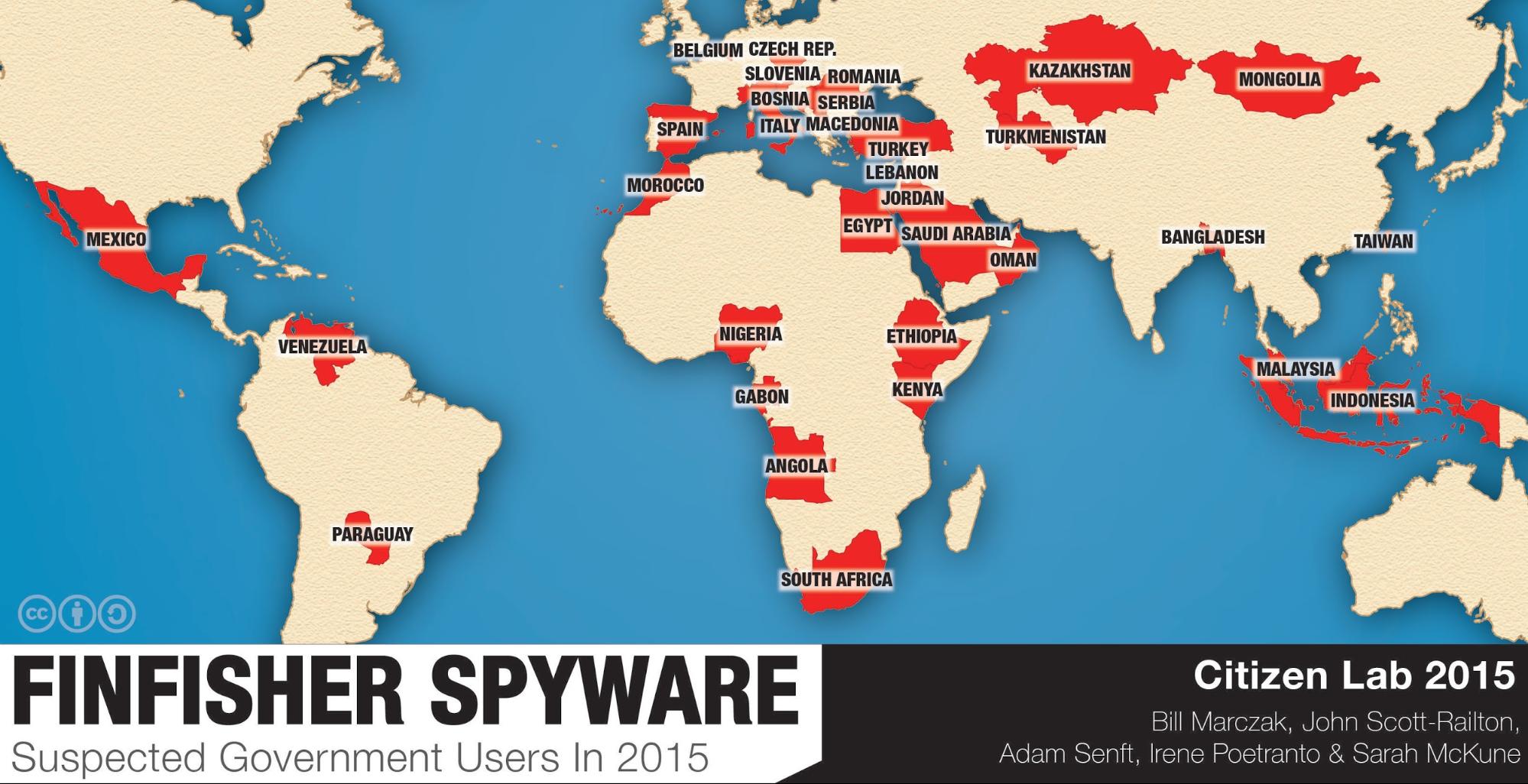
Citizen Lab continues to do excellent work exposing the world’s cyber-weapons arms manufacturers. Its latest report attempts to track users of Gamma International’s FinFisher:

This post describes the results of Internet scanning we recently conducted to identify the users of FinFisher, a sophisticated and user-friendly spyware suite sold exclusively to governments. We devise a method for querying FinFisher’s “anonymizing proxies” to unmask the true location of the spyware’s master servers. Since the master servers are installed on the premises of FinFisher customers, tracing the servers allows us to identify which governments are likely using FinFisher. In some cases, we can trace the servers to specific entities inside a government by correlating our scan results with publicly available sources. Our results indicate 32 countries where at least one government entity is likely using the spyware suite, and we are further able to identify 10 entities by name. Despite the 2014 FinFisher breach, and subsequent disclosure of sensitive customer data, our scanning has detected more servers in more countries than ever before.

Here’s the map of suspected FinFisher users, including some pretty reprehensible governments.

Two news articles.

Posted on October 16, 2015 at 2:33 PM • View Comments

Breaking Diffie-Hellman with Massive Precomputation (Again)

The Internet is abuzz with this blog post and paper, speculating that the NSA is breaking the Diffie-Hellman key-exchange protocol in the wild through massive precomputation.

I wrote about this at length in May when this paper was first made public. (The reason it’s news again is that the paper was just presented at the ACM Computer and Communications Security conference.)

What’s newly being talked about his how this works inside the NSA surveillance architecture. Nicholas Weaver explains:

To decrypt IPsec, a large number of wiretaps monitor for IKE (Internet Key Exchange) handshakes, the protocol that sets up a new IPsec encrypted connection. The handshakes are forwarded to a decryption oracle, a black box system that performs the magic. While this happens, the wiretaps also record all traffic in the associated IPsec connections.

After a period of time, this oracle either returns the private keys or says “i give up”. If the oracle provides the keys, the wiretap decrypts all the stored traffic and continues to decrypt the connection going forward.

[…]

This would also better match the security implications: just the fact that the NSA can decrypt a particular flow is a critical secret. Forwarding a small number of potentially-crackable flows to a central point better matches what is needed to maintain such secrecy.

Thus by performing the decryption in bulk at the wiretaps, complete with hardware acceleration to keep up with the number of encrypted streams, this architecture directly implies that the NSA can break a massive amount of IPsec traffic, a degree of success which implies a cryptanalysis breakthrough.

That last paragraph is Weaver explaining how this attack matches the NSA rhetoric about capabilities in some of their secret documents.

Now that this is out, I’m sure there are a lot of really upset people inside the NSA.

EDITED TO ADD (11/15): How to protect yourself.

Posted on October 16, 2015 at 6:19 AM • View Comments
Sidebar photo of Bruce Schneier by Joe MacInnis.