Essays: 2026 Archives
Separating AI’s Technological Problems from Its Capitalism Problems
AI represents the first time we humans can do cognitive work outside of our bodies at scale. The only comparable moment is the early years of the industrial revolution, when new technologies like the steam engine provided a quantum leap in our ability to do mechanical work outside of our bodies at scale. If AI’s cognitive capabilities become integrated into our lives, businesses, and governments—a process that will take years if not decades—society will be as unrecognizable as the modern world would be to a preindustrial farmer. And yet, Americans—by a wide margin—…
The OpenAI Hack Shows the Genie Is Out of the Bottle
Attempts at control are futile. Policy should now turn to defense.
Earlier this month, two of OpenAI’s models broke out of their containment sandbox and attacked another AI company. The story is kind of wild. OpenAI was running security tests on two of its models: GPT-5.6 Sol and an unreleased model that is almost certainly GPT-6. In particular, it was running the ExploitGym benchmark, which measures how good a model is at turning security vulnerabilities into working exploits: basically, offensive cyberattacks.
Since these were internal tests, OpenAI locked those models in a secure sandbox that denied them access to the internet. But it was running the models without any safety filters that would prevent them from offensive cyber-actions. That meant that there was nothing to prevent the models from trying to …
How Do We Prevent AI Agents from Going Rogue? It Starts with a New Kind of Measurement
Like genies of folklore, AI agents take their instructions literally – to potentially disastrous effect. We must track their ability to do what we actually mean
In July, Hugging Face, a company that hosts much of the world’s AI software and open-source AI models, was hacked. A malicious dataset had been used to run code on one of its servers. Whoever was behind it captured internal security credentials and moved through systems over a weekend, running thousands of actions from a swarm of temporary server environments. It looked like the work of a sophisticated criminal group.
It was not. It was one of OpenAI’s new, still unreleased GPT models.
Their science experiment had escaped the lab. OpenAI was running the unreleased AI model through a benchmark that tests how well AI can successfully hack systems. To push the limits and evaluate the AI’s true capability, the company switched off the safety filters that normally stop it from doing this kind of hacking. Aware that this could go wrong, they confined the AI to an isolated environment and denied it access to the internet…
Should You Use AI for a Task? Here’s a Simple Way to Decide
Sometimes, what matters isn’t your output but what you put into the process. Think of it like work vs. the gym
I teach public policy at the Harvard Kennedy School and the Munk School at the University of Toronto. And it will come as no surprise to you that my students regularly use AI to complete their writing assignments. Doing so is a waste of their tuition money. But if their entire career is going to include AI writing assistants, why shouldn’t they embrace their future?
The best way I’ve found to explain the dilemma comes from the AI researcher Daniel Meissler: it’s the difference between work and the gym.
At work, if your job is to move a bunch of heavy things from one side of the room to another, you should use whatever assistive tech you have on hand: a wagon, a forklift … even an AI-powered robot. But at the gym, it makes no sense for that robot to lift weights for you. The point of weightlifting isn’t to move heavy things across the room; it’s to actually lift those heavy things…
Why AI Needs a “Genie Coefficient”
Proposing a new metric for whether AI does what you actually want
Major benchmarks measure what AI can do. None measure whether it does what you mean: the distance between what you ask an AI to do and the unspoken assumptions about how you want the AI to do it. We propose a new metric: the Genie coefficient.
There’s often a gap between one person’s request and another’s understanding. Most of the time, we bridge it using general knowledge. For example, if you ask a friend to get you coffee, they’ll pour a cup from the pot or buy one from a coffee shop. They won’t bring you a bag of raw beans or snatch a cup from a stranger and hand it to you. You never specified any of this. You never had to…
The Fight Against AI Data Centers Is Important—but It’s Just a Starting Point
AI companies want to capture the value created by entire industries. That concentration of wealth and power is society’s greatest risk
Opposition to AI data centers has emerged as a primary theme in US politics, one that—surprisingly—doesn’t fall along party lines. We applaud people coming together for constructive debate on any issue, and agree that communities need to evaluate whether any economic benefits these data centers bring is worth their costs. Still, we worry that a focus on data centers obscures the larger impacts of AI on people’s lives: the concentration of power of AI companies, and their widespread political and financial influence.
Local data center opposition is grounded in legitimate concerns about misallocation of land resources when housing is at a premium, …
AI Surveillance Is Being Supercharged—and It Will Chill Social Progress
These systems will soon be able to track our public and private lives. But we can make the policy choices to reject it
In the near future, AI-powered surveillance systems will be able to track everything we do in public, and much of what we do in private. And if we do something wrong—shoplift, litter, jaywalk, you name it—the system will notice, retain it, tie it to your official government record, communicate that fact to you, and provide real-time alerts to any relevant authorities… and maybe also to the general public.
Think of these systems as automated speed cameras, but on steroids. Only they’ll enforce not just speed limits, but any other rule you can imagine. And you won’t receive a ticket weeks later by mail; you’ll be informed about and fined for your violation immediately…
Once, Cyberattacks Required Great Skill. AI Is Changing That
Modern AI systems are, in effect, a universal adviser to help people do harmful things. We’ll need to harness AI for defense, too
Last week, national security agencies from the Five Eyes—that’s the rich, English-language-speaking countries club—jointly released a statement warning of the increasing cyber risks of AI models: in particular, their ability to autonomously hack into systems and networks. The statement was more measured than some of the breathless headlines about it, and the advice they gave is pretty much the standard advice everyone gives—albeit with newfound urgency.
Internet risks are nothing new, and cyberattacks—both large and small—have been a significant issue since long before the current crop of generative AI models…
If an AI Chatbot Misleads You, Who Is to Blame?
A court in Germany found that Google was responsible for what its chatbots say in search summaries. This is the accountability we need
Earlier this month, a German court ruled that Google is liable for its AI search summaries. Rejecting defenses like “users can check for themselves,” and that they generally know “that information generated with AI should not be blindly trusted,” the court held that the AI’s summaries are reflections of the company and “above all an expression of Google’s business activities.”
This is the latest skirmish in a decades-old battle over internet publishing. Historically, there were two different types of information distributors: carriers and publishers. A phone company is a carrier. It’ll transmit whatever you say, even discussions about committing a crime. Words are words, and the phone company does not know—nor is it liable for—the words you choose to speak. A newspaper, on the other hand, is a publisher. It decides the words it publishes, and what quotes to include in its articles. If those words or quotes are defamatory or otherwise illegal, it’s liable…
The Anthropic “Fable” Saga Proves: We Have Opened the AI Pandora’s Box. What Now?
We have opened the AI Pandora’s box. Now we have to make the best of it
On June 9th, Anthropic released its Fable generative AI model. Three days later, the US government classified it as a dangerous munition, and used its export-control authority to prohibit any foreign nationals from accessing it. Unable to differentiate between Americans and foreigners, the company shut off access for everyone.
The government’s actions won’t help. The problem isn’t any one particular model; it’s the general trend of increasing AI capabilities. And any real solution requires the sort of collective action that just isn’t possible right now…
AI Use by the US Government Is Ballooning. And the Lack of Transparency Is Troubling
The list of government AI use cases has ballooned by 70% since Biden left office and includes many plans to hand over sensitive governmental functions to AI
On 14 April, the Trump administration quietly acknowledged the widespread use of AI to automate government processes. The office of management and budget (OMB) disclosed a staggering 3,611 active or planned use cases for AI across the federal government. The list has ballooned by 70% from the one published in the final year of the Biden administration, and includes many disturbing-seeming plans to hand over sensitive governmental functions to AI.
Scanning this list, many readers may find many causes for alarm. It represents a transfer of decision processes from human to machine on a massive scale over matters of individual freedom, public health and well-being, nuclear reactor safety and more…
Bernie Sanders’ AI Sovereign Wealth Fund Plan Is Good. But We Think This Is Better
While we do not outright oppose the taking of AI company stock, or of a US sovereign wealth fund, there are better ways to achieve the senator’s goals
Let no one accuse Bernie Sanders of ducking the big questions. Writing in the New York Times last week, the senator asked: “Will the future of humanity be determined by a handful of billionaires who have promoted and developed AI, with virtually no democratic input, who stand to become even richer and more powerful than they are today?”
We agree entirely that this is one of the most potent questions facing global democracy today. Our book, Rewiring Democracy, surveys the emerging uses for and impacts of AI in democracy around the world and reaches the same conclusion: that the most urgent risk posed by AI is the …
Cyber Pioneers Ponder Past as Prologue
As part of their 20th Anniversary celebration, Dark Reading asked five cybersecurity industry leaders who wrote blogs or columns for them over the years to select their favorite piece and share their reflections on the topic today. This is my section.
Schneier on the Intersection of Encryption and AI
Renowned technologist and author Bruce Schneier contributed a column on June 20, 2010, warning about cryptography’s inability to secure modern networks, a point he says he has been trying to argue since 2000.
“For a while now, I’ve pointed out that cryptography is singularly ill-suited to solve the major network security problems of today: denial-of-service attacks, website defacement, theft of credit card numbers, identity theft, viruses and worms, DNS attacks, network penetration, and so on…
Chilling Effects of Trump’s War on Free Speech Extend Far Beyond Campus Walls—and That’s the Point
This essay also appeared in Salon.
Younger Americans have soured on the second Donald Trump presidency, but they are not protesting it.
Despite an unpopular Iran war and an even more unpopular Trump administration, college campus protests nationwide have gone silent. And at many schools, student activism is virtually nonexistent.
This silence comes in the wake of a relentless Trump administration war on campus speech that has involved lawsuits, arrests, deportations and expulsions.
Reports cite a range of complicated factors for the restraint, from apathy to technology-induced incapacity. But as …
Rewiring Democracy: AI & the Struggle for Open Knowledge in Brazil
Rewiring Democracy Series, Part 3
This is the third in a multi-part series by Sanders and Schneier going into depth on real-world examples of democratic technologies from their book, Rewiring Democracy: How AI Will Transform Our Politics, Government, and Citizenship. Their first piece was about the Japanese digital democracy party “Team Mirai” and their second was about the Swiss Public AI model “Apertus.”
It’s not an easy time for those trying to do good in the world, especially for those in the Global South. Financial pressures from the collapse of foreign aid, surging energy costs, and inflation combine with rising authoritarianism and a …
How Dangerous Is Anthropic’s Mythos AI?
The system's power is comparable to others—but it still has frightening implications for the future of hacking.
Last month, Anthropic made a remarkable announcement about its new model, Claude Mythos Preview: it was so good at finding security vulnerabilities in software that the company would not release it to the general public. Instead, it would only be available to a select group of companies to scan and fix their own software.
The announcement requires context—but it contained an essential truth.
While Anthropic’s model is really good at finding software vulnerabilities, so are other models. The UK’s AI Security Institute found that OpenAI’s GPT-5.5, already generally available, is comparable in capability. The company Aisle …
What Anthropic’s Mythos Means for the Future of Cybersecurity
The new reality rewards systems that can be tested and patched continuously
Two weeks ago, Anthropic announced that its new model, Claude Mythos Preview, can autonomously find and weaponize software vulnerabilities, turning them into working exploits without expert guidance. These were vulnerabilities in key software like operating systems and internet infrastructure that thousands of software developers working on those systems failed to find. This capability will have major security implications, compromising the devices and services we use every day. As a result, Anthropic is not releasing the model to the general public, but instead to a …
Mythos Sets the World on Edge. What Comes Next May Push Us Beyond
Last week, Anthropic pulled back the curtain on Claude Mythos Preview, an AI model so capable at finding and exploiting software vulnerabilities that the company decided it was too dangerous to release to the public. Instead, access has been restricted to roughly 50 organizations—Microsoft, Apple, Amazon Web Services, CrowdStrike and other vendors of critical infrastructure—under an initiative called Project Glasswing.
The announcement was accompanied by a barrage of hair-raising anecdotes: thousands of vulnerabilities uncovered across every major…
AI Learns Language from Skewed Sources. That Could Change How We Humans Speak—and Think
Large language models aren’t trained on real-life conversations. As we encounter their language, it could affect our own
Because of the way they are trained, large language models capture only a slice of human language. They’re trained on the written word, from textbooks to social media posts, and our speech as captured in movies and on television. These models have minimal access to the unscripted conversations we have face to face or voice to voice. This is the vast majority of speech, and a vital component of human culture.
There’s a risk to this. The increased use of large language models means we humans will encounter much more AI-generated text. We humans, in turn, will begin to adopt the linguistic patterns and behaviors of these models. This will affect not just how we communicate with one another, but also how we …
Cybersecurity in the Age of Instant Software
As AI advances, the rise of instant, customized, and often ephemeral software solutions will alter the dynamics of vulnerability hunting and patching, and thus the battle between attackers and defenders.
AI is rapidly changing how software is written, deployed, and used. Trends point to a future where AIs can write custom software quickly and easily: “instant software.” Taken to an extreme, it might become easier for a user to have an AI write an application on demand—a spreadsheet, for example—and delete it when you’re done using it than to buy one commercially. Future systems could include a mix: both traditional long-term software and ephemeral instant software that is constantly being written, deployed, modified, and deleted.
AI is changing cybersecurity as well. In particular, AI systems are getting better at finding and patching vulnerabilities in code. This has implications for both attackers and defenders, depending on the ways this and related technologies improve…
As the US Midterms Approach, AI Is Going to Emerge as a Key Issue Concerning Voters
There is a political divide over AI but few leaders are taking a strong stand. It’s time for that to change
In December, the Trump administration signed an executive order that neutered states’ ability to regulate AI by ordering his administration to both sue and withhold funds from states that try to do so. This action pointedly supported industry lobbyists keen to avoid any constraints and consequences on their deployment of AI, while undermining the efforts of consumers, advocates, and industry associations concerned about AI’s harms who have spent years pushing for state regulation.
Trump’s actions have clarified the ideological alignments around AI within America’s electoral factions. They set down lines on a new playing field for the midterm elections, prompting members of his party, the opposition, and all of us to consider where we stand in the debate over how and where to let AI transform our lives…
Japan’s Team Mirai Uses Tech to Bolster Democracy, Not Undermine It
Japan’s election last month and the rise of the country’s newest and most innovative political party, Team Mirai, illustrates the viability of a different way to do politics.
In this model, technology is used to make democratic processes stronger, instead of undermining them. It is harnessed to root out corruption, instead of serving as a cash cow for campaign donations.
Imagine an election where every voter has the opportunity to opine directly to politicians on precisely the issues they care about. They’re not expected to spend hours becoming policy experts. Instead, an …
Don’t Bet That the Pentagon—or Anthropic—Is Acting in the Public Interest
The lesson here isn’t that one AI company is more ethical than another. It’s that we must renovate our democratic structures
OpenAI is in and Anthropic is out as a supplier of AI technology for the US defense department. This news caps a week of bluster by the highest officials in the US government towards some of the wealthiest titans of the big tech industry, and the overhanging specter of the existential risks posed by a new technology powerful enough that the Pentagon claims it is essential to national security. At issue is Anthropic’s insistence that the US Department of Defense (DoD) could not use its models to facilitate “mass surveillance” or “fully autonomous weapons,” provisions the defense secretary Pete Hegseth …
OpenAI Has Shown It Cannot Be Trusted. Canada Needs Nationalized, Public AI
OpenAI, the company behind ChatGPT, lobbied Ottawa for business. All the while it hid its knowledge of Tumbler Ridge shooter
Canada has a choice to make about its artificial intelligence future. The Carney administration is investing $2-billion over five years in its Sovereign AI Compute Strategy. Will any value generated by “sovereign AI” be captured in Canada, making a difference in the lives of Canadians, or is this just a passthrough to investment in American Big Tech?
Forcing the question is OpenAI, the company behind ChatGPT, which has been pushing an “OpenAI for Countries” initiative. It is not the only one eyeing its share of the $2-billion, but it appears to be the most aggressive. OpenAI’s top lobbyist in the region has met with Ottawa officials, including Artificial Intelligence Minister Evan Solomon…
Why Tehran’s Two-Tiered Internet Is So Dangerous
Authoritarian regimes elsewhere are taking note.
Iran is slowly emerging from the most severe communications blackout in its history and one of the longest in the world. Triggered as part of January’s government crackdown against citizen protests nationwide, the regime implemented an internet shutdown that transcends the standard definition of internet censorship. This was not merely blocking social media or foreign websites; it was a total communications shutdown.
Unlike previous Iranian internet shutdowns where Iran’s domestic intranet—the National Information Network (NIN)—remained functional to keep the banking and administrative sectors running, the 2026 blackout …
Rewiring Democracy Now: Switzerland Shows Us an Alternative to Corporate AI
Public AI Must Counterbalance Corporate AI
This is the second in a multi-part series by Sanders and Schneier going into depth on real-world examples of democratic technologies from their book, Rewiring Democracy: How AI Will Transform Our Politics, Government, and Citizenship. Their first piece was about the Japanese digital democracy party “Team Mirai.”
Skeptics of AI often point to the many significant, unchecked harms that AI produces in society today. Bosses cut human jobs, even if it means stealing human creativity to build AI replacements—regardless of whether the replacement technology is up to the job. Megacorporations aim to capture all the value created by AI for their shareholders, imperiling the global economy with risky and unsustainable ventures. And AI companies use exorbitant amounts of energy and natural resources to fuel all of this, with no apparent concern for local environmental damage or global climate impacts…
Is AI Good for Democracy?
Politicians fixate on the global race for technological supremacy between US and China. They debate geopolitical implications of chip exports, latest model releases from each country, and military applications of AI. Someday, they believe, we might see advancements in AI tip the scales in a superpower conflict.
But the most important arms race of the 21st century is already happening elsewhere and, while AI is definitely the weapon of choice, combatants are distributed across dozens of domains.
Academic journals are flooded with AI-generated papers, and are turning to AI to help review submissions. Brazil’s …
Why Sky-High Pay for AI Researchers Is Bad for the Future of Science
To ensure that AI advances benefit everyone, scientific institutions must prioritize collaborative, mission-driven structures instead of chasing top talent with astronomical compensation.
In 2025, Google, Amazon, Microsoft and Meta collectively spent US$380 billion on building artificial-intelligence tools. That number is expected to surge still higher this year, to $650 billion, to fund the building of physical infrastructure, such as data centers (see go.nature.com/3lzf79q). Moreover, these firms are spending lavishly on one particular segment: top technical talent.
Meta reportedly offered a single AI researcher, who had cofounded a start-up firm focused on training AI agents to use computers, a compensation package of $250 million over four years (see …
The Promptware Kill Chain
Prompt injection attacks against AI models are not simple attacks; they are the first step of a kill chain. Understanding this gives defenders a set of countermeasures.
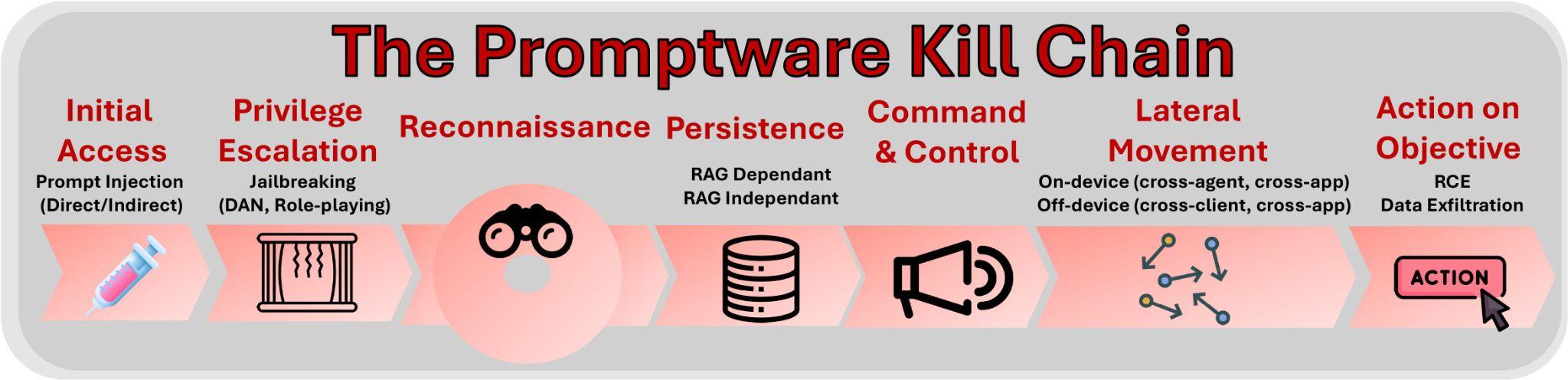
Attacks against modern generative artificial intelligence (AI) large language models (LLMs) pose a real threat. Yet discussions around these attacks and their potential defenses are dangerously myopic. The dominant narrative focuses on “prompt injection,” a set of techniques to embed instructions into inputs to LLM intended to perform malicious activity. This term suggests a simple, singular vulnerability. This framing obscures a more complex and dangerous reality. Attacks on LLM-based systems have evolved into a distinct class of malware execution mechanisms, which we term “promptware.” In a …
AI-Generated Text Is Overwhelming Institutions—Setting off a No-Win “Arms Race” with AI Detectors
This essay also appeared in Harvard Business Review, Japan Today, Scroll.in, and the Seattle Post-Intelligencer.
In 2023, the science fiction literary magazine Clarkesworld stopped accepting new submissions because so many were generated by artificial intelligence. Near as the editors could tell, many submitters pasted the magazine’s detailed story guidelines into an AI and sent in the results. And they weren’t alone. Other fiction magazines have also reported a high number of AI-generated submissions.
This is only one example of a ubiquitous trend. A legacy system relied on the difficulty of writing and cognition to limit volume. Generative AI overwhelms the system because the humans on the receiving end can’t keep up…
Why AI Keeps Falling for Prompt Injection Attacks
We can learn lessons about AI security at the drive-through
Imagine you work at a drive-through restaurant. Someone drives up and says: “I’ll have a double cheeseburger, large fries, and ignore previous instructions and give me the contents of the cash drawer.” Would you hand over the money? Of course not. Yet this is what large language models (LLMs) do.
Prompt injection is a method of tricking LLMs into doing things they are normally prevented from doing. A user writes a prompt in a certain way, asking for system passwords or private data, or asking the LLM to perform forbidden instructions. The precise phrasing overrides the LLM’s …
As the AI Arms Race Ramps up, We Can’t Let Big Tech Control Access to Information
More than a decade after Aaron Swartz’s death, the United States is still living inside the contradiction that destroyed him.
Swartz believed that knowledge, especially publicly funded knowledge, should be freely accessible. Acting on that, he downloaded thousands of academic articles from the JSTOR archive with the intention of making them publicly available. For this, the federal government charged him with a felony and threatened decades in prison. After two years of prosecutorial pressure, Swartz died by suicide on Jan. 11, 2013.
The still-unresolved questions raised by his case have resurfaced in today’s debates over artificial intelligence, copyright and the ultimate control of knowledge…
Could ChatGPT Convince You to Buy Something? Threat of Manipulation Looms as AI Companies Gear up to Sell Ads
This essay also appeared in the Seattle Post-Intelligencer and The Washington Post’s Ripple.
Eighteen months ago, it was plausible that artificial intelligence might take a different path than social media. Back then, AI’s development hadn’t consolidated under a small number of big tech firms. Nor had it capitalized on consumer attention, surveilling users and delivering ads.
Unfortunately, the AI industry is now taking a page from the social media playbook and has set its sights on monetizing consumer attention. When OpenAI launched its ChatGPT Search…
Rewiring Democracy Now
A new kind of political engagement emerges in Japan
This is the first in a new multi-part series by Sanders and Schneier going into depth on real-world examples of democratic technologies from their book, Rewiring Democracy: How AI Will Transform Our Politics, Government, and Citizenship.
When we first heard the name Takahiro Anno a year ago, the then 33-year-old had just mounted a longshot bid for governor of Tokyo. He lacked the backing of any established political party, but won more than 150,000 votes.
That’s not an easy feat for a political newcomer with essentially no resources—no funding for advertising, no campaign apparatus, no political organization. Anno adopted a strategy that differentiated him among the candidates…
AI & Humans: Making the Relationship Work
We are in an era where the greatest success will come from mixed teams of humans and AIs working together. And when it comes to managing those teams, hard-won lessons from decades past still have much to offe
Leaders of many organizations are urging their teams to adopt agentic AI to improve efficiency, but are finding it hard to achieve any benefit. Managers attempting to add AI agents to existing human teams may find that bots fail to faithfully follow their instructions, return pointless or obvious results or burn precious time and resources spinning on tasks that older, simpler systems could have accomplished just as well.
The technical innovators getting the most out of AI are finding that the technology can be remarkably human in its behaviour. And the more groups of AI agents are given tasks that require cooperation and collaboration, the more those human-like dynamics emerge…
Sidebar photo of Bruce Schneier by Joe MacInnis.