Entries Tagged "homeland security"

Page 13 of 37

Voluntary Security Inspections

What could possibly be the point of this?

Cars heading to Austin-Bergstrom International Airport will see random, voluntary inspections Monday.

The searches are part of an increase in security at the airport.

It’s a joint operation between the U.S. Department of Homeland Security, Austin Police, and airport security.

The enhancements are not a response to specific threats, and the security level has not changed.

Officials say the searches are voluntary and drivers can opt out if they want.

Training? Reassuring a jittery public? Looking busy? This can’t possibly be done for security reasons.

Posted on June 1, 2010 at 1:00 PMView Comments

Another Scene from an Airport

I’ve gotten to the front of the security line at a different airport, and handed a different TSA officer my ID and ticket.

TSA Officer: (Looks everything over. Reads the name on my passport.) The Bruce Schneier?

Me: (Nods, managing not to say: “No no, just a Bruce Schneier; didn’t you hear I come in six-packs?”)

TSA Officer: The security expert?

Me: Yes.

TSA Officer: (Takes off his glove. Offers me his hand to shake.)

Me: (Shakes his hand.)

TSA Officer: I read your stuff all the time.

That’s twice in a row, after years of not being recognized by any TSA officer ever. This is starting to worry me.

Posted on May 28, 2010 at 12:00 PMView Comments

Scene from an Airport

I’ve gotten to the front of the security line and handed the TSA officer my ID and ticket.

TSA Officer: (Looks at my ticket. Looks at my ID. Looks at me. Smiles.)

Me: (Smiles back.)

TSA Officer: (Looks at my ID. Looks at me. Smiles.)

Me: (Tips hat. Smiles back.)

TSA Officer: A beloved name from the blogosphere.

Me: And I always thought that I slipped through these lines anonymously.

TSA Officer: Don’t worry. No one will notice. This isn’t the sort of job that rewards competence, you know.

Me: Have a good day.

Posted on May 24, 2010 at 2:29 PMView Comments

Dead on the No-Fly List

Such “logic“:

If a person on the no-fly list dies, his name could stay on the list so that the government can catch anyone trying to assume his identity.

But since a terrorist might assume anyone’s identity, by the same logic we should put everyone on the no-fly list.

Otherwise, it’s an interesting article on how the no-fly list works.

Posted on March 24, 2010 at 6:38 AMView Comments

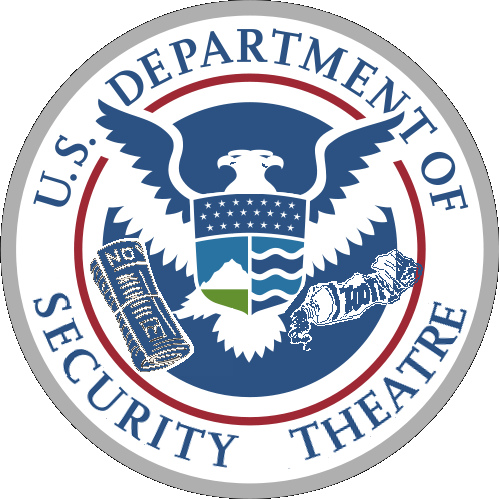
TSA Logo Contest Winner

In January I announced a contest to redesign the TSA logo. Last week I announced the five finalists—chosen by Patrick Smith from "Ask the Pilot" and myself—and asked you all to vote on the winner.

Four hundred and seven votes later, we have a tie. No really; we have a tie. Rhys Gibson and “I love to fly and it shows” have 135 votes each. (It’s still a tie at 141 votes each if I give half credit for all split votes.) Both are well ahead of the third place winner, with 81 votes. There were a few ambiguous comments that could possibly break the tie, but rather than scrutinize the hanging chad any more closely, I’m going to appeal to the judges to cast the deciding votes.

Although both logos are excellent, both Patrick Smith and I vote for Rhys Gibson.

U.S. Department of Security Theatre logo

Congratulations. Send me your physical address and we’ll get you your prizes.

Posted on February 22, 2010 at 2:00 PMView Comments

TSA Logo Contest Finalists

Last month I announced a contest to redesign the TSA logo. Here are the finalists. Clicking on them will bring up a larger, and easier to read, version.

photo
Travis McHale
photo
Will Imholte
photo
Rhys Gibson
photo
Kurushio
photo
I love to fly and it shows


Vote in the comments. The winner will receive a copy of our most recent books, a fake boarding pass on any flight for any date, and an empty 12-ounce bottle labeled “saline” that you can refill and get through any TSA security checkpoint.

Voting will close at noon PST on Sunday, February 21.

EDITED TO ADD (2/22): Winner here.

Posted on February 14, 2010 at 3:28 PMView Comments

Airplane Security Commentary

Excellent commentary from The Register:

As the smoke clears following the case of Umar Farouk Abdul Mutallab, the failed Christmas Day “underpants bomber” of Northwest Airlines Flight 253 fame, there are just three simple points for us Westerners to take away.

First: It is completely impossible to prevent terrorists from attacking airliners.

Second: This does not matter. There is no need for greater efforts on security.

Third: A terrorist set fire to his own trousers, suffering eyewateringly painful burns to what Australian cricket commentators sometimes refer to as the “groinal area”, and nobody seems to be laughing. What’s wrong with us?

Posted on January 13, 2010 at 2:55 PMView Comments

Post-Underwear-Bomber Airport Security

In the headlong rush to “fix” security after the Underwear Bomber’s unsuccessful Christmas Day attack, there’s been far too little discussion about what worked and what didn’t, and what will and will not make us safer in the future.

The security checkpoints worked. Because we screen for obvious bombs, Umar Farouk Abdulmutallab—or, more precisely, whoever built the bomb—had to construct a far less reliable bomb than he would have otherwise. Instead of using a timer or a plunger or a reliable detonation mechanism, as would any commercial user of PETN, he had to resort to an ad hoc and much more inefficient homebrew mechanism: one involving a syringe and 20 minutes in the lavatory and we don’t know exactly what else. And it didn’t work.

Yes, the Amsterdam screeners allowed Abdulmutallab onto the plane with PETN sewn into his underwear, but that’s not a failure, either. There is no security checkpoint, run by any government anywhere in the world, designed to catch this. It isn’t a new threat; it’s more than a decade old. Nor is it unexpected; anyone who says otherwise simply isn’t paying attention. But PETN is hard to explode, as we saw on Christmas Day.

Additionally, the passengers on the airplane worked. For years, I’ve said that exactly two things have made us safer since 9/11: reinforcing the cockpit door and convincing passengers that they need to fight back. It was the second of these that, on Christmas Day, quickly subdued Abdulmutallab after he set his pants on fire.

To the extent security failed, it failed before Abdulmutallab even got to the airport. Why was he issued an American visa? Why didn’t anyone follow up on his father’s tip? While I’m sure there are things to be improved and fixed, remember that everything is obvious in hindsight. After the fact, it’s easy to point to the bits of evidence and claim that someone should have “connected the dots.” But before the fact, when there are millions of dots—some important but the vast majority unimportant—uncovering plots is a lot harder.

Despite this, the proposed fixes focus on the details of the plot rather than the broad threat. We’re going to install full-body scanners, even though there are lots of ways to hide PETN—stuff it in a body cavity, spread it thinly on a garment—from the machines. We’re going to profile people traveling from 14 countries, even though it’s easy for a terrorist to travel from a different country. Seating requirements for the last hour of flight were the most ridiculous example.

The problem with all these measures is that they’re only effective if we guess the plot correctly. Defending against a particular tactic or target makes sense if tactics and targets are few. But there are hundreds of tactics and millions of targets, so all these measures will do is force the terrorists to make a minor modification to their plot.

It’s magical thinking: If we defend against what the terrorists did last time, we’ll somehow defend against what they do next time. Of course this doesn’t work. We take away guns and bombs, so the terrorists use box cutters. We take away box cutters and corkscrews, and the terrorists hide explosives in their shoes. We screen shoes, they use liquids. We limit liquids, they sew PETN into their underwear. We implement full-body scanners, and they’re going to do something else. This is a stupid game; we should stop playing it.

But we can’t help it. As a species, we’re hardwired to fear specific stories—terrorists with PETN underwear, terrorists on subways, terrorists with crop dusters—and we want to feel secure against those stories. So we implement security theater against the stories, while ignoring the broad threats.

What we need is security that’s effective even if we can’t guess the next plot: intelligence, investigation, and emergency response. Our foiling of the liquid bombers demonstrates this. They were arrested in London, before they got to the airport. It didn’t matter if they were using liquids—which they chose precisely because we weren’t screening for them—or solids or powders. It didn’t matter if they were targeting airplanes or shopping malls or crowded movie theaters. They were arrested, and the plot was foiled. That’s effective security.

Finally, we need to be indomitable. The real security failure on Christmas Day was in our reaction. We’re reacting out of fear, wasting money on the story rather than securing ourselves against the threat. Abdulmutallab succeeded in causing terror even though his attack failed.

If we refuse to be terrorized, if we refuse to implement security theater and remember that we can never completely eliminate the risk of terrorism, then the terrorists fail even if their attacks succeed.

This essay previously appeared on Sphere, the AOL.com news site.

EDITED TO ADD (1/8): Similar sentiment.

Posted on January 7, 2010 at 1:18 PMView Comments

Another Contest: Fixing Airport Security

Slate is hosting an airport security suggestions contest: ideas “for making airport security more effective, more efficient, or more pleasant.” Deadline is midday Friday.

I had already submitted a suggestion before I was asked to be a judge. Since I’m no longer eligible, here’s what I sent them:

Reduce the TSA’s budget, and spend the money on:

1. Intelligence. Security measures that focus on specific tactics or targets are a waste of money unless we guess the next attack correctly. Security measures that just force the terrorists to make a minor change in their tactics or targets is not money well spent.

2. Investigation. Since the terrorists deliberately choose plots that we’re not looking for, the best security is to stop plots before they get to the airport. Remember the arrest of the London liquid bombers.

3. Emergency response. Terrorism’s harm depends more on our reactions to attacks than the attacks themselves. We’re naturally resilient, but how we respond in those first hours and days is critical.

And as an added bonus, all of these measures protect us against non-airplane terrorism as well. All we have to do is stop focusing on specific movie plots, and start thinking about the overall threat.

Probably not what they were looking for, and certainly not anything the government is even going to remotely consider—but the smart solution all the same.

Posted on January 7, 2010 at 10:53 AMView Comments

1 11 12 13 14 15 37

Sidebar photo of Bruce Schneier by Joe MacInnis.