Entries Tagged "TSA"

Page 11 of 31

Sky Marshals Flying First Class

I regularly say that security decisions are primarily made for non-security reasons. This article about the placement of sky marshals on airplanes is an excellent example. Basically, the airlines would prefer they fly coach instead of first class.

Airline CEOs met recently with TSA administrator John Pistole and officials from the Federal Air Marshal Service requesting the TSA to reconsider the placement of marshals based on current security threats.

“Our concern is far less revenue and more that we have defenses appropriate to the threat,” said James May, chief executive of the Air Transport Association, the airline industry’s lobbying group. “We think there needs to be an even distribution, particularly when we have multiple agents on board.”

[…]

By law, airlines must provide seats to marshals at no cost in any cabin requested. With first-class and business-class seats in particular, the revenue loss to airlines can be substantial because they can’t sell last-minute tickets or upgrades, and travelers sometimes get bumped to the back or lose out on upgrade opportunities. When travelers do get bumped, airlines are barred from divulging why the first-class seat was unexpectedly taken away, to keep the presence of a marshal a secret. Bumped travelers—airlines can’t disclose how many passengers are affected—typically get coach seats and refunds on the cash or miles they paid for the better seat.

When I list the few improvements to airline security since 9/11, I don’t include sky marshals.

EDITED TO ADD (10/9): An article from The Economist.

Posted on October 4, 2010 at 1:55 PMView Comments

Popsicle Makers a Security Threat

Chicago chef Rick Bayless photographed this security sign, posted before airport security as people were returning home from the Aspen Food & Wine Festival:

No popsicle makers are allowed through security.

Anyone have any idea why something like this is so dangerous? Is the TSA prohibiting random things to toy with us? Their blog is silent on this question.

EDITED TO ADD (6/23): Seems that it’s not all popsicle makers, but the Zoku Quick Pop Maker that Williams Sonoma was selling at the festival. It has a small amount of liquid inside. And remember, if there isn’t a printed label stating the volume of liquid, the TSA assumes that it’s over 3 ounces. (Terrorists take note: print official looking labels on your larger-than-three-ounce bottles and you’ll have no trouble at airport security.)

Posted on June 23, 2010 at 1:16 PMView Comments

Behavioral Profiling at Airports

There’s a long article in Nature on the practice:

It remains unclear what the officers found anomalous about George’s behaviour, and why he was detained. The TSA’s parent agency, the Department of Homeland Security (DHS), has declined to comment on his case because it is the subject of a federal lawsuit that was filed on George’s behalf in February by the American Civil Liberties Union. But the incident has brought renewed attention to a burgeoning controversy: is it possible to know whether people are being deceptive, or planning hostile acts, just by observing them?

Some people seem to think so. At London’s Heathrow Airport, for example, the UK government is deploying behaviour-detection officers in a trial modelled in part on SPOT. And in the United States, the DHS is pursuing a programme that would use sensors to look at nonverbal behaviours, and thereby spot terrorists as they walk through a corridor. The US Department of Defense and intelligence agencies have expressed interest in similar ideas.

Yet a growing number of researchers are dubious ­ not just about the projects themselves, but about the science on which they are based. “Simply put, people (including professional lie-catchers with extensive experience of assessing veracity) would achieve similar hit rates if they flipped a coin,” noted a 2007 report from a committee of credibility-assessment experts who reviewed research on portal screening.

“No scientific evidence exists to support the detection or inference of future behaviour, including intent,” declares a 2008 report prepared by the JASON defence advisory group. And the TSA had no business deploying SPOT across the nation’s airports “without first validating the scientific basis for identifying suspicious passengers in an airport environment”, stated a two-year review of the programme released on 20 May by the Government Accountability Office (GAO), the investigative arm of the US Congress.

Commentary from the MindHacks blog.

Also, the GAO has published a report on the U.S. DHS’s SPOT program: “Aviation Security: Efforts to Validate TSA’s Passenger Screening Behavior Detection Program Underway, but Opportunities Exist to Strengthen Validation and Address Operational Challenges.”

As of March 2010, TSA deployed about 3,000 BDOs at an annual cost of about $212 million; this force increased almost fifteen-fold between March 2007 and July 2009. BDOs have been selectively deployed to 161 of the 457 TSA-regulated airports in the United States at which passengers and their property are subject to TSA-mandated screening procedures.

It seems pretty clear that the program only catches criminals, and no terrorists. You’d think there would be more important things to spend $200 million a year on.

EDITED TO ADD (6/14): In the comments, a couple of people asked how this compares with the Israeli model of airport security—concentrate on the person—and the idea that trained officers notice if someone is acting “hinky”: both things that I have written favorably about.

The difference is the experience of the detecting officer and the amount of time they spend with each person. If you read about the programs described above, they’re supposed to “spot terrorists as they walk through a corridor,” or possibly after a few questions. That’s very different from what happens when you check into a flight an Ben Gurion Airport.

The problem with fast detection programs is that they don’t work, and the problem with the Israeli security model is that it doesn’t scale.

Posted on June 14, 2010 at 6:23 AMView Comments

Voluntary Security Inspections

What could possibly be the point of this?

Cars heading to Austin-Bergstrom International Airport will see random, voluntary inspections Monday.

The searches are part of an increase in security at the airport.

It’s a joint operation between the U.S. Department of Homeland Security, Austin Police, and airport security.

The enhancements are not a response to specific threats, and the security level has not changed.

Officials say the searches are voluntary and drivers can opt out if they want.

Training? Reassuring a jittery public? Looking busy? This can’t possibly be done for security reasons.

Posted on June 1, 2010 at 1:00 PMView Comments

Another Scene from an Airport

I’ve gotten to the front of the security line at a different airport, and handed a different TSA officer my ID and ticket.

TSA Officer: (Looks everything over. Reads the name on my passport.) The Bruce Schneier?

Me: (Nods, managing not to say: “No no, just a Bruce Schneier; didn’t you hear I come in six-packs?”)

TSA Officer: The security expert?

Me: Yes.

TSA Officer: (Takes off his glove. Offers me his hand to shake.)

Me: (Shakes his hand.)

TSA Officer: I read your stuff all the time.

That’s twice in a row, after years of not being recognized by any TSA officer ever. This is starting to worry me.

Posted on May 28, 2010 at 12:00 PMView Comments

Scene from an Airport

I’ve gotten to the front of the security line and handed the TSA officer my ID and ticket.

TSA Officer: (Looks at my ticket. Looks at my ID. Looks at me. Smiles.)

Me: (Smiles back.)

TSA Officer: (Looks at my ID. Looks at me. Smiles.)

Me: (Tips hat. Smiles back.)

TSA Officer: A beloved name from the blogosphere.

Me: And I always thought that I slipped through these lines anonymously.

TSA Officer: Don’t worry. No one will notice. This isn’t the sort of job that rewards competence, you know.

Me: Have a good day.

Posted on May 24, 2010 at 2:29 PMView Comments

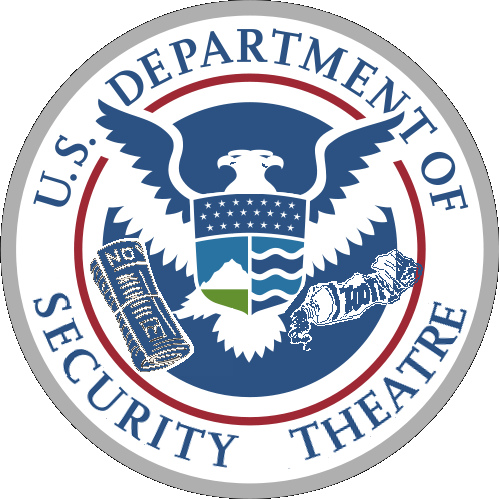
TSA Logo Contest Winner

In January I announced a contest to redesign the TSA logo. Last week I announced the five finalists—chosen by Patrick Smith from "Ask the Pilot" and myself—and asked you all to vote on the winner.

Four hundred and seven votes later, we have a tie. No really; we have a tie. Rhys Gibson and “I love to fly and it shows” have 135 votes each. (It’s still a tie at 141 votes each if I give half credit for all split votes.) Both are well ahead of the third place winner, with 81 votes. There were a few ambiguous comments that could possibly break the tie, but rather than scrutinize the hanging chad any more closely, I’m going to appeal to the judges to cast the deciding votes.

Although both logos are excellent, both Patrick Smith and I vote for Rhys Gibson.

U.S. Department of Security Theatre logo

Congratulations. Send me your physical address and we’ll get you your prizes.

Posted on February 22, 2010 at 2:00 PMView Comments

TSA Logo Contest Finalists

Last month I announced a contest to redesign the TSA logo. Here are the finalists. Clicking on them will bring up a larger, and easier to read, version.

photo
Travis McHale
photo
Will Imholte
photo
Rhys Gibson
photo
Kurushio
photo
I love to fly and it shows


Vote in the comments. The winner will receive a copy of our most recent books, a fake boarding pass on any flight for any date, and an empty 12-ounce bottle labeled “saline” that you can refill and get through any TSA security checkpoint.

Voting will close at noon PST on Sunday, February 21.

EDITED TO ADD (2/22): Winner here.

Posted on February 14, 2010 at 3:28 PMView Comments

1 9 10 11 12 13 31

Sidebar photo of Bruce Schneier by Joe MacInnis.