Entries Tagged "terrorism"

Page 59 of 80

Copycats

It’s called “splash-and-grab,” and it’s a new way to rob convenience stores. Two guys walk into a store, and one comes up to the counter with a cup of hot coffee or cocoa. He pays for it, and when the clerk opens the cash drawer, he throws the coffee in the clerk’s face. The other one grabs the cash drawer, and they both run.

Crimes never change, but tactics do. This tactic is new; someone just invented it. But now that it’s in the news, copycats are repeating the trick. There have been at least 19 such robberies in Delaware, Pennsylvania and New Jersey. (Some arrests have been made since then.)

Here’s another example: On Nov. 24, 1971, someone with the alias Dan Cooper invented a new way to hijack an aircraft. Claiming he had a bomb, he forced a plane to land and then exchanged the passengers and flight attendants for $200,000 and four parachutes. (I leave it as an exercise for the reader to explain why asking for more than one parachute is critical to the plan’s success.) Taking off again, he told the pilots to fly to 10,000 feet. He then lowered the plane’s back stairs and parachuted away. He was never caught, and the FBI still doesn’t know who he is or whether he survived.

After this story hit the press, there was an epidemic of copycat attacks. In 31 hijackings the following year, half of the hijackers demanded parachutes. It got so bad that the FAA required Boeing to install a special latch—the Cooper Vane—on the back staircases of its 727s so they couldn’t be lowered in the air.

The internet is filled with copycats. Green-card lawyers invented spam; now everyone does it. Other people invented phishing, pharming, spear phishing. The virus, the worm, the Trojan: It’s hard to believe that these ubiquitous internet attack tactics were, until comparatively recently, tactics that no one had thought of.

Most attackers are copycats. They aren’t clever enough to invent a new way to rob a convenience store, use the web to steal money, or hijack an airplane. They try the same attacks again and again, or read about a new attack in the newspaper and decide they can try it, too.

In combating threats, it makes sense to focus on copycats when there is a population of people already willing to commit the crime, who will migrate to a new tactic once it has been demonstrated to be successful. In instances where there aren’t many attacks or attackers, and they’re smarter—al-Qaida-style terrorism comes to mind—focusing on copycats is less effective because the bad guys will respond by modifying their attacks accordingly.

Compare that to suicide bombings in Israel, which are mostly copycat attacks. The authorities basically know what a suicide bombing looks like, and do a pretty good job defending against the particular tactics they tend to see again and again. It’s still an arms race, but there is a lot of security gained by defending against copycats.

But even so, it’s important to understand which aspect of the crime will be adopted by copycats. Splash-and-grab crimes have nothing to do with convenience stores; copycats can target any store where hot coffee is easily available and there is only one clerk on duty. And the tactic doesn’t necessarily need coffee; one copycat used bleach. The new idea is to throw something painful and damaging in a clerk’s face, grab the valuables and run.

Similarly, when a suicide bomber blows up a restaurant in Israel, the authorities don’t automatically assume the copycats will attack other restaurants. They focus on the particulars of the bomb, the triggering mechanism and the way the bomber arrived at his target. Those are the tactics that copycats will repeat. The next target may be a theater or a hotel or any other crowded location.

The lesson for counterterrorism in America: Stay flexible. We’re not threatened by a bunch of copycats, so we’re best off expending effort on security measures that will work regardless of the tactics or the targets: intelligence, investigation and emergency response. By focusing too much on specifics—what the terrorists did last time—we’re wasting valuable resources that could be used to keep us safer.

This essay originally appeared on Wired.com.
Posted on March 8, 2007 at 3:23 PMView Comments

Sky Marshals in Australia

Their cost-effectiveness is being debated:

They’ve cost the taxpayer $106 million so far, they travel in business class, and over the past four years Australia’s armed air marshals have had to act only once—subduing a 68-year-old man who produced a small knife on a flight from Sydney to Cairns in 2003.

I have not seen any similar cost analysis from the United States.

Posted on March 8, 2007 at 7:37 AMView Comments

Canadian Anti-Terrorism Law News

Big news:

The court said the men, who are accused of having ties to al-Qaeda, have the right to see and respond to evidence against them. It pointed to a law in Britain that allows special advocates or lawyers to see sensitive intelligence material, but not share details with their clients.

In its ruling, the court said while it’s important to protect Canada’s national security, the government can do more to protect individual rights.

But the court suspended the judgment from taking legal effect for a year, giving Parliament time to write a new law complying with constitutional principles.

Critics have long denounced the certificates, which can lead to deportation of non-citizens on the basis of secret intelligence presented to a Federal Court judge at closed-door hearings.

Those who fight the allegations can spend years in jail while the case works its way through the legal system. In the end, they can sometimes face removal to countries with a track record of torture, say critics.

And that’s not the only piece of good news from Canada. Two provisions from an anti-terrorism law passed at the end of 2001 were due to expire at the end of February. The House of Commons has voted against extending them:

One of the anti-terrorism measures allows police to arrest suspects without a warrant and detain them for three days without charges, provided police believe a terrorist act may be committed. The other measure allows judges to compel witnesses to testify in secret about past associations or pending acts. The witnesses could go to jail if they don’t comply.

The two measures, introduced by a previous Liberal government in 2001, have never been used.

“These two provisions especially have done nothing to fight against terrorism,” Dion said Tuesday. “[They] have not been helpful and have continued to create some risk for civil liberties.”

Another article here.

Posted on March 2, 2007 at 6:54 AMView Comments

Is Everything a Bomb These Days?

In New Mexico, a bomb squad blew up two CD players, duct-taped to the bottoms of church pews, that played pornographic messages during Mass. This is a pretty funny high school prank and I hope the kids that did it get suitably punished. But they’re not terrorists. And I have a hard time believing that the police actually thought CD players were bombs.

Meanwhile, Irish police blew up a tape dispenser left outside a police station.

And not to be outdone, the Dutch police mistook one of their own transmitters for a bomb. At least they didn’t blow anything up.

Okay, everyone. We need some ideas, here. If we’re going to think everything weird is a bomb, then the false alarms are going to kill any hope of security.

EDITED TO ADD (3/3): If you’re having trouble identifying bombs, this quiz should help. And here’s a relevant cartoon.

Posted on February 23, 2007 at 12:38 PMView Comments

U.S Terrorism Arrests/Convictions Significantly Overstated

Interesting report (long, but at least read the Executive Summary) from the U.S. Department of Justice’s Inspector General that says, basically, that all the U.S. terrorism statistics since 9/11—arrests, convictions, and so on—have been grossly inflated.

As summarized in the following table, we determined that the FBI, EOUSA, and the Criminal Division did not accurately report 24 of the 26 statistics we reviewed.

“EOUSA” is the Executive Office for United States Attorneys, part of the U.S. Department of Justice.

The report gives a series of reasons why the statistics were so bad. Here’s one:

The number of terrorism-related convictions was overstated because the FBI initially coded the investigative cases as terrorism-related when the cases were opened, but did not recode cases when no link to terrorism was established.

And here’s an example of a problem:

For example, Operation Tarmac was a worksite enforcement operation launched in November 2001 at the nation’s airports. During this operation, Department and other federal agents went into regional airports and checked the immigration papers of airport workers. The agents then arrested any individuals who used falsified documents, such as social security numbers, drivers’ licenses, and other identification documents, to gain employment. EOUSA officials told us they believe these defendants are properly coded under the anti-terrorism program activity. We do not agree that law enforcement efforts such as these should be counted as “anti-terrorism” unless the subject or target is reasonably linked to terrorist activity.

There’s an enormous amount of detail in the report, if you want to wade through the 80ish pages of report and another 80ish of appendices.

Posted on February 23, 2007 at 7:13 AMView Comments

CYA Security

Since 9/11, we’ve spent hundreds of billions of dollars defending ourselves from terrorist attacks. Stories about the ineffectiveness of many of these security measures are common, but less so are discussions of why they are so ineffective. In short: much of our country’s counterterrorism security spending is not designed to protect us from the terrorists, but instead to protect our public officials from criticism when another attack occurs.

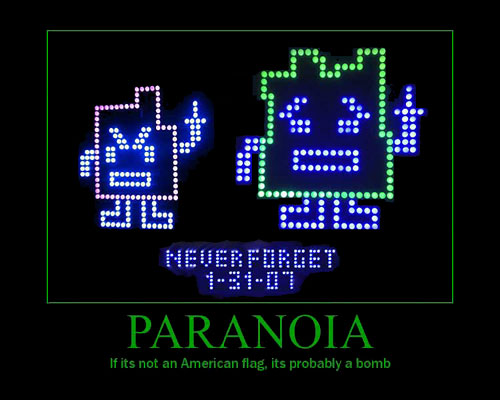
Boston, January 31: As part of a guerilla marketing campaign, a series of amateur-looking blinking signs depicting characters in the Aqua Teen Hunger Force, a show on the Cartoon Network, were placed on bridges, near a medical center, underneath an interstate highway, and in other crowded public places.

Police mistook these signs for bombs and shut down parts of the city, eventually spending over $1M sorting it out. Authorities blasted the stunt as a terrorist hoax, while others ridiculed the Boston authorities for overreacting. Almost no one looked beyond the finger pointing and jeering to discuss exactly why the Boston authorities overreacted so badly. They overreacted because the signs were weird.

If someone left a backpack full of explosives in a crowded movie theater, or detonated a truck bomb in the middle of a tunnel, no one would demand to know why the police hadn’t noticed it beforehand. But if a weird device with blinking lights and wires turned out to be a bomb—what every movie bomb looks like—there would be inquiries and demands for resignations. It took the police two weeks to notice the Mooninite blinkies, but once they did, they overreacted because their jobs were at stake.

This is “Cover Your Ass” security, and unfortunately it’s very common.

Airplane security seems to forever be looking backwards. Pre-9/11, it was bombs, guns, and knives. Then it was small blades and box cutters. Richard Reid tried to blow up a plane, and suddenly we all have to take off our shoes. And after last summer’s liquid plot, we’re stuck with a series of nonsensical bans on liquids and gels.

Once you think about this in terms of CYA, it starts to make sense. The TSA wants to be sure that if there’s another airplane terrorist attack, it’s not held responsible for letting it slip through. One year ago, no one could blame the TSA for not detecting liquids. But since everything seems obvious in hindsight, it’s basic job preservation to defend against what the terrorists tried last time.

We saw this kind of CYA security when Boston and New York randomly checked bags on the subways after the London bombing, or when buildings started sprouting concrete barriers after the Oklahoma City bombing. We also see it in ineffective attempts to detect nuclear bombs; authorities employ CYA security against the media-driven threat so they can say “we tried.”

At the same time, we’re ignoring threat possibilities that don’t make the news as much—against chemical plants, for example. But if there were ever an attack, that would change quickly.

CYA also explains the TSA’s inability to take anyone off the no-fly list, no matter how innocent. No one is willing to risk his career on removing someone from the no-fly list who might—no matter how remote the possibility—turn out to be the next terrorist mastermind.

Another form of CYA security is the overly specific countermeasures we see during big events like the Olympics and the Oscars, or in protecting small towns. In all those cases, those in charge of the specific security don’t dare return the money with a message “use this for more effective general countermeasures.” If they were wrong and something happened, they’d lose their jobs.

And finally, we’re seeing CYA security on the national level, from our politicians. We might be better off as a nation funding intelligence gathering and Arabic translators, but it’s a better re-election strategy to fund something visible but ineffective, like a national ID card or a wall between the U.S. and Mexico.

Securing our nation from threats that are weird, threats that either happened before or captured the media’s imagination, and overly specific threats are all examples of CYA security. It happens not because the authorities involved—the Boston police, the TSA, and so on—are not competent, or not doing their job. It happens because there isn’t sufficient national oversight, planning, and coordination.

People and organizations respond to incentives. We can’t expect the Boston police, the TSA, the guy who runs security for the Oscars, or local public officials to balance their own security needs against the security of the nation. They’re all going to respond to the particular incentives imposed from above. What we need is a coherent antiterrorism policy at the national level: one based on real threat assessments, instead of fear-mongering, re-election strategies, or pork-barrel politics.

Sadly, though, there might not be a solution. All the money is in fear-mongering, re-election strategies, and pork-barrel politics. And, like so many things, security follows the money.

This essay originally appeared on Wired.com.

EDITED TO ADD (2/23): Interesting commentary, and a Slashdot thread.

Posted on February 22, 2007 at 5:52 AMView Comments

Movie Plot Threat in Vancouver

The idiocy of this is impressive:

A Vancouver Police computer crime investigator has warned the city that plans for a citywide wireless Internet system put the city at risk of terrorist attack during the 2010 Winter Olympic Games.

The problem? Well, the problem seems to be that terrorists might attend the Olympic games and use the Internet while they’re there.

“If you have an open wireless system across the city, as a bad guy I could sit on a bus with a laptop and do global crime,” Fenton explained. “It would be virtually impossible to find me.”

There’s also some scary stuff about SCADA systems, and the city putting some of its own service on the Internet. Clearly this guy has thought about the risks a lot, just not with any sense. He’s overestimating cyberterrorism. He’s overestimating how important this one particular method of wireless Internet access is. He’s overestimating how important the 2010 Winter Olympics is.

But the newspaper was happy to play along and spread the fear. The photograph accompanying the article is captioned: “Anyone with a laptop and wireless access could commit a terrorist act, police warn.”

Posted on February 21, 2007 at 6:51 AMView Comments

The Doghouse: Onboard Threat Detection System

It’s almost too absurd to even write about seriously—this plan to spot terrorists in airplane seats:

Cameras fitted to seat-backs will record every twitch, blink, facial expression or suspicious movement before sending the data to onboard software which will check it against individual passenger profiles.

[…]

They say that rapid eye movements, blinking excessively, licking lips or ways of stroking hair or ears are classic symptoms of somebody trying to conceal something.

A separate microphone will hear and record even whispered remarks. Islamic suicide bombers are known to whisper texts from the Koran in the moments before they explode bombs.

The software being developed by the scientists will be so sophisticated that it will be able to take account of nervous flyers or people with a natural twitch, helping to ensure there are no false alarms.

The only thing I can think of is that some company press release got turned into real news without a whole lot of thinking.

Posted on February 16, 2007 at 6:55 AMView Comments

1 57 58 59 60 61 80

Sidebar photo of Bruce Schneier by Joe MacInnis.