Entries Tagged "surveillance"

Page 27 of 93

Policy Repercussions of the Paris Terrorist Attacks

In 2013, in the early days of the Snowden leaks, Harvard Law School professor and former Assistant Attorney General Jack Goldsmith reflected on the increase in NSA surveillance post 9/11. He wrote:

Two important lessons of the last dozen years are (1) the government will increase its powers to meet the national security threat fully (because the People demand it), and (2) the enhanced powers will be accompanied by novel systems of review and transparency that seem to those in the Executive branch to be intrusive and antagonistic to the traditional national security mission, but that in the end are key legitimating factors for the expanded authorities.

Goldsmith is right, and I think about this quote as I read news articles about surveillance policies with headlines like “Political winds shifting on surveillance after Paris attacks?

The politics of surveillance are the politics of fear. As long as the people are afraid of terrorism—regardless of how realistic their fears are—they will demand that the government keep them safe. And if the government can convince them that it needs this or that power in order to keep the people safe, the people will willingly grant them those powers. That’s Goldsmith’s first point.

Today, in the wake of the horrific and devastating Paris terror attacks, we’re at a pivotal moment. People are scared, and already Western governments are lining up to authorize more invasive surveillance powers. The US want to back-door encryption products in some vain hope that the bad guys are 1) naive enough to use those products for their own communications instead of more secure ones, and 2) too stupid to use the back doors against the rest of us. The UK is trying to rush the passage of legislation that legalizes a whole bunch of surveillance activities that GCHQ has already been doing to its own citizens. France just gave its police a bunch of new powers. It doesn’t matter that mass surveillance isn’t an effective anti-terrorist tool: a scared populace wants to be reassured.

And politicians want to reassure. It’s smart politics to exaggerate the threat. It’s smart politics to do something, even if that something isn’t effective at mitigating the threat. The surveillance apparatus has the ear of the politicians, and the primary tool in its box is more surveillance. There’s minimal political will to push back on those ideas, especially when people are scared.

Writing about our country’s reaction to the Paris attacks, Tom Engelhardt wrote:

…the officials of that security state have bet the farm on the preeminence of the terrorist ‘threat,’ which has, not so surprisingly, left them eerily reliant on the Islamic State and other such organizations for the perpetuation of their way of life, their career opportunities, their growing powers, and their relative freedom to infringe on basic rights, as well as for that comfortably all-embracing blanket of secrecy that envelops their activities.

Goldsmith’s second point is more subtle: when these power increases are made in public, they’re legitimized through bureaucracy. Together, the scared populace and their scared elected officials serve to make the expanded national security and law enforcement powers normal.

Terrorism is singularly designed to push our fear buttons in ways completely out of proportion to the actual threat. And as long as people are scared of terrorism, they’ll give their governments all sorts of new powers of surveillance, arrest, detention, and so on, regardless of whether those powers actually combat the threat. This means that those who want those powers need a steady stream of terrorist attacks to enact their agenda. It’s not that these people are actively rooting for the terrorists, but they know a good opportunity when they see it.

We know that the PATRIOT Act was largely written before the 9/11 terrorist attacks, and that the political climate was right for its introduction and passage. More recently:

Although “the legislative environment is very hostile today,” the intelligence community’s top lawyer, Robert S. Litt, said to colleagues in an August e-mail, which was obtained by The Post, “it could turn in the event of a terrorist attack or criminal event where strong encryption can be shown to have hindered law enforcement.”

The Paris attacks could very well be that event.

I am very worried that the Obama administration has already secretly told the NSA to increase its surveillance inside the US. And I am worried that there will be new legislation legitimizing that surveillance and granting other invasive powers to law enforcement. As Goldsmith says, these powers will be accompanied by novel systems of review and transparency. But I have no faith that those systems will be effective in limiting abuse any more than they have been over the last couple of decades.

EDITED TO ADD (12/14): Trevor Timm is all over this issue. Dan Gillmor wrote something good, too.

Posted on November 24, 2015 at 6:32 AMView Comments

Voter Surveillance

There hasn’t been that much written about surveillance and big data being used to manipulate voters. In Data and Goliath, I wrote:

Unique harms can arise from the use of surveillance data in politics. Election politics is very much a type of marketing, and politicians are starting to use personalized marketing’s capability to discriminate as a way to track voting patterns and better “sell” a candidate or policy position. Candidates and advocacy groups can create ads and fund-raising appeals targeted to particular categories: people who earn more than $100,000 a year, gun owners, people who have read news articles on one side of a particular issue, unemployed veterans…anything you can think of. They can target outraged ads to one group of people, and thoughtful policy-based ads to another. They can also fine-tune their get-out-the-vote campaigns on Election Day, and more efficiently gerrymander districts between elections. Such use of data will likely have fundamental effects on democracy and voting.

A new research paper looks at the trends:

Abstract: This paper surveys the various voter surveillance practices recently observed in the United States, assesses the extent to which they have been adopted in other democratic countries, and discusses the broad implications for privacy and democracy. Four broad trends are discussed: the move from voter management databases to integrated voter management platforms; the shift from mass-messaging to micro-targeting employing personal data from commercial data brokerage firms; the analysis of social media and the social graph; and the decentralization of data to local campaigns through mobile applications. The de-alignment of the electorate in most Western societies has placed pressures on parties to target voters outside their traditional bases, and to find new, cheaper, and potentially more intrusive, ways to influence their political behavior. This paper builds on previous research to consider the theoretical tensions between concerns for excessive surveillance, and the broad democratic responsibility of parties to mobilize voters and increase political engagement. These issues have been insufficiently studied in the surveillance literature. They are not just confined to the privacy of the individual voter, but relate to broader dynamics in democratic politics.

Posted on November 23, 2015 at 12:03 PMView Comments

On CISA

I have avoided writing about the Cybersecurity Information Sharing Act (CISA), largely because the details kept changing. (For those not following closely, similar bills were passed by both the House and the Senate. They’re now being combined into a single bill which will be voted on again, and then almost certainly signed into law by President Obama.)

Now that it’s pretty solid, I find that I don’t have to write anything, because Danny Weitzner did such a good job, writing about how the bill encourages companies to share personal information with the government, allows them to take some offensive measures against attackers (or innocents, if they get it wrong), waives privacy protections, and gives companies immunity from prosecution.

Information sharing is essential to good cybersecurity, and we need more of it. But CISA is a really bad law.

This is good, too.

Posted on November 17, 2015 at 12:03 PMView Comments

Refuse to Be Terrorized

Paul Krugman has written a really good update of my 2006 essay.

Krugman:

So what can we say about how to respond to terrorism? Before the atrocities in Paris, the West’s general response involved a mix of policing, precaution, and military action. All involved difficult tradeoffs: surveillance versus privacy, protection versus freedom of movement, denying terrorists safe havens versus the costs and dangers of waging war abroad. And it was always obvious that sometimes a terrorist attack would slip through.

Paris may have changed that calculus a bit, especially when it comes to Europe’s handling of refugees, an agonizing issue that has now gotten even more fraught. And there will have to be a post-mortem on why such an elaborate plot wasn’t spotted. But do you remember all the pronouncements that 9/11 would change everything? Well, it didn’t—and neither will this atrocity.

Again, the goal of terrorists is to inspire terror, because that’s all they’re capable of. And the most important thing our societies can do in response is to refuse to give in to fear.

Me:

But our job is to remain steadfast in the face of terror, to refuse to be terrorized. Our job is to not panic every time two Muslims stand together checking their watches. There are approximately 1 billion Muslims in the world, a large percentage of them not Arab, and about 320 million Arabs in the Middle East, the overwhelming majority of them not terrorists. Our job is to think critically and rationally, and to ignore the cacophony of other interests trying to use terrorism to advance political careers or increase a television show’s viewership.

The surest defense against terrorism is to refuse to be terrorized. Our job is to recognize that terrorism is just one of the risks we face, and not a particularly common one at that. And our job is to fight those politicians who use fear as an excuse to take away our liberties and promote security theater that wastes money and doesn’t make us any safer.

This crass and irreverent essay was written after January’s Paris terrorist attack, but is very relevant right now.

Posted on November 17, 2015 at 6:36 AMView Comments

The Effects of Surveillance on the Victims

Last month, the Cato Institute held its Second Annual Cato Surveillance Conference. It was an excellent event, with many interesting talks and panels. But their was one standout: a panel by victims of surveillance. Titled “The Feeling of Being Watched,” it consisted of Assia Boundaoui, Faisal Gill, and Jumana Musa. It was very powerful and moving to hear them talk about what it’s like to live under the constant threat of surveillance.

Watch the video or listen to the audio.

By the way, I gave the closing keynote (video and audio).

Posted on November 5, 2015 at 6:16 AMView Comments

The Need for Transparency in Surveillance

In Data and Goliath, I talk about the need for transparency, oversight, and accountability as the mechanism to allow surveillance when it is necessary, while preserving our security against excessive surveillance and surveillance abuse.

James Losey has a new paper that discusses the need for transparency in surveillance. His conclusion:

Available transparency reports from ICT companies demonstrate the rise in government requests to obtain user communications data. However, revelations on the surveillance capabilities of the United States, Sweden, the UK, and other countries demonstrate that the available data is insufficient and falls short of supporting rational debate. Companies can contribute by increasing granularity, particularly on the legal processes through which they are required to reveal user data. However, the greatest gaps remain in the information provided directly from governments. Current understanding of the scope of surveillance can be credited to whistleblowers risking prosecution in order to publicize illegitimate government activity. The lack of transparency on government access to communications data and the legal processes used undermines the legitimacy of the practices.

Transparency alone will not eliminate barriers to freedom of expression or harm to privacy resulting from overly broad surveillance. Transparency provides a window into the scope of current practices and additional measures are needed such as oversight and mechanisms for redress in cases of unlawful surveillance. Furthermore, international data collection results in the surveillance of individuals and communities beyond the scope of a national debate. Transparency offers a necessary first step, a foundation on which to examine current practices and contribute to a debate on human security and freedom. Transparency is not the sole responsibility of any one country, and governments, in addition to companies, are well positioned to provide accurate and timely data to support critical debate on policies and laws that result in censorship and surveillance. Supporting an informed debate should be the goal of all democratic nations.

Posted on October 27, 2015 at 9:52 AMView Comments

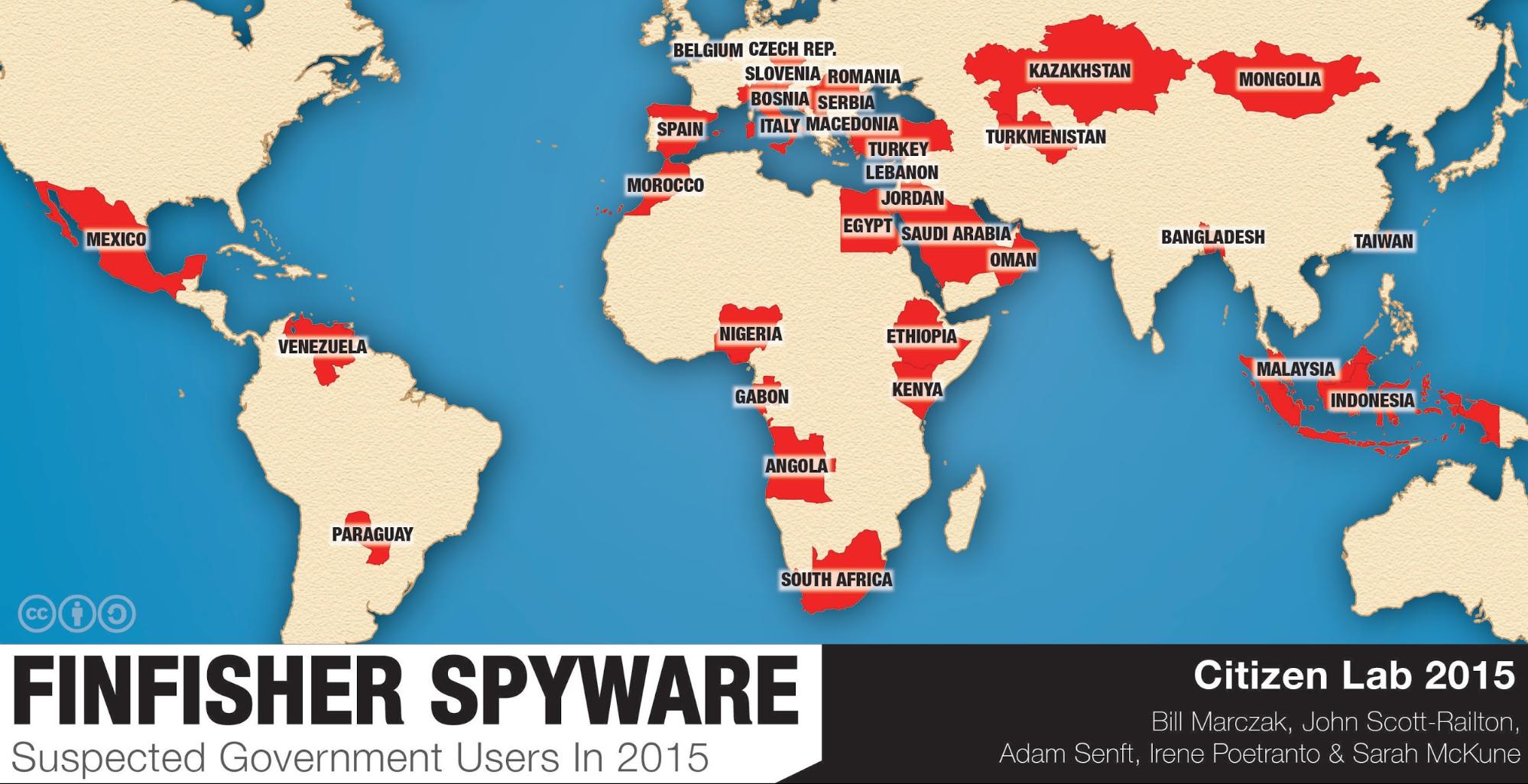
Mapping FinFisher Users

Citizen Lab continues to do excellent work exposing the world’s cyber-weapons arms manufacturers. Its latest report attempts to track users of Gamma International’s FinFisher:

This post describes the results of Internet scanning we recently conducted to identify the users of FinFisher, a sophisticated and user-friendly spyware suite sold exclusively to governments. We devise a method for querying FinFisher’s “anonymizing proxies” to unmask the true location of the spyware’s master servers. Since the master servers are installed on the premises of FinFisher customers, tracing the servers allows us to identify which governments are likely using FinFisher. In some cases, we can trace the servers to specific entities inside a government by correlating our scan results with publicly available sources. Our results indicate 32 countries where at least one government entity is likely using the spyware suite, and we are further able to identify 10 entities by name. Despite the 2014 FinFisher breach, and subsequent disclosure of sensitive customer data, our scanning has detected more servers in more countries than ever before.

Here’s the map of suspected FinFisher users, including some pretty reprehensible governments.

Two news articles.

Posted on October 16, 2015 at 2:33 PMView Comments

Automatic Face Recognition and Surveillance

ID checks were a common response to the terrorist attacks of 9/11, but they’ll soon be obsolete. You won’t have to show your ID, because you’ll be identified automatically. A security camera will capture your face, and it’ll be matched with your name and a whole lot of other information besides. Welcome to the world of automatic facial recognition. Those who have access to databases of identified photos will have the power to identify us. Yes, it’ll enable some amazing personalized services; but it’ll also enable whole new levels of surveillance. The underlying technologies are being developed today, and there are currently no rules limiting their use.

Walk into a store, and the salesclerks will know your name. The store’s cameras and computers will have figured out your identity, and looked you up in both their store database and a commercial marketing database they’ve subscribed to. They’ll know your name, salary, interests, what sort of sales pitches you’re most vulnerable to, and how profitable a customer you are. Maybe they’ll have read a profile based on your tweets and know what sort of mood you’re in. Maybe they’ll know your political affiliation or sexual identity, both predictable by your social media activity. And they’re going to engage with you accordingly, perhaps by making sure you’re well taken care of or possibly by trying to make you so uncomfortable that you’ll leave.

Walk by a policeman, and she will know your name, address, criminal record, and with whom you routinely are seen. The potential for discrimination is enormous, especially in low-income communities where people are routinely harassed for things like unpaid parking tickets and other minor violations. And in a country where people are arrested for their political views, the use of this technology quickly turns into a nightmare scenario.

The critical technology here is computer face recognition. Traditionally it has been pretty poor, but it’s slowly improving. A computer is now as good as a person. Already Google’s algorithms can accurately match child and adult photos of the same person, and Facebook has an algorithm that works by recognizing hair style, body shape, and body language ­- and works even when it can’t see faces. And while we humans are pretty much as good at this as we’re ever going to get, computers will continue to improve. Over the next years, they’ll continue to get more accurate, making better matches using even worse photos.

Matching photos with names also requires a database of identified photos, and we have plenty of those too. Driver’s license databases are a gold mine: all shot face forward, in good focus and even light, with accurate identity information attached to each photo. The enormous photo collections of social media and photo archiving sites are another. They contain photos of us from all sorts of angles and in all sorts of lighting conditions, and we helpfully do the identifying step for the companies by tagging ourselves and our friends. Maybe this data will appear on handheld screens. Maybe it’ll be automatically displayed on computer-enhanced glasses. Imagine salesclerks ­—or politicians ­—being able to scan a room and instantly see wealthy customers highlighted in green, or policemen seeing people with criminal records highlighted in red.

Science fiction writers have been exploring this future in both books and movies for decades. Ads followed people from billboard to billboard in the movie Minority Report. In John Scalzi’s recent novel Lock In, characters scan each other like the salesclerks I described above.

This is no longer fiction. High-tech billboards can target ads based on the gender of who’s standing in front of them. In 2011, researchers at Carnegie Mellon pointed a camera at a public area on campus and were able to match live video footage with a public database of tagged photos in real time. Already government and commercial authorities have set up facial recognition systems to identify and monitor people at sporting events, music festivals, and even churches. The Dubai police are working on integrating facial recognition into Google Glass, and more US local police forces are using the technology.

Facebook, Google, Twitter, and other companies with large databases of tagged photos know how valuable their archives are. They see all kinds of services powered by their technologies ­ services they can sell to businesses like the stores you walk into and the governments you might interact with.

Other companies will spring up whose business models depend on capturing our images in public and selling them to whoever has use for them. If you think this is farfetched, consider a related technology that’s already far down that path: license-plate capture.

Today in the US there’s a massive but invisible industry that records the movements of cars around the country. Cameras mounted on cars and tow trucks capture license places along with date/time/location information, and companies use that data to find cars that are scheduled for repossession. One company, Vigilant Solutions, claims to collect 70 million scans in the US every month. The companies that engage in this business routinely share that data with the police, giving the police a steady stream of surveillance information on innocent people that they could not legally collect on their own. And the companies are already looking for other profit streams, selling that surveillance data to anyone else who thinks they have a need for it.

This could easily happen with face recognition. Finding bail jumpers could even be the initial driving force, just as finding cars to repossess was for license plate capture.

Already the FBI has a database of 52 million faces, and describes its integration of facial recognition software with that database as “fully operational.” In 2014, FBI Director James Comey told Congress that the database would not include photos of ordinary citizens, although the FBI’s own documents indicate otherwise. And just last month, we learned that the FBI is looking to buy a system that will collect facial images of anyone an officer stops on the street.

In 2013, Facebook had a quarter of a trillion user photos in its database. There’s currently a class-action lawsuit in Illinois alleging that the company has over a billion “face templates” of people, collected without their knowledge or consent.

Last year, the US Department of Commerce tried to prevail upon industry representatives and privacy organizations to write a voluntary code of conduct for companies using facial recognition technologies. After 16 months of negotiations, all of the consumer-focused privacy organizations pulled out of the process because industry representatives were unable to agree on any limitations on something as basic as nonconsensual facial recognition.

When we talk about surveillance, we tend to concentrate on the problems of data collection: CCTV cameras, tagged photos, purchasing habits, our writings on sites like Facebook and Twitter. We think much less about data analysis. But effective and pervasive surveillance is just as much about analysis. It’s sustained by a combination of cheap and ubiquitous cameras, tagged photo databases, commercial databases of our actions that reveal our habits and personalities, and ­—most of all ­—fast and accurate face recognition software.

Don’t expect to have access to this technology for yourself anytime soon. This is not facial recognition for all. It’s just for those who can either demand or pay for access to the required technologies ­—most importantly, the tagged photo databases. And while we can easily imagine how this might be misused in a totalitarian country, there are dangers in free societies as well. Without meaningful regulation, we’re moving into a world where governments and corporations will be able to identify people both in real time and backwards in time, remotely and in secret, without consent or recourse.

Despite protests from industry, we need to regulate this budding industry. We need limitations on how our images can be collected without our knowledge or consent, and on how they can be used. The technologies aren’t going away, and we can’t uninvent these capabilities. But we can ensure that they’re used ethically and responsibly, and not just as a mechanism to increase police and corporate power over us.

This essay previously appeared on Forbes.com.

EDITED TO ADD: Two articles that say much the same thing.

Posted on October 5, 2015 at 6:11 AMView Comments

1 25 26 27 28 29 93

Sidebar photo of Bruce Schneier by Joe MacInnis.