Entries Tagged "security theater"

Page 7 of 21

TSA Backscatter X-ray Backlash

Things are happening so fast that I don’t know if I should bother. But here are some links and observations.

The head of the Allied Pilots Association is telling its members to avoid both the full body scanners and the patdowns.

This first-hand report, from a man who refused to fly rather than subject himself to a full-body scan or an enhanced patdown, has been making the rounds. (The TSA is now investigating him.) It reminds me of Penn Jillette’s story from 2002.

A woman has a horrific story of opting-out of the full body scanners. More stories: this one about the TSA patting down a screaming toddler. And here’s Dave Barry’s encounter (also this NPR interview).

Sadly, I agree with this:

It is no accident that women have been complaining about being pulled out of line because of their big breasts, having their bodies commented on by TSA officials, and getting inappropriate touching when selected for pat-downs for nearly 10 years now, but just this week it went viral. It is no accident that CAIR identified Islamic head scarves (hijab) as an automatic trigger for extra screenings in January, but just this week it went viral. What was different?

Suddenly an able-bodied white man is the one who was complaining.

Seems that once you enter airport security, you need to be subjected to it—whether you decide to fly or not.

I experienced the enhanced patdown myself, at DCA, on Tuesday. It was invasive, but not as bad as these stories. It seems clear that TSA agents are inconsistent about these procedures. They’ve probably all had the same training, but individual agents put it into practice very differently.

Of course, airport security is an extra-Constitutional area, so there’s no clear redress mechanism for those subjected to too-intimate patdowns.

This video provides tips to parents flying with young children. Around 2:50 in, the reporter indicates that you can find out if your child has been pre-selected for secondary, and then recommends requesting “de-selection.” That doesn’t make sense.

Neither does this story, which says that the TSA will only touch Muslim women in the head and neck area.

Nor this story. The author convinces people on line to opt-out with him. After the first four opt-outs, the TSA just sent people through the metal detectors.

Yesterday, the TSA administrator John Pistole was grilled by the Senate Commerce, Science, and Transportation Committee on full-body scanners. Rep. Ron Paul introduced a bill to ban them. (His floor speech is here.) I’m one of the plaintiffs in a lawsuit to ban them.

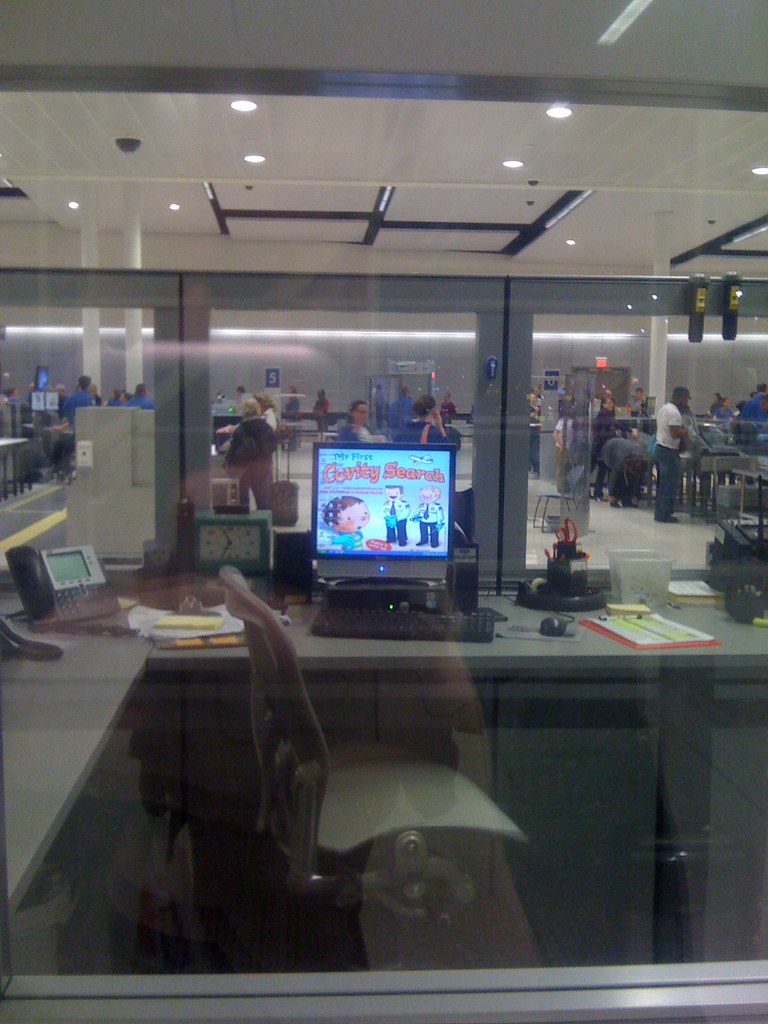
Book for kids: My First Cavity Search. Cover seen at at TSA checkpoint.
T-shirts: one, two, and three and four. “Comply with Me” song parody. Political cartoons: one, two, three, and four. New TSA logo. Best TSA tweets, including “It’s not a grope. It’s a freedom pat.”
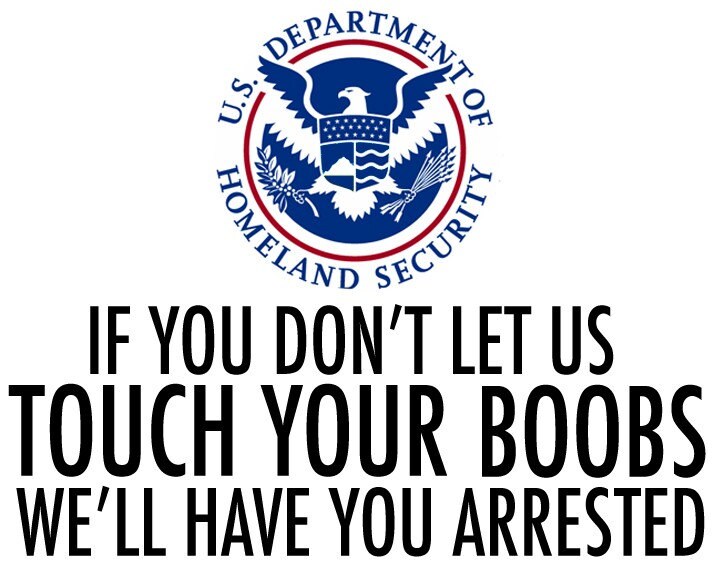
Good essay from a libertarian perspective. Two more. Marc Rotenberg’s essay. Ralph Nader’s essay. And the Los Angeles Times really screws up with this editorial: “Shut Up and Be Scanned.” Amitai Etzioni makes a better case for the machines.

Michael Chertoff, former Department of Homeland Security secretary, has been touting the full-body scanners, while at the same time maintaining a financial interest in the company that makes them.

There’s talk about the health risks of the machines, but I can’t believe you won’t get more radiation on the flight. Here’s some data:

A typical dental X-ray exposes the patient to about 2 millirems of radiation. According to one widely cited estimate, exposing each of 10,000 people to one rem (that is, 1,000 millirems) of radiation will likely lead to 8 excess cancer deaths. Using our assumption of linearity, that means that exposure to the 2 millirems of a typical dental X-ray would lead an individual to have an increased risk of dying from cancer of 16 hundred-thousandths of one percent. Given that very small risk, it is easy to see why most rational people would choose to undergo dental X-rays every few years to protect their teeth.

More importantly for our purposes, assuming that the radiation in a backscatter X-ray is about a hundredth the dose of a dental X-ray, we find that a backscatter X-ray increases the odds of dying from cancer by about 16 ten millionths of one percent. That suggests that for every billion passengers screened with backscatter radiation, about 16 will die from cancer as a result.

Given that there will be 600 million airplane passengers per year, that makes the machines deadlier than the terrorists.

Nate Silver on the hidden cost of these new airport security measures.

According to the Cornell study, roughly 130 inconvenienced travelers died every three months as a result of additional traffic fatalities brought on by substituting ground transit for air transit. That’s the equivalent of four fully-loaded Boeing 737s crashing each year.

Jeffrey Goldberg asked me which I would rather see for children: backscatter X-ray or enhanced pat down. After remarking what an icky choice it was, I opted for the X-ray; it’s less traumatic.

Here are a bunch of leaked body scans. They’re not from airports, but they should make you think twice before accepting the TSA’s assurances that the images will never be saved. RateMyBackscatter.com.

November 24 is National Opt Out Day. Doing this just before the Thanksgiving holiday is sure to clog up airports. Jeffrey Goldberg suggests that men wear kilts, commando style if possible.

At least one airport is opting out of the TSA entirely. I hadn’t known you could do that.

The New York Times on the protests.

Common sense from the Netherlands:

The security boss of Amsterdam’s Schiphol Airport is calling for an end to endless investment in new technology to improve airline security.

Marijn Ornstein said: “If you look at all the recent terrorist incidents, the bombs were detected because of human intelligence not because of screening … If even a fraction of what is spent on screening was invested in the intelligence services we would take a real step toward making air travel safer and more pleasant.”

And here’s Rafi Sela, former chief security officer of the Israel Airport Authority:

A leading Israeli airport security expert says the Canadian government has wasted millions of dollars to install “useless” imaging machines at airports across the country.

“I don’t know why everybody is running to buy these expensive and useless machines. I can overcome the body scanners with enough explosives to bring down a Boeing 747,” Rafi Sela told parliamentarians probing the state of aviation safety in Canada.

“That’s why we haven’t put them in our airport,” Sela said, referring to Tel Aviv’s Ben Gurion International Airport, which has some of the toughest security in the world.

They can be fooled by creased clothing. And remember this German video?

I’m quoted in the Los Angeles Times:

Some experts argue the new procedures could make passengers uncomfortable without providing a substantial increase in security. “Security measures that just force the bad guys to change tactics and targets are a waste of money,” said Bruce Schneier, a security expert who works for British Telecom. “It would be better to put that money into investigations and intelligence.”

I’m quoted in The Wall Street Journal twice—once as saying:

“All these machines require you to guess the plot correctly. If you don’t, then they are completely worthless,” said Bruce Schneier, a security expert.

Mr. Schneier and some other experts argue that assembling better intelligence on fliers is the key to making travel safer.

and once as saying:

Security guru Bruce Schneier, a plaintiff in the scanner suit, calls this “magical thinking . . . Descend on what the terrorists happened to do last time, and we’ll all be safe. As if they won’t think of something else.”

In 2005, I wrote:

I’m not impressed with this security trade-off. Yes, backscatter X-ray machines might be able to detect things that conventional screening might miss. But I already think we’re spending too much effort screening airplane passengers at the expense of screening luggage and airport employees…to say nothing of the money we should be spending on non-airport security.

On the other side, these machines are expensive and the technology is incredibly intrusive. I don’t think that people should be subjected to strip searches before they board airplanes. And I believe that most people would be appalled by the prospect of security screeners seeing them naked.

I believe that there will be a groundswell of popular opposition to this idea. Aside from the usual list of pro-privacy and pro-liberty groups, I expect fundamentalist Christian groups to be appalled by this technology. I think we can get a bevy of supermodels to speak out against the invasiveness of the search.

On the other hand, CBS News is reporting that 81% of Americans support full-body scans. Maybe they should only ask flying Americans.

I still stand by this, also from 2005:

Exactly two things have made airline travel safer since 9/11: reinforcement of cockpit doors, and passengers who now know that they may have to fight back. Everything else—Secure Flight and Trusted Traveler included—is security theater. We would all be a lot safer if, instead, we implemented enhanced baggage security—both ensuring that a passenger’s bags don’t fly unless he does, and explosives screening for all baggage—as well as background checks and increased screening for airport employees.

Then we could take all the money we save and apply it to intelligence, investigation and emergency response. These are security measures that pay dividends regardless of what the terrorists are planning next, whether it’s the movie plot threat of the moment, or something entirely different.

And this, written in 2010 after the Underwear Bomber failed:

Finally, we need to be indomitable. The real security failure on Christmas Day was in our reaction. We’re reacting out of fear, wasting money on the story rather than securing ourselves against the threat. Abdulmutallab succeeded in causing terror even though his attack failed.

If we refuse to be terrorized, if we refuse to implement security theater and remember that we can never completely eliminate the risk of terrorism, then the terrorists fail even if their attacks succeed.

See these two essays of mine as well, from the same time.

More resources on the EPIC pages.

What else is going on?

EDITED TO ADD: (11/19): Lots more political cartoons.

Good summary of your legal rights and options from the ACLU. They also have a form you can fill out and send to your Congresscritter.

This has to win for DHS Quote of the Year, from Secretary Janet Napolitano on the issue:

I really want to say, look, let’s be realistic and use our common sense.

The TSA doesn’t train its screeners very well. A response to a letter-writer from Sen. Coburn. From Slate: "Does the TSA Ever Catch Terrorists?" A pilot’s story. The screeners’ point of view. Good essay from the National Post.

Fun with the Playmobil airline security screening playset.

Meg McLain, whose horrific story I linked to above, lied. Here’s an interview with her.

EDITED TO ADD (11/20): I was interviewed by Popular Mechanics.

Woman forced to remove prosthetic breast. TSO officer caught saying “heads up, got a cutie for you” into his headset to the other officers. Complication news video of TSA behavior.

Here’s an alert you can hand out to passengers at security checkpoints where there are backscatter machines.

EDITED TO ADD (11/21): Me in an Associated Press piece on the anti-TSA backlash:

“After 9/11 people were scared and when people are scared they’ll do anything for someone who will make them less scared,” said Bruce Schneier, a Minneapolis security technology expert who has long been critical of the TSA. “But … this is particularly invasive. It’s strip-searching. It’s body groping. As abhorrent goes, this pegs it.”

President Obama comments:

“I understand people’s frustrations, and what I’ve said to the TSA is that you have to constantly refine and measure whether what we’re doing is the only way to assure the American people’s safety. And you also have to think through are there other ways of doing it that are less intrusive,” Obama said.

“But at this point, TSA in consultation with counterterrorism experts have indicated to me that the procedures that they have been putting in place are the only ones right now that they consider to be effective against the kind of threat that we saw in the Christmas Day bombing.”

TSA sendup on Saturday Night Live yesterday.

EDITED TO ADD (11/22): The thing about Muslim women being exempt seems to be based on a misreading of this press release. What they seem to be saying is that if you’re selected because you could have something under your hijab, then they only need to just pat down the area the hijab covers. It’s not a special exemption.

TSA Administrator John Pistole comments:

We are constantly evaluating and adapting our security measures, and as we have said from the beginning, we are seeking to strike the right balance between privacy and security. In all such security programs, especially those that are applied nation-wide, there is a continual process of refinement and adjustment to ensure that best practices are applied and that feedback and comment from the traveling public is taken into account.

EDITED TO ADD (11/23): Fantastic infographic. Excellent poster image. This, too. And another political cartoon.

Yesterday I participated in a New York Times “Room for Debate” discussion on airline security. My contribution is nothing I haven’t said before, so I won’t reprint it here. The other participants are worth reading too.

More from Nate Silver, on public opinion and the likely TSA reaction:

It is perhaps foolish to predict how the T.S.A. will respond this time—when they have relaxed rules in the past, they have done so quietly, rather than in response to some acute public backlash. But caution aside, I would be surprised if the new procedures survived much past the New Year without significant modification.

CNN’s advice to the public.

Things are definitely strained out there:

Through a statement released by his attorney Sunday night, Wolanyk said “TSA needs to see that I’m not carrying any weapons, explosives, or other prohibited substances, I refuse to have images of my naked body viewed by perfect strangers, and having been felt up for the first time by TSA the week prior (I travel frequently) I was not willing to be molested again.”

Wolanyk’s attorney said that TSA requested his client put his clothes on so he could be patted down properly but his client refused to put his clothes back on. He never refused a pat down, according to his attorney. Wolanyk was arrested for refusing to complete the security process.

From the same article:

A woman, identified by Harbor police as Danielle Kelli Hayman,39, of San Diego was detained for recording the incident on a phone.

That’s much more worrying.

Interview with Brian Michael Jenkins, a senior advisor at the RAND Corp. and a former member of the White House Commission on Aviation Safety and Security.

Here’s someone who managed to avoid both the full-body scanners and the enhanced pat down. It took him two and a half hours. And here someone who got patted down, and managed to sneak two razor blades through security anyway.

How the TSA will deal with people with disabilities. How the pat downs affect survivors of sexual assault. (Read also the comments here.) Juan Cole on how airport security has shifted from looking for people with guns and traditional bombs to looking for people with PETN. And TSA-proof underwear.

EDITED TO ADD (11/24): Information on the health risks of the backscatter machines. And here’s a woman who stripped down to her underwear before going through airport security. This comes from a perspective I generally don’t buy, but it’s hard to dismiss his writing. I don’t think it’s a conspiracy, but I do think it’s a trend. “This Modern World” has a comic on the topic. Slate on the lack of guidelines. Why the TSA should be privatized.

EDITED TO ADD (11/25): I was on Keith Olbermann last night.

Posted on November 19, 2010 at 5:37 AMView Comments

The End of In-Flight Wi-Fi?

Okay, now the terrorists have really affected me personally: they’re forcing us to turn off airplane Wi-Fi. No, it’s not that the Yemeni package bombs had a Wi-Fi triggering mechanism—they seem to have had a cell phone triggering mechanism, dubious at best—but we can imagine an Internet-based triggering mechanism. Put together a sloppy and unsuccessful package bomb with an imagined triggering mechanism, and you have a new and dangerous threat that—even though it was a threat ever since the first airplane got Wi-Fi capability—must be immediately dealt with right now.

Please, let’s not ever tell the TSA about timers. Or altimeters.

And, while we’re talking about the TSA, be sure to opt out of the full-body scanners and remember your sense of humor when a TSA officer slips white powder into your suitcase and then threatens you with arrest.

EDITED TO ADD (11/8): We’re banning toner cartridges over 16 ounces.

Additionally, toner and ink cartridges that are over 16 ounces will be banned from all U.S. passenger flights and planes heading to the United States, she said. That ban will also apply to some air cargo shipments.

Other new rules include:

  • International mail packages sent to the U.S. must be screened individually and certified to have come from an established postal shipper;
  • Cargo shippers, such as UPS, Federal Express, and DHL, have been encouraged to report cargo manifests to Homeland Security faster, prior to departure, to aid in identifying risky cargo based on current intelligence.

There’s some impressive magical thinking going on here.

Posted on November 8, 2010 at 10:21 AMView Comments

Halloween and the Irrational Fear of Stranger Danger

From the Wall Street Journal:

Take “stranger danger,” the classic Halloween horror. Even when I was a kid, back in the “Bewitched” and “Brady Bunch” costume era, parents were already worried about neighbors poisoning candy. Sure, the folks down the street might smile and wave the rest of the year, but apparently they were just biding their time before stuffing us silly with strychnine-laced Smarties.

That was a wacky idea, but we bought it. We still buy it, even though Joel Best, a sociologist at the University of Delaware, has researched the topic and spends every October telling the press that there has never been a single case of any child being killed by a stranger’s Halloween candy. (Oh, yes, he concedes, there was once a Texas boy poisoned by a Pixie Stix. But his dad did it for the insurance money. He was executed.)

Anyway, you’d think that word would get out: poisoned candy not happening. But instead, most Halloween articles to this day tell parents to feed children a big meal before they go trick-or-treating, so they won’t be tempted to eat any candy before bringing it home for inspection.

[…]

Then along came new fears. Parents are warned annually not to let their children wear costumes that are too tight—those could seriously restrict breathing! But not too loose either—kids could trip! Fall! Die!

Treating parents like idiots who couldn’t possibly notice that their kid is turning blue or falling on his face might seem like a losing proposition, but it caught on too.

Halloween taught marketers that parents are willing to be warned about anything, no matter how preposterous, and then they’re willing to be sold whatever solutions the market can come up with. Face paint so no mask will obscure a child’s vision. Purell, so no child touches a germ. And the biggest boondoggle of all: an adult-supervised party, so no child encounters anything exciting, er, “dangerous.”

I remember one year when I filled a few Pixie Stix with garlic powder. But that was a long time ago.

EDITED TO ADD (11/2): Interesting essay:

The precise methods of the imaginary Halloween sadist are especially interesting. Apples and home goods occasionally appear in the stories, but the most common culprit is regular candy. This crazed person would purchase candy, open the wrapper, and DO SOMETHING to it, something that would be designed to hurt the unsuspecting child. But also something that would be sufficiently obvious and clumsy that the vigilant parent could spot it (hence the primacy of candy inspection).

The idea that someone, even a greedy child, might consume candies hiding razor blades and needles without noticing seems to strain credulity. And how, exactly, a person might go about coating a jelly bean with arsenic or lacing a molasses chew with Drano has never been clear to me. Yet it is an undisputed fact of Halloween hygiene: Unwrapped candy is the number-one suspect. If Halloween candy is missing a wrapper, or if the wrapper seems loose or flimsy, the candy goes straight into the trash.

Here is where I think we can discover some deeper meanings in the myth of the Halloween sadist. It’s all about the wrappers.

Wrappers are like candy condoms: Safe candy is candy that is covered and sealed. And not just any wrapper will do. Loose, casual, cheap wrappers, the kind of wrappers one might find on locally produced candies or non-brand-name candies, are also liable to send candy to Halloween purgatory. The close, tight factory wrapper says “sealed for your protection.” And the recognized brand name on the wrapper also lends a reassuring aura of corporate responsibility and accountability. It’s a basic axiom of consumer faith: The bigger the brand, the safer the candy.

Ironic, since we know that the most serious food dangers are those that originate from just the kind of large-scale industrial food processing environments that also bring us name-brand, mass-market candies. Salmonella, E. coli, and their bacterial buddies lurking in bagged salads and pre-formed hamburger patties are real food dangers; home-made cookies laced with ground glass are not.

EDITED TO ADD (11/11): Wondermark comments.

Posted on October 31, 2010 at 10:02 AMView Comments

Security Theater on the Boston T

Since a fatal crash a few years ago, Boston T (their subway) operators have been forbidden from using—or even having—cell phones while on the job. Passengers are encouraged to report violators. But sometimes T operators need to use their official radios on the job, and passengers can’t tell the difference. The solution: orange tape:

The solution? Goodbye, sober black; hello, bright orange, a hue so vivid that, MBTA officials hope, no one will mistake the radios for phones anymore. Workers at the agency’s car barns and garages are in the process of outfitting every handset in the fleet with strips of reflective tape emblazoned with T logos.

[…]

… a small but steady number of hot line tips have been found to be cases of drivers or operators communicating with dispatch by radio, according to video and operations-center call logs.

That is where the electric-orange tape should help, Davey said. Over the past two months, the tape has been applied to handheld radios on about 95 percent of the T’s 1,050 buses (each of which has one handset) and one-fourth of its nearly 210 double-ended Green Line trolleys, which have handsets at each end. The rest of the Green Line and the Orange, Blue, and Red line radios will follow.

Taisha O’Bryant, a Roxbury resident who serves as chairwoman of the T Riders Union, said she is more concerned with the frequency and reliability of bus service than the appearance of bus radios. But she said it is a good thing if a driver or operator can call dispatch in the event of a breakdown or service problem without worrying about appearing to talk on a cellphone, and she hailed the cellphone ban.

Of course, no T operator would ever think of putting bright orange tape on his cell phone. Because if he did that, the passengers would immediately know not to report him.

Posted on August 30, 2010 at 5:31 AMView Comments

"The Fear Tax"

Good essay by Seth Godin:

We pay the fear tax every time we spend time or money seeking reassurance. We pay it twice when the act of seeking that reassurance actually makes us more anxious, not less.

We pay the tax when we cover our butt instead of doing the right thing, and we pay the tax when we take away someone’s dignity because we’re afraid.

We should quantify the tax. The government should publish how much of our money they’re spending to create fear and then spending to (apparently) address fear. Corporations should add to their annual reports how much they spent just-in-case. Once we know how much it costs, we can figure out if it’s worth it.

Posted on August 18, 2010 at 3:48 PMView Comments

Book Review: How Risky Is It, Really?

David Ropeik is a writer and consultant who specializes in risk perception and communication. His book, How Risky Is It, Really?: Why Our Fears Don’t Always Match the Facts, is a solid introduction to the biology, psychology, and sociology of risk. If you’re well-read on the topic already, you won’t find much you didn’t already know. But if this is a new topic for you, or if you want a well-organized guide to the current research on risk perception all in one place, this pretty close to the perfect book.

Ropeik builds his model of human risk perception from the inside out. Chapter 1 is about fear, our largely subconscious reaction to risk. Chapter 2 discusses bounded rationality, the cognitive shortcuts that allow us to efficiently make risk trade-offs. Chapter 3 discusses some of the common cognitive biases we have that cause us to either overestimate or underestimate risk: trust, control, choice, natural vs. man-made, fairness, etc.—thirteen in all. Finally, Chapter 4 discusses the sociological aspects of risk perception: how our estimation of risk depends on that of the people around us.

The book is primarily about how we humans get risk wrong: how our perception of risk differs from the reality of risk. But Ropeik is careful not to use the word “wrong,” and repeatedly warns us not to do it. Risk perception is not right or wrong, he says; it simply is. I don’t agree with this. There is both a feeling and reality of risk and security, and when they differ, we make bad security trade-offs. If you think your risk of dying in a terrorist attack, or of your children being kidnapped, is higher than it really is, you’re going to make bad security trade-offs. Yes, security theater has its place, but we should try to make that place as small as we can.

In Chapter 5, Ropeik tries his hand at solutions to this problem: “closing the perception gap” is how he puts it; reducing the difference between the feeling of security and the reality is how I like to explain it. This is his weakest chapter, but it’s also a very hard problem. My writings along this line are similarly weak. Still, his ideas are worth reading and thinking about.

I don’t have any other complaints with the book. Ropeik nicely balances readability with scientific rigor, his examples are interesting and illustrative, and he is comprehensive without being boring. Extensive footnotes allow the reader to explore the actual research behind the generalities. Even though I didn’t learn much from reading it, I enjoyed the ride.

How Risky Is It, Really? is available in hardcover and for the Kindle. Presumably a paperback will come out in a year or so. Ropeik has a blog, although he doesn’t update it much.

Posted on August 2, 2010 at 6:38 AMView Comments

Popsicle Makers a Security Threat

Chicago chef Rick Bayless photographed this security sign, posted before airport security as people were returning home from the Aspen Food & Wine Festival:

No popsicle makers are allowed through security.

Anyone have any idea why something like this is so dangerous? Is the TSA prohibiting random things to toy with us? Their blog is silent on this question.

EDITED TO ADD (6/23): Seems that it’s not all popsicle makers, but the Zoku Quick Pop Maker that Williams Sonoma was selling at the festival. It has a small amount of liquid inside. And remember, if there isn’t a printed label stating the volume of liquid, the TSA assumes that it’s over 3 ounces. (Terrorists take note: print official looking labels on your larger-than-three-ounce bottles and you’ll have no trouble at airport security.)

Posted on June 23, 2010 at 1:16 PMView Comments

New York and the Moscow Subway Bombing

People intent on preventing a Moscow-style terrorist attack against the New York subway system are proposing a range of expensive new underground security measures, some temporary and some permanent.

They should save their money – and instead invest every penny they’re considering pouring into new technologies into intelligence and old-fashioned policing.

Intensifying security at specific stations only works against terrorists who aren’t smart enough to move to another station. Cameras are useful only if all the stars align: The terrorists happen to walk into the frame, the video feeds are being watched in real time and the police can respond quickly enough to be effective. They’re much more useful after an attack, to figure out who pulled it off.

Installing biological and chemical detectors requires similarly implausible luck – plus a terrorist plot that includes the specific biological or chemical agent that is being detected.

What all these misguided reactions have in common is that they’re based on “movie-plot threats”: overly specific attack scenarios. They fill our imagination vividly, in full color with rich detail. Before long, we’re envisioning an entire story line, with or without Bruce Willis saving the day. And we’re scared.

It’s not that movie-plot threats are not worth worrying about. It’s that each one – Moscow’s subway attack, the bombing of the Oklahoma City federal building, etc. – is too specific. These threats are infinite, and the bad guys can easily switch among them.

New York has thousands of possible targets, and there are dozens of possible tactics. Implementing security against movie-plot threats is only effective if we correctly guess which specific threat to protect against. That’s unlikely.

A far better strategy is to spend our limited counterterrorism resources on investigation and intelligence – and on emergency response. These measures don’t hinge on any specific threat; they don’t require us to guess the tactic or target correctly. They’re effective in a variety of circumstances, even nonterrorist ones.

The result may not be flashy or outwardly reassuring – as are pricey new scanners in airports. But the strategy will save more lives.

The 2006 arrest of the liquid bombers – who wanted to detonate liquid explosives to be brought onboard airliners traveling from England to North America – serves as an excellent example. The plotters were arrested in their London apartments, and their attack was foiled before they ever got to the airport.

It didn’t matter if they were using liquids or solids or gases. It didn’t even matter if they were targeting airports or shopping malls or theaters. It was a straightforward, although hardly simple, matter of following leads.

Gimmicky security measures are tempting – but they’re distractions we can’t afford. The Christmas Day bomber chose his tactic because it would circumvent last year’s security measures, and the next attacker will choose his tactic – and target – according to similar criteria. Spend money on cameras and guards in the subways, and the terrorists will simply modify their plot to render those countermeasures ineffective.

Humans are a species of storytellers, and the Moscow story has obvious parallels in New York. When we read the word “subway,” we can’t help but think about the system we use every day. This is a natural response, but it doesn’t make for good public policy. We’d all be safer if we rose above the simple parallels and the need to calm our fears with expensive and seductive new technologies – and countered the threat the smart way.

This essay originally appeared in the New York Daily News.

Posted on April 7, 2010 at 8:52 AMView Comments

Jeremy Clarkson on Security Guards

Nice essay:

Of course, we know why he’s really there. He’s really there so that if the bridge is destroyed by terrorists, the authorities can appear on the television news and say they had taken all possible precautions. Plus, if you employ a security guard, then I should imagine that your insurance premiums are going to be significantly lower.

This is probably why so many companies use security guards these days. It must be, because when it comes to preventing a crime, they are pretty much useless. No, really. If you are planning a heist, job one on the list of things to do is “take out the guard”. He is therefore not an impenetrable wall of steel; he’s just a nuisance.

And he’s not just a nuisance to the people planning to hit him on the head. He’s also a nuisance to the thousands of people who legitimately wish to enter or leave the building he’s supposed to be guarding.

At the office where I work, everyone is issued with laminated photo-ID cards that open all the barriers and doors. It is quite impossible to make any sort of progress unless you have such a thing about your person. But even so, every barrier and door is also guarded by a chap who, in a fight, would struggle to beat Christopher Robin. One looks like his heart would give out if you said “boo.” Another has a face that’s so grey that, in some lights, he appears to be slightly lilac. I cannot for the life of me work out what these people are supposed to achieve, apart from making the lives of normal people a little bit more difficult.

EDITED TO ADD (4/13): Another Clarkson essay, this one on security theater.

Posted on March 30, 2010 at 6:06 AM

1 5 6 7 8 9 21

Sidebar photo of Bruce Schneier by Joe MacInnis.