Interview with Me
I was interviewed on chomp.fm.
Page 28 of 46
I was interviewed on chomp.fm.
Humans have a natural propensity to trust non-kin, even strangers. We do it so often, so naturally, that we don’t even realize how remarkable it is. But except for a few simplistic counterexamples, it’s unique among life on this planet. Because we are intelligently calculating and value reciprocity (that is, fairness), we know that humans will be honest and nice: not for any immediate personal gain, but because that’s how they are. We also know that doesn’t work perfectly; most people will be dishonest some of the time, and some people will be dishonest most of the time. How does society—the honest majority—prevent the dishonest minority from taking over, or ruining society for everyone? How is the dishonest minority kept in check? The answer is security—in particular, something I’m calling societal security.
I want to divide security into two types. The first is individual security. It’s basic. It’s direct. It’s what normally comes to mind when we think of security. It’s cops vs. robbers, terrorists vs. the TSA, Internet worms vs. firewalls. And this sort of security is as old as life itself or—more precisely—as old as predation. And humans have brought an incredible level of sophistication to individual security.
Societal security is different. At the tactical level, it also involves attacks, countermeasures, and entire security systems. But instead of A vs. B, or even Group A vs. Group B, it’s Group A vs. members of Group A. It’s security for individuals within a group from members of that group. It’s how Group A protects itself from the dishonest minority within Group A. And it’s where security really gets interesting.
There are many types—I might try to estimate the number someday—of societal security systems that enforce our trust of non-kin. They’re things like laws prohibiting murder, taxes, traffic laws, pollution control laws, religious intolerance, Mafia codes of silence, and moral codes. They enable us to build a society that the dishonest minority can’t exploit and destroy. Originally, these security systems were informal. But as society got more complex, the systems became more formalized, and eventually were embedded into technologies.
James Madison famously wrote: “If men were angels, no government would be necessary.” Government is just the beginning of what wouldn’t be necessary. Currency, that paper stuff that’s deliberately made hard to counterfeit, wouldn’t be necessary, as people could just keep track of how much money they had. Angels never cheat, so nothing more would be required. Door locks, and any barrier that isn’t designed to protect against accidents, wouldn’t be necessary, since angels never go where they’re not supposed to go. Police forces wouldn’t be necessary. Armies: I suppose that’s debatable. Would angels—not the fallen ones—ever go to war against one another? I’d like to think they would be able to resolve their differences peacefully. If people were angels, every security measure that isn’t designed to be effective against accident, animals, forgetfulness, or legitimate differences between scrupulously honest angels could be dispensed with.
Security isn’t just a tax on the honest; it’s a very expensive tax on the honest. It’s the most expensive tax we pay, regardless of the country we live in. If people were angels, just think of the savings!
It wasn’t always like this. Security—especially societal security—used to be cheap. It used to be an incidental cost of society.
In a primitive society, informal systems are generally good enough. When you’re living in a small community, and objects are both scarce and hard to make, it’s pretty easy to deal with the problem of theft. If Alice loses a bowl, and at the same time, Bob shows up with an identical bowl, everyone knows Bob stole it from Alice, and the community can then punish Bob as it sees fit. But as communities get larger, as social ties weaken and anonymity increases, this informal system of theft prevention—detection and punishment leading to deterrence—fails. As communities get more technological and as the things people might want to steal get more interchangeable and harder to identify, it also fails. In short, as our ancestors made the move from small family groups to larger groups of unrelated families, and then to a modern form of society, the informal societal security systems started failing and more formal systems had to be invented to take their place. We needed to put license plates on cars and audit people’s tax returns.
We had no choice. Anything larger than a very primitive society couldn’t exist without societal security.
I’m writing a book about societal security. I will discuss human psychology: how we make security trade-offs, why we routinely trust non-kin (an evolutionary puzzle, to be sure), how the majority of us are honest, and that a minority of us are dishonest. That dishonest minority are the free riders of societal systems, and security is how we protect society from them. I will model the fundamental trade-off of societal security—individual self-interest vs. societal group interest—as a group prisoner’s dilemma problem, and use that metaphor to examine the basic mechanics of societal security. A lot falls out of this: free riders, the Tragedy of the Commons, the subjectivity of both morals and risk trade-offs.
Using this model, I will explore the security systems that protect—and fail to protect—market economics, corporations and other organizations, and a variety of national systems. I think there’s a lot we can learn about security by applying the prisoner’s dilemma model, and I’ve only recently started. Finally, I want to discuss modern changes to our millennia-old systems of societal security. The Information Age has changed a number of paradigms, and it’s not clear that our old security systems are working properly now or will work in the future. I’ve got a lot of work to do yet, and the final book might look nothing like this short outline. That sort of thing happens.
Tentative title: The Dishonest Minority: Security and its Role in Modern Society. I’ve written several books on the how of security. This book is about the why of security.
I expect to finish my first draft before Summer. Throughout 2011, expect to see bits from the book here. They might not make sense as a coherent whole at first—especially because I don’t write books in strict order—but by the time the book is published, it’ll all be part of a coherent and (hopefully) compelling narrative.
And if I write fewer extended blog posts and essays in the coming year, you’ll know why.
I haven’t written anything about the suicide bombing at Moscow’s Domodedovo Airport because I didn’t think there was anything to say. The bomber was outside the security checkpoint, in the area where family and friends wait for arriving passengers. From a security perspective, the bombing had nothing to do with airport security. He could have just as easily been in a movie theater, stadium, shopping mall, market, or anywhere else lots of people are crowded together with limited exits. The large death and injury toll indicates the bomber chose his location well.
I’ve often written that security measures that are only effective if the implementers guess the plot correctly are largely wastes of money—at best they would have forced this bomber to choose another target—and that our best security investments are intelligence, investigation, and emergency response. This latest terrorist attack underscores that even more. “Critics say” that the TSA couldn’t have detected this sort of attack. Of course; the TSA can’t be everywhere. And that’s precisely the point.
Many reporters asked me about the likely U.S. reaction. I don’t know; it could range from “Moscow is a long way off and that doesn’t concern us” to “Oh my god we’re all going to die!” The worry, of course, is that we will need to “do something,” even though there is no “something” that should be done.
I was interviewed by the Esquire politics blog about this. I’m not terribly happy with the interview; I was rushed and sloppy on the phone.
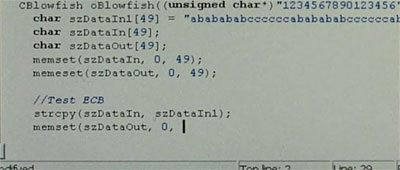
This screen shot is from the movie “Good Time Max.” 17 minutes and 52 seconds into the movie, it shows Blowfish being used as an encryption algorithm.
Last week, I spoke at an airport security conference hosted by EPIC: The Stripping of Freedom: A Careful Scan of TSA Security Procedures. Here’s the video of my half-hour talk.
Yesterday, NIST announced the five hash functions to advance to the third (and final) round in the SHA-3 selection process: BLAKE, Grøstl, JH, Keccak, and Skein. Not really a surprise; my predictions—which I did not publish—listed ECHO instead of JH, but correctly identified the other four. (Most of the predictions I saw guessed BLAKE, Grøstl, Keccak, and Skein, but differed on the fifth.)
NIST will publish a report that explains its rationale for selecting the five it did.
Next is the Third SHA-3 Candidate Conference, which will probably be held in March 2012 in Washington, DC, in conjunction with FSE 2012. NIST will then pick a single algorithm to become SHA-3.
More information about Skein and the SHA-3 selection process, including lots of links, is here. Version 1.3 of the Skein paper, which discusses the new constant to defeat the Khovratovich-Nikolié-Rechberger attack, is here (description of the tweak here). And there’s this new analysis of Skein.
And if you ordered a Skein polo shirt in September, they’ve been shipped.
Yesterday I participated in a New York Times “Room for Debate” discussion on airline security. My contribution is nothing I haven’t said before, so I won’t reprint it here.
A short history of airport security: We screen for guns and bombs, so the terrorists use box cutters. We confiscate box cutters and corkscrews, so they put explosives in their sneakers. We screen footwear, so they try to use liquids. We confiscate liquids, so they put PETN bombs in their underwear. We roll out full-body scanners, even though they wouldn’t have caught the Underwear Bomber, so they put a bomb in a printer cartridge. We ban printer cartridges over 16 ounces—the level of magical thinking here is amazing—and they’re going to do something else.
This is a stupid game, and we should stop playing it.
The other participants are worth reading, too.
I also did an interview in—of all places—Popular Mechanics.
Last week, I gave a talk on cyberwar and cyberconflict at the Institute for International and European Affairs in Dublin. Here’s the video.
It was only the second time I’ve given the talk. About three quarters in, I noticed that I didn’t have my fourth and final page of notes. So if the ending feels a bit scattered, that’s why.
Saturday, I visited Bletchley Park to speak at the Annual ACCU Security Fundraising Conference. They had a stellar line of speakers this year, and I was pleased to be a part of the day.
Talk #1: “The Art of Forensic Warfare,” Andy Clark. Riffing on Sun Tzu’s The Art of War, Clark discussed the war—the back and forth—between cyber attackers and cyber forensics. This isn’t to say that we’re at war, but today’s attacker tactics are increasingly sophisticated and warlike. Additionally, the pace is greater, the scale of impact is greater, and the subjects of attack are broader. To defend ourselves, we need to be equally sophisticated and—possibly—more warlike.
Clark drew parallels from some of the chapters of Sun Tzu’s book combined with examples of the work at Bletchley Park. Laying plans: when faced with an attacker—especially one of unknown capabilities, tactics, and motives—it’s important to both plan ahead and plan for the unexpected. Attack by stratagem: increasingly, attackers are employing complex and long-term strategies; defenders need to do the same. Energy: attacks increasingly start off simple and get more complex over time; while it’s easier to defect primary attacks, secondary techniques tend to be more subtle and harder to detect. Terrain: modern attacks take place across a very broad range of terrain, including hardware, OSs, networks, communication protocols, and applications. The business environment under attack is another example of terrain, equally complex. The use of spies: not only human spies, but also keyloggers and other embedded eavesdropping malware. There’s a great World War II double-agent story about Eddie Chapman, codenamed ZIGZAG.
Talk #2: “How the Allies Suppressed the Second Greatest Secret of World War II,” David Kahn. This talk is from Kahn’s article of the same name, published in the Oct 2010 issue of The Journal of Military History. The greatest secret of World War II was the atom bomb; the second greatest secret was that the Allies were reading the German codes. But while there was a lot of public information in the years after World War II about Japanese codebreaking and its value, there was almost nothing about German codebreaking. Kahn discussed how this information was suppressed, and how historians writing World War II histories never figured it out. No one imagined as large and complex an operation as Bletchley Park; it was the first time in history that something like this had ever happened. Most of Kahn’s time was spent in a very interesting Q&A about the history of Bletchley Park and World War II codebreaking.
Talk #3: “DNSSec, A System for Improving Security of the Internet Domain Name System,” Whitfield Diffie. Whit talked about three watersheds in modern communications security. The first was the invention of the radio. Pre-radio, the most common communications security device was the code book. This was no longer enough when radio caused the amount of communications to explode. In response, inventors took the research in Vigenère ciphers and automated them. This automation led to an explosion of designs and an enormous increase in complexity—and the rise of modern cryptography.
The second watershed was shared computing. Before the 1960s, the security of computers was the physical security of computer rooms. Timesharing changed that. The result was computer security, a much harder problem than cryptography. Computer security is primarily the problem of writing good code. But writing good code is hard and expensive, so functional computer security is primarily the problem of dealing with code that isn’t good. Networking—and the Internet—isn’t just an expansion of computing capacity. The real difference is how cheap it is to set up communications connections. Setting up these connections requires naming: both IP addresses and domain names. Security, of course, is essential for this all to work; DNSSec is a critical part of that.
The third watershed is cloud computing, or whatever you want to call the general trend of outsourcing computation. Google is a good example. Every organization uses Google search all the time, which probably makes it the most valuable intelligence stream on the planet. How can you protect yourself? You can’t, just as you can’t whenever you hand over your data for storage or processing—you just have to trust your outsourcer. There are two solutions. The first is legal: an enforceable contract that protects you and your data. The second is technical, but mostly theoretical: homomorphic encryption that allows you to outsource computation of data without having to trust that outsourcer.
Diffie’s final point is that we’re entering an era of unprecedented surveillance possibilities. It doesn’t matter if people encrypt their communications, or if they encrypt their data in storage. As long as they have to give their data to other people for processing, it will be possible to eavesdrop on. Of course the methods will change, but the result will be an enormous trove of information about everybody.
Talk #4: “Reconceptualizing Security,” me. It was similar to this essay and this video.
Sidebar photo of Bruce Schneier by Joe MacInnis.