Entries Tagged "DHS"

Page 15 of 39

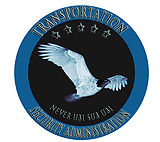
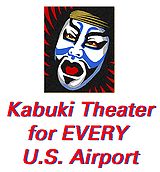
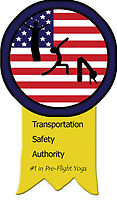
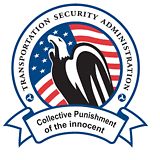
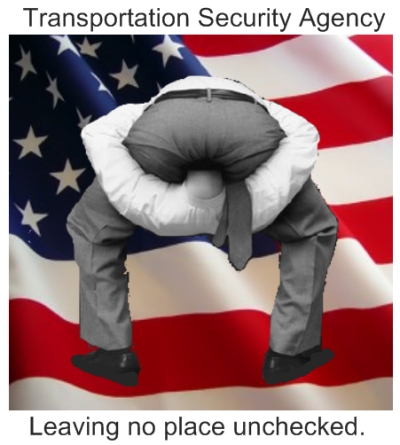
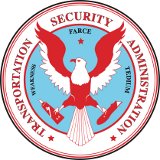
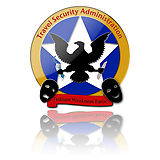
TSA Logo Contest

Over at “Ask the Pilot,” Patrick Smith has a great idea:

Calling all artists: One thing TSA needs, I think, is a better logo and a snappy motto. Perhaps there’s a graphic designer out there who can help with a new rendition of the agency’s circular eagle-and-flag motif. I’m imagining a revised eagle, its talons clutching a box cutter and a toothpaste tube. It says “Transportation Security Administration” around the top. Below are the three simple words of the TSA mission statement: “Tedium, Weakness, Farce.”

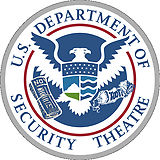
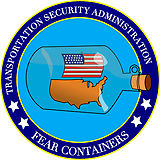
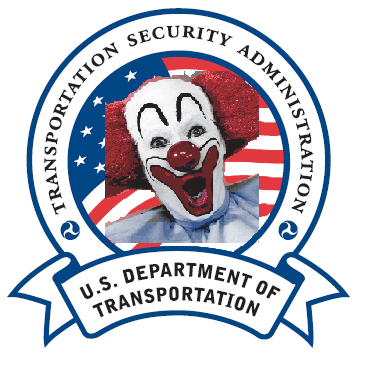
Let’s do it. I’m announcing the TSA Logo Contest. Rules are simple: create a TSA logo. People are welcome to give ideas in the comments, but only actual created logos are eligible to compete. (When my website administrator wakes up, I’ll ask him how we can post images in the comments.) Contest ends on February 6. Winner receives copies of my books, copies of Patrick Smith’s book, an empty 12-ounce bottle labeled “saline” that you can refill and get through any TSA security checkpoint, and a fake boarding pass on any flight for any date.

EDITED TO ADD (1/6): Please leave links to your submissions in the comments, and I will add them to the post. After the contest is over, I’ll choose five finalists and post them. The winner will be chosen by popular acclaim.

The Entries:

photo
Sean Flanagan
photo
Tom B
photo
Rhys Gibson
photo
Baz (1)
photo
Baz (2)
photo
Russell Nelson
photo
Kurushio
photo
Cathy
photo
Tonio Loewald
photo
I love to fly and it shows (1)
photo
Evanda
photo
Shesparticular
photo
MrJM
photo
Amy
photo
Hudsn
photo
Auximinus
photo
DS
photo
Pox Voldius
photo
I love to fly and it shows (2)
photo
Brendan McTague
photo
Andy S.
photo
Pope Noonius I
photo
Travis McHale
photo
T
photo
Matthew Williams
photo
Will Imholte


EDITED TO ADD: vote on the finalists here.

Posted on January 6, 2010 at 8:42 AMView Comments

Breaching the Secure Area in Airports

An unidentified man breached airport security at Newark Airport on Sunday, walking into the secured area through the exit, prompting the evacuation of a terminal and flight delays that continued into the next day. This isn’t common, but it happens regularly. The result is always the same, and it’s not obvious that fixing the problem is the right solution.

This kind of security breach is inevitable, simply because human guards are not perfect. Sometimes it’s someone going in through the out door, unnoticed by a bored guard. Sometimes it’s someone running through the checkpoint and getting lost in the crowd. Sometimes it’s an open door that should be locked. Amazing as it seems to frequent fliers, the perpetrator often doesn’t even know he did anything wrong.

Basically, whenever there is—or could be—an unscreened person lost within the secure area of an airport, there are two things the TSA can do. They can say “this isn’t a big deal,” and ignore it. Or they can evacuate everyone inside the secure area, search every nook and cranny—inside the large boxes of napkins at the fast food restaurant, above the false ceilings in the bathrooms, everywhere—looking for anyone hiding or anything anyone hid, and then rescreen everybody: causing delays of six, eight, twelve, or more hours. That’s it; those are the options. And there’s no way someone in charge will choose to ignore the risk; even if the odds of a terrorist exploit are minuscule, it’ll cost him his career if he’s wrong.

Several European airports have their security screening organized differently. At Schipol Airport in Amsterdam, for example, passengers are screened at the gates. This is more expensive and requires a substantially different airport design, but it does mean that if there is a security breach, only the gate has to be evacuated and searched, and the people rescreened.

American airports can do more to secure against this risk, but I’m reasonably sure it’s not worth it. We could double the guards to reduce the risk of inattentiveness, and redesign the airports to make this kind of thing less likely, but those are expensive solutions to an already rare problem. As much as I don’t like saying it, the smartest thing is probably to live with this occasional but major inconvenience.

This essay originally appeared on ThreatPost.com.

EDITED TO ADD (1/9): A first-person account of the chaos at Newark Airport, with observations and recommendations.

Posted on January 6, 2010 at 6:10 AMView Comments

Matt Blaze on the New "Unpredictable" TSA Screening Measures

Interesting:

“Unpredictable” security as applied to air passenger screening means that sometimes (perhaps most of the time), certain checks that might detect terrorist activity are not applied to some or all passengers on any given flight. Passengers can’t predict or influence when or whether they are be subjected to any particular screening mechanism. And so, the strategy assumes, the would-be terrorist will be forced to prepare for every possible mechanism in the TSA’s arsenal, effectively narrowing his or her range of options enough to make any serious mischief infeasible.

But terrorist organizations—especially those employing suicide bombers—have very different goals and incentives from those of smugglers, fare beaters and tax cheats. Groups like Al Qaeda aim to cause widespread disruption and terror by whatever means they can, even at great cost to individual members. In particular, they are willing and able to sacrifice—martyr—the very lives of their solders in the service of that goal. The fate of any individual terrorist is irrelevant as long as the loss contributes to terror and disruption.

Paradoxically, the best terrorist strategy (as long as they have enough volunteers) under unpredictable screening may be to prepare a cadre of suicide bombers for the least rigorous screening to which they might be subjected, and not, as the strategy assumes, for the most rigorous. Sent on their way, each will either succeed at destroying a plane or be caught, but either outcome serves the terrorists’ objective.

The problem is that catching someone under a randomized strategy creates a terrible dilemma for the authorities. What do we do when we detect a bomb-wielding terrorist whose device was discovered through the enhanced, randomly applied screening procedure?

EDITED TO ADD (1/5): In this blog post, a reader of Andrew Sullivan’s blog argues that the terrorist didn’t care if he blew the plane up or not, that he went back to his seat instead of detonating the explosive in the toilet precisely because he wanted his fellow passengers to see his attempt—just in case it failed.

Posted on January 5, 2010 at 11:41 AMView Comments

Adopting the Israeli Airport Security Model

I’ve been reading a lot recently—like this article on the Israeli airport security model, and how we should adopt more of the Israeli security model here in the U.S. This sums up the problem with that idea nicely:

On the other hand, no matter how safe or how wonderful the flying experience on El Al, it is TINY airline by U.S. standards, with only 38 aircraft, 46 destinations, and fewer than two million passengers in 2008. As near as I can tell, Cairo is their only destination in a majority Muslim country. Delta, before the Northwest merger is included, reported 449 aircraft and 375 destinations.

Ben Gurion Airport is Israel’s primary (not only) international gateway. In 2008, Ben Gurion served 11.1 million international passengers and 470,000 domestic passengers, roughly comparable to the 10 million total served at Sacramento, the airport I use most often. Amsterdam served 47.4 million total, and Detroit served 35.1 million total in 2008.

By American standards, in terms of passengers served, Ben Gurion is a busy regional airport.

Simply put, the Israeli airport security model does not scale.

EDITED TO ADD (1/7): More.

EDITED TO ADD (1/12): Interview with El Al’s former head of security.

Posted on January 5, 2010 at 7:04 AMView Comments

Christmas Bomber: Where Airport Security Worked

With all the talk about the failure of airport security to detect the PETN that the Christmas bomber sewed into his underwear—and to think I’ve been using the phrase “underwear bomber” as a joke all these years—people forget that airport security played an important role in foiling the plot.

In order to get through airport security, Abdulmutallab—or, more precisely, whoever built the bomb—had to construct a far less reliable bomb than he would have otherwise; he had to resort to a much more ineffective detonation mechanism. And, as we’ve learned, detonating PETN is actually very hard.

Additionally, I don’t think it’s fair to criticize airport security for not catching the PETN. The security systems at airports aren’t designed to catch someone strapping a plastic explosive to his body. Even more strongly: no security system, at any airport, in any country on the planet, is designed to catch someone doing this. This isn’t a surprise. It isn’t even a new idea. It wasn’t even a new idea when I said this to then TSA head Kip Hawley in 2007: “I don’t want to even think about how much C4 I can strap to my legs and walk through your magnetometers.” You can try to argue that the TSA, and other airport security organizations around the world, should have been redesigned years ago to catch this, but anyone who is surprised by this attack simply hasn’t been paying attention.

EDITED TO ADD (1/4): I don’t know what to make of this:

Ben Wallace, who used to work at defence firm QinetiQ, one of the companies making the technology, warned it was not a “big silver bullet”.

[…]

Mr Wallace said the scanners would probably not have detected the failed Detroit plane plot of Christmas Day.

He said the same of the 2006 airliner liquid bomb plot and of explosives used in the 2005 bombings of three Tube trains and a bus in London.

[…]

He said the “passive millimetre wave scanners” – which QinetiQ helped develop – probably would not have detected key plots affecting passengers in the UK in recent years.

[…]

Mr Wallace told BBC Radio 4’s Today programme: “The advantage of the millimetre waves are that they can be used at longer range, they can be quicker and they are harmless to travellers.

“But there is a big but, and the but was in all the testing that we undertook, it was unlikely that it would have picked up the current explosive devices being used by al-Qaeda.”

He added: “It probably wouldn’t have picked up the very large plot with the liquids in 2006 at Heathrow or indeed the… bombs that were used on the Tube because it wasn’t very good and it wasn’t that easy to detect liquids and plastics unless they were very solid plastics.

“This is not necessarily the big silver bullet that is somehow being portrayed by Downing Street.”

A spokeswoman for QinetiQ said “no single technology can address every eventuality or security risk”.

“QinetiQ’s passive millimetre wave system, SPO, is a… people-screening system which can identify potential security threats concealed on the human body. It is not a checkpoint security system.

“SPO can effectively shortlist people who may need further investigation, either via other technology such as x-rays, or human intervention such as a pat-down search.”

Posted on January 4, 2010 at 6:28 AMView Comments

Me and the Christmas Underwear Bomber

I spent a lot of yesterday giving press interviews. Nothing I haven’t said before, but it’s now national news and everyone wants to hear it.

These are the most interesting bits. Rachel Maddow interviewed me last night on her show. Jeffrey Goldberg interviewed me for the Atlantic website. And CNN.com published a rewrite of an older article of mine on terrorism and security.

I’ve started to call the bizarre new TSA rules “magical thinking”: if we somehow protect against the specific tactic of the previous terrorist, we make ourselves safe from the next terrorist.

EDITED TO ADD (12/29): I don’t know about this quote:

“I flew 265,000 miles last year,” said Bruce Schneier, a cryptographer and security analyst. “You know what really pisses me off? Making me check my luggage. Not letting me use my laptop, so I can’t work. Taking away my Kindle, so I can’t read. I care about those things. I care about making me safer much, much less.”

For the record, I do care about being safer. I just don’t think any of the airplane security measures proposed by the TSA accomplish that.

Posted on December 29, 2009 at 11:17 AMView Comments

Separating Explosives from the Detonator

Chechen terrorists did it in 2004. I said this in an interview with then TSA head Kip Hawley in 2007:

I don’t want to even think about how much C4 I can strap to my legs and walk through your magnetometers.

And what sort of magical thinking is behind the rumored TSA rule about keeping passengers seated during the last hour of flight? Do we really think the terrorist won’t think of blowing up their improvised explosive devices during the first hour of flight?

For years I’ve been saying this:

Only two things have made flying safer [since 9/11]: the reinforcement of cockpit doors, and the fact that passengers know now to resist hijackers.

This week, the second one worked over Detroit. Security succeeded.

EDITED TO ADD (12/26): Only one carry on? No electronics for the first hour of flight? I wish that, just once, some terrorist would try something that you can only foil by upgrading the passengers to first class and giving them free drinks.

Posted on December 26, 2009 at 5:43 PMView Comments

TSA Publishes Standard Operating Procedures

BoingBoing is pretty snarky:

The TSA has published a “redacted” version of their s00per s33kr1t screening procedure guidelines (Want to know whether to frisk a CIA operative at the checkpoint? Now you can!). Unfortunately, the security geniuses at the DHS don’t know that drawing black blocks over the words you want to eliminate from your PDF doesn’t actually make the words go away, and can be defeated by nefarious al Qaeda operatives through a complex technique known as ctrl-a/ctrl-c/ctrl-v. Thankfully, only the most elite terrorists would be capable of matching wits with the technology brilliance on display at the agency charged with defending our nation’s skies by ensuring that imaginary hair-gel bombs are kept off of airplanes.

TSA is launching a “full review” to determine how this could have happened. I’ll save them the effort: someone screwed up.

In a statement Tuesday night, the TSA sought to minimize the impact of the unintentional release—calling the document “outdated,” “unclassified” and unimplemented—while saying that it took the incident “very seriously,” and “took swift action” when it was discovered.

Yeah, right.

The original link to the document is dead, but here’s the unredacted document.

I’ve skimmed it, and haven’t found anything terribly interesting. Here’s what Wired.com noticed:

One of the redacted sections, for example, indicates that an armed law enforcement officer in or out of uniform may pass beyond the checkpoint without screening after providing a U.S. government-issued photo ID and “Notice of LEO Flying Armed Document.”

Some commercial airline pilots receive training by the U.S. Marshals Service and are allowed to carry TSA-issued firearms on planes. They can pass through without screening only after presenting “bonafide credentials and aircraft operator photo ID,” the document says.

Foreign dignitaries equivalent to cabinet rank and above, accompanying a spouse, their children under the age of 12, and a State Department escort are exempt from screening.

There are also references to a CIA program called WOMAP, the Worldwide Operational Meet and Assist Program. As part of WOMAP, foreign dignitaries and their escorts—authorized CIA representatives—are exempt from screening, provided they’re approved in advance by TSA’s Office of Intelligence.

Passengers carrying passports from Cuba, Iran, North Korea, Libya, Syria, Sudan, Afghanistan, Lebanon, Somalia, Iraq, Yemen or Algeria are to be designated for selective screening.

Although only a few portions of the document were redacted, the manual contains other tidbits that weren’t redacted, such as a thorough description of diplomatic pouches that are exempt from screening.

I’m a little bit saddened when we all make a big deal about how dumb people are at redacting digital documents. We’ve had a steady stream of these badly redacted documents, and I don’t want to lose that. I also don’t want agencies deciding not to release documents at all, rather than risk this sort of embarrassment.

EDITED TO ADD (12/10): News:

Five Transportation Security Administration employees have been placed on administrative leave after a sensitive airport security manual was posted on the Internet, the agency announced Wednesday.

EDITED TO ADD (12/12): Did the TSA compromise an intelligence program?

Posted on December 10, 2009 at 6:47 AMView Comments

1 13 14 15 16 17 39

Sidebar photo of Bruce Schneier by Joe MacInnis.