Entries Tagged "books"

Page 13 of 17

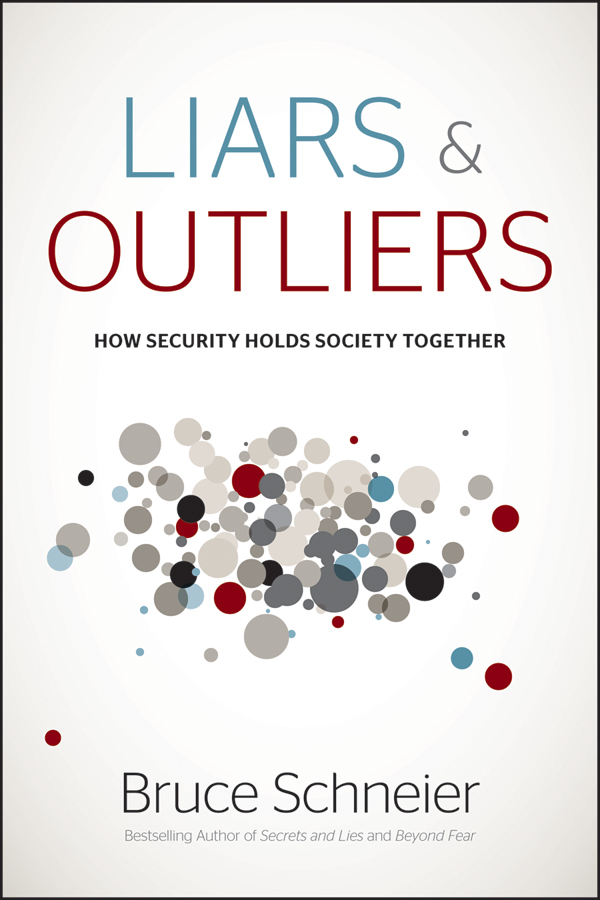
Liars and Outliers Cover

My new book, Liars and Outliers, has a cover.

proposed cover

Publication is still scheduled for the end of February—in time for the RSA Conference—assuming I finish the manuscript in time.

EDITED TO ADD (8/12): The cover was inspired by a design by Luke Fretwell. He sent me an unsolicited cover design, which I liked and sent to my publisher. They liked the general idea, but refined it into the cover you see. Luke has a blog post on the exchange, which includes a picture of his cover.

Posted on August 12, 2011 at 2:09 PMView Comments

My Next Book: Title and Cover

As my regular readers already know, I’m in the process of writing my next book. It’s a book about why security exists: specifically, how a group of people protects itself from individuals within that group. My working title has been The Dishonest Minority. The idea behind the title is that “honesty” is defined by social convention, then those that don’t follow the social conventions are by definition dishonest.

In my second blog post about the book, there was a lot of commentary about the word “dishonest.” The problem is that there are two kinds of dishonest people: those who are selfish, and those who are differently moral than the rest of society. So the word has to apply to both burglars and abolitionists. It has to apply to a criminal within society as a whole, and a police informant within a society of criminals. It has to apply to people who don’t pay their taxes because they’re selfish, and those who don’t pay because they are morally opposed to what the government is doing with the money. It has to apply to both Bernie Madoff and Gandhi.

It’s true that it’s a bit pejorative to use the word “dishonest” to describe both Madoff and Gandhi. But I can’t think of a better word. Here are some options:

  • The Dishonest Minority
  • The Dangerous Minority
  • The Deviant Minority
  • The Disobedient Minority

I don’t really like any of them.

Another option is to explicitly call out the two different types:

  • Murderers, Messiahs, and Other Dangerous People
  • Sinners, Saints, and Other Dangerous People
  • Sociopaths, Saints, and Other Dangerous People
  • Criminals, Revolutionaries, and Other Dangerous People
  • Criminals, Activists, and Other Dangerous People
  • Madoff, Gandhi, and Other Dangerous People
  • Jesus, the Two Thieves, and other Dangerous People
  • Liars, Outliers, and Other Threats
  • Crime, Revolution, and Other Dangers

Alliteration is always a plus. Biblical references I’m less sure about.

I like this general concept for title, because the potential reader will be intrigued how the two are related. They’re both “transgressors,” which might be a good word for the title.

  • Criminals, Revolutionaries, and Other Transgressors
  • Sociopaths, Saints, and Other Transgressors
  • Crime, Activism, and Other Transgressions
  • Murder, Revolution, and Other Transgressions

Or the word alone:

  • Transgressors
  • Transgressions

The subtitle is still one of these:

  • Security and its Role in Modern Society
  • Security and its Role in Protecting Modern Society
  • Security and its Role in Defending Modern Society
  • Security and its Role in Defending Society
  • Security and its Role in Protecting Society

Other options:

  • Protecting Society through Security
  • Securing Society from its Deviants

In general, I like an exciting title paired with a descriptive subtitle. But I’m willing to be convinced otherwise.

Remember, the goal of a title is to make people—people who don’t already know me and my writing—want to read my book.

Question 1: What do you think of the title options? What other words would work, either in the “adjective noun” title style, or the “A, B, and other Cs” style? What other completely different titles or subtitles would work?

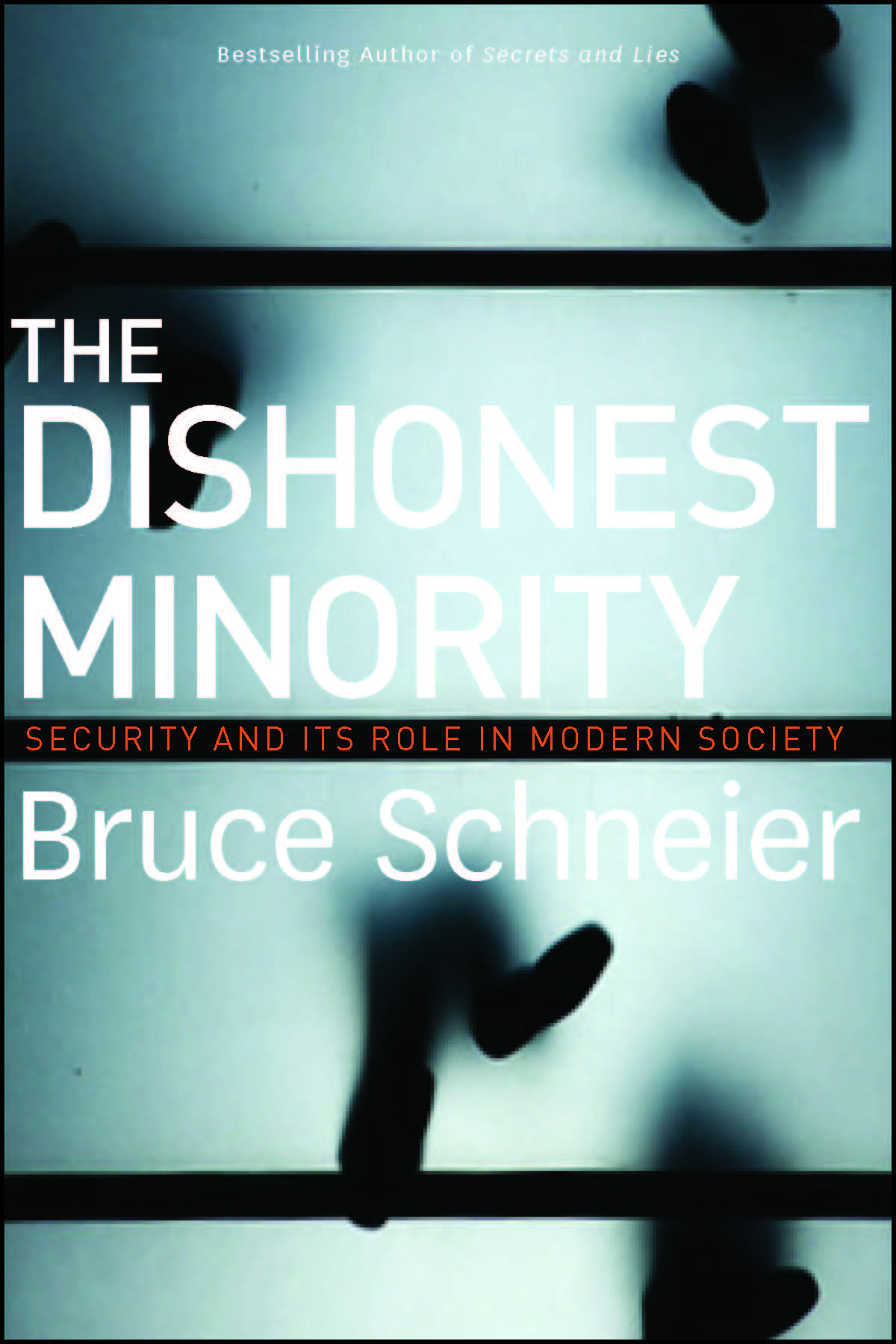
Next: cover options. I’m not sure how much book cover matters anymore, now that my books will primarily be sold from online stores and in ebook formats. But I’d like a cover that doesn’t suck. And it’s hard. “Security” is a concept that’s full of trite metaphors. And it’s hard to come up with a picture that really captures what I am writing about. (Maybe this one.) Below are five options that my publisher has sent me.

1. proposed cover 2. proposed cover 3. proposed cover 4. proposed cover 5. proposed cover

Note that the stock photos sometimes have watermarks, or are shown in artificially reduced resolution. If we actually use one of the photos, those artifacts will disappear.

Question 2: What do you think of the cover options: the stock photos, the typefaces, the colors, the overall layout of the cover? Will any of those work, or do we have to go back to the drawing board?

I appreciate your opinions. Please first give them to me cold, without reading the other comments. Then feel free to comment on what other people think.

Posted on June 21, 2011 at 11:20 AMView Comments

Status Report: The Dishonest Minority

Three months ago, I announced that I was writing a book on why security exists in human societies. This is basically the book’s thesis statement:

All complex systems contain parasites. In any system of cooperative behavior, an uncooperative strategy will be effective—and the system will tolerate the uncooperatives—as long as they’re not too numerous or too effective. Thus, as a species evolves cooperative behavior, it also evolves a dishonest minority that takes advantage of the honest majority. If individuals within a species have the ability to switch strategies, the dishonest minority will never be reduced to zero. As a result, the species simultaneously evolves two things: 1) security systems to protect itself from this dishonest minority, and 2) deception systems to successfully be parasitic.

Humans evolved along this path. The basic mechanism can be modeled simply. It is in our collective group interest for everyone to cooperate. It is in any given individual’s short-term self interest not to cooperate: to defect, in game theory terms. But if everyone defects, society falls apart. To ensure widespread cooperation and minimal defection, we collectively implement a variety of societal security systems.

Two of these systems evolved in prehistory: morals and reputation. Two others evolved as our social groups became larger and more formal: laws and technical security systems. What these security systems do, effectively, is give individuals incentives to act in the group interest. But none of these systems, with the possible exception of some fanciful science-fiction technologies, can ever bring that dishonest minority down to zero.

In complex modern societies, many complications intrude on this simple model of societal security. Decisions to cooperate or defect are often made by groups of people—governments, corporations, and so on—and there are important differences because of dynamics inside and outside the groups. Much of our societal security is delegated—to the police, for example—and becomes institutionalized; the dynamics of this are also important. Power struggles over who controls the mechanisms of societal security are inherent: “group interest” rapidly devolves to “the king’s interest.” Societal security can become a tool for those in power to remain in power, with the definition of “honest majority” being simply the people who follow the rules.

The term “dishonest minority” is not a moral judgment; it simply describes the minority who does not follow societal norm. Since many societal norms are in fact immoral, sometimes the dishonest minority serves as a catalyst for social change. Societies without a reservoir of people who don’t follow the rules lack an important mechanism for societal evolution. Vibrant societies need a dishonest minority; if society makes its dishonest minority too small, it stifles dissent as well as common crime.

At this point, I have most of a first draft: 75,000 words. The tentative title is still “The Dishonest Minority: Security and its Role in Modern Society.” I have signed a contract with Wiley to deliver a final manuscript in November for February 2012 publication. Writing a book is a process of exploration for me, and the final book will certainly be a little different—and maybe even very different—from what I wrote above. But that’s where I am today.

And it’s why my other writings continue to be sparse.

Posted on May 9, 2011 at 7:02 AMView Comments

Social Solidarity as an Effect of the 9/11 Terrorist Attacks

It’s standard sociological theory that a group experiences social solidarity in response to external conflict. This paper studies the phenomenon in the United States after the 9/11 terrorist attacks.

Conflict produces group solidarity in four phases: (1) an initial few days of shock and idiosyncratic individual reactions to attack; (2) one to two weeks of establishing standardized displays of solidarity symbols; (3) two to three months of high solidarity plateau; and (4) gradual decline toward normalcy in six to nine months. Solidarity is not uniform but is clustered in local groups supporting each other’s symbolic behavior. Actual solidarity behaviors are performed by minorities of the population, while vague verbal claims to performance are made by large majorities. Commemorative rituals intermittently revive high emotional peaks; participants become ranked according to their closeness to a center of ritual attention. Events, places, and organizations claim importance by associating themselves with national solidarity rituals and especially by surrounding themselves with pragmatically ineffective security ritual. Conflicts arise over access to centers of ritual attention; clashes occur between pragmatists deritualizing security and security zealots attempting to keep up the level of emotional intensity. The solidarity plateau is also a hysteria zone; as a center of emotional attention, it attracts ancillary attacks unrelated to the original terrorists as well as alarms and hoaxes. In particular historical circumstances, it becomes a period of atrocities.

This certainly makes sense as a group survival mechanism: self-interest giving way to group interest in face of a threat to the group. It’s the kind of thing I am talking about in my new book.

Paper also available here.

Posted on April 27, 2011 at 9:10 AMView Comments

Ebook Fraud

Interesting post—and discussion—on Making Light about ebook fraud. Currently there are two types of fraud. The first is content farming, discussed in these two interesting blog posts. People are creating automatically generated content, web-collected content, or fake content, turning it into a book, and selling it on an ebook site like Amazon.com. Then they use multiple identities to give it good reviews. (If it gets a bad review, the scammer just relists the same content under a new name.) That second blog post contains a screen shot of something called “Autopilot Kindle Cash,” which promises to teach people how to post dozens of ebooks to Amazon.com per day.

The second type of fraud is stealing a book and selling it as an ebook. So someone could scan a real book and sell it on an ebook site, even though he doesn’t own the copyright. It could be a book that isn’t already available as an ebook, or it could be a “low cost” version of a book that is already available. Amazon doesn’t seem particularly motivated to deal with this sort of fraud. And it too is suitable for automation.

Broadly speaking, there’s nothing new here. All complex ecosystems have parasites, and every open communications system we’ve ever built gets overrun by scammers and spammers. Far from making editors superfluous, systems that democratize publishing have an even greater need for editors. The solutions are not new, either: reputation-based systems, trusted recommenders, white lists, takedown notices. Google has implemented a bunch of security countermeasures against content farming; ebook sellers should implement them as well. It’ll be interesting to see what particular sort of mix works in this case.

Posted on April 4, 2011 at 9:18 AMView Comments

Societal Security

Humans have a natural propensity to trust non-kin, even strangers. We do it so often, so naturally, that we don’t even realize how remarkable it is. But except for a few simplistic counterexamples, it’s unique among life on this planet. Because we are intelligently calculating and value reciprocity (that is, fairness), we know that humans will be honest and nice: not for any immediate personal gain, but because that’s how they are. We also know that doesn’t work perfectly; most people will be dishonest some of the time, and some people will be dishonest most of the time. How does society—the honest majority—prevent the dishonest minority from taking over, or ruining society for everyone? How is the dishonest minority kept in check? The answer is security—in particular, something I’m calling societal security.

I want to divide security into two types. The first is individual security. It’s basic. It’s direct. It’s what normally comes to mind when we think of security. It’s cops vs. robbers, terrorists vs. the TSA, Internet worms vs. firewalls. And this sort of security is as old as life itself or—more precisely—as old as predation. And humans have brought an incredible level of sophistication to individual security.

Societal security is different. At the tactical level, it also involves attacks, countermeasures, and entire security systems. But instead of A vs. B, or even Group A vs. Group B, it’s Group A vs. members of Group A. It’s security for individuals within a group from members of that group. It’s how Group A protects itself from the dishonest minority within Group A. And it’s where security really gets interesting.

There are many types—I might try to estimate the number someday—of societal security systems that enforce our trust of non-kin. They’re things like laws prohibiting murder, taxes, traffic laws, pollution control laws, religious intolerance, Mafia codes of silence, and moral codes. They enable us to build a society that the dishonest minority can’t exploit and destroy. Originally, these security systems were informal. But as society got more complex, the systems became more formalized, and eventually were embedded into technologies.

James Madison famously wrote: “If men were angels, no government would be necessary.” Government is just the beginning of what wouldn’t be necessary. Currency, that paper stuff that’s deliberately made hard to counterfeit, wouldn’t be necessary, as people could just keep track of how much money they had. Angels never cheat, so nothing more would be required. Door locks, and any barrier that isn’t designed to protect against accidents, wouldn’t be necessary, since angels never go where they’re not supposed to go. Police forces wouldn’t be necessary. Armies: I suppose that’s debatable. Would angels—not the fallen ones—ever go to war against one another? I’d like to think they would be able to resolve their differences peacefully. If people were angels, every security measure that isn’t designed to be effective against accident, animals, forgetfulness, or legitimate differences between scrupulously honest angels could be dispensed with.

Security isn’t just a tax on the honest; it’s a very expensive tax on the honest. It’s the most expensive tax we pay, regardless of the country we live in. If people were angels, just think of the savings!

It wasn’t always like this. Security—especially societal security—used to be cheap. It used to be an incidental cost of society.

In a primitive society, informal systems are generally good enough. When you’re living in a small community, and objects are both scarce and hard to make, it’s pretty easy to deal with the problem of theft. If Alice loses a bowl, and at the same time, Bob shows up with an identical bowl, everyone knows Bob stole it from Alice, and the community can then punish Bob as it sees fit. But as communities get larger, as social ties weaken and anonymity increases, this informal system of theft prevention—detection and punishment leading to deterrence—fails. As communities get more technological and as the things people might want to steal get more interchangeable and harder to identify, it also fails. In short, as our ancestors made the move from small family groups to larger groups of unrelated families, and then to a modern form of society, the informal societal security systems started failing and more formal systems had to be invented to take their place. We needed to put license plates on cars and audit people’s tax returns.

We had no choice. Anything larger than a very primitive society couldn’t exist without societal security.

I’m writing a book about societal security. I will discuss human psychology: how we make security trade-offs, why we routinely trust non-kin (an evolutionary puzzle, to be sure), how the majority of us are honest, and that a minority of us are dishonest. That dishonest minority are the free riders of societal systems, and security is how we protect society from them. I will model the fundamental trade-off of societal security—individual self-interest vs. societal group interest—as a group prisoner’s dilemma problem, and use that metaphor to examine the basic mechanics of societal security. A lot falls out of this: free riders, the Tragedy of the Commons, the subjectivity of both morals and risk trade-offs.

Using this model, I will explore the security systems that protect—and fail to protect—market economics, corporations and other organizations, and a variety of national systems. I think there’s a lot we can learn about security by applying the prisoner’s dilemma model, and I’ve only recently started. Finally, I want to discuss modern changes to our millennia-old systems of societal security. The Information Age has changed a number of paradigms, and it’s not clear that our old security systems are working properly now or will work in the future. I’ve got a lot of work to do yet, and the final book might look nothing like this short outline. That sort of thing happens.

Tentative title: The Dishonest Minority: Security and its Role in Modern Society. I’ve written several books on the how of security. This book is about the why of security.

I expect to finish my first draft before Summer. Throughout 2011, expect to see bits from the book here. They might not make sense as a coherent whole at first—especially because I don’t write books in strict order—but by the time the book is published, it’ll all be part of a coherent and (hopefully) compelling narrative.

And if I write fewer extended blog posts and essays in the coming year, you’ll know why.

Posted on February 15, 2011 at 5:43 AMView Comments

Book Review: Cyber War

Cyber War: The Next Threat to National Security and What to do About It by Richard Clarke and Robert Knake, HarperCollins, 2010.

Cyber War is a fast and enjoyable read. This means you could give the book to your non-techy friends, and they’d understand most of it, enjoy all of it, and learn a lot from it. Unfortunately, while there’s a lot of smart discussion and good information in the book, there’s also a lot of fear-mongering and hyperbole as well. Since there’s no easy way to tell someone what parts of the book to pay attention to and what parts to take with a grain of salt, I can’t recommend it for that purpose. This is a pity, because parts of the book really need to be widely read and discussed.

The fear-mongering and hyperbole is mostly in the beginning. There, the authors describe the cyberwar of novels. Hackers disable air traffic control, delete money from bank accounts, cause widespread blackouts, release chlorine gas from chemical plants, and—this is my favorite—remotely cause your printer to catch on fire. It’s exciting and scary stuff, but not terribly realistic. Even their discussions of previous “cyber wars”—Estonia, Georgia, attacks against U.S. and South Korea on July 4, 2009—are full of hyperbole. A lot of what they write is unproven speculation, but they don’t say that.

Better is the historical discussion of the formation of the U.S. Cyber Command, but there are important omissions. There’s nothing about the cyberwar fear being stoked that accompanied this: by the NSA’s General Keith Alexander—who became the first head of the command—or by the NSA’s former director, current military contractor, by Mike McConnell, who’s Senior Vice President at Booz Allen Hamilton, and by others. By hyping the threat, the former has amassed a lot of power, and the latter a lot of money. Cyberwar is the new cash cow of the military-industrial complex, and any political discussion of cyberwar should include this as well.

Also interesting is the discussion of the asymmetric nature of the threat. A country like the United States, which is heavily dependent on the Internet and information technology, is much more vulnerable to cyber-attacks than a less-developed country like North Korea. This means that a country like North Korea would benefit from a cyberwar exchange: they’d inflict far more damage than they’d incur. This also means that, in this hypothetical cyberwar, there would be pressure on the U.S. to move the war to another theater: air and ground, for example. Definitely worth thinking about.

Most important is the section on treaties. Clarke and Knake have a lot of experience with nuclear treaties, and have done considerable thinking about how to apply that experience to cyberspace. The parallel isn’t perfect, but there’s a lot to learn about what worked and what didn’t, and—more importantly—how things worked and didn’t. The authors discuss treaties banning cyberwar entirely (unlikely), banning attacks against civilians, limiting what is allowed in peacetime, stipulating no first use of cyber weapons, and so on. They discuss cyberwar inspections, and how these treaties might be enforced. Since cyberwar would be likely to result in a new worldwide arms race, one with a more precarious trigger than the nuclear arms race, this part should be read and discussed far and wide. Sadly, it gets lost in the rest of the book. And, since the book lacks an index, it can be hard to find any particular section after you’re done reading it.

In the last chapter, the authors lay out their agenda for the future, which largely I agree with.

  1. We need to start talking publicly about cyber war. This is certainly true. The threat of cyberwar is going to consume the sorts of resources we shoveled into the nuclear threat half a century ago, and a realistic discussion of the threats, risks, countermeasures, and policy choices is essential. We need more universities offering degrees in cyber security, because we need more expertise for the entire gamut of threats.
  2. We need to better defend our military networks, the high-level ISPs, and our national power grid. Clarke and Knake call this the “Defensive Triad.” The authors and I disagree strongly on how this should be done, but there is no doubt that it should be done. The two parts of that triad currently in commercial hands are simply too central to our nation, and too vulnerable, to be left insecure. And their value is far greater to the nation than it is to the corporations that own it, which means the market will not naturally secure it. I agree with the authors that regulation is necessary.
  3. We need to reduce cybercrime. Even without the cyber warriors bit, we need to do that. Cybercrime is bad, and it’s continuing to get worse. Yes, it’s hard. But it’s important.
  4. We need international cyberwar treaties. I couldn’t agree more about this. We do. We need to start thinking about them, talking about them, and negotiating them now, before the cyberwar arms race takes off. There are all kind of issues with cyberwar treaties, and the book talks about a lot of them. However full of loopholes they might be, their existence will do more good than harm.
  5. We need more research on secure network designs. Again, even without the cyberwar bit, this is essential. We need more research in cybersecurity, a lot more.
  6. We need decisions about cyberwar—what weapons to build, what offensive actions to take, who to target—to be made as far up the command structure as possible. Clarke and Knake want the president to personally approve all of this, and I agree. Because of its nature, it can be easy to launch a small-scale cyber attack, and it can be easy for a small-scale attack to get out of hand and turn into a large-scale attack. We need the president to make the decisions, not some low-level military officer ensconced in a computer-filled bunker late one night.

This is great stuff, and a fine starting place for a national policy discussion on cybersecurity, whether it be against a military, espionage, or criminal threat. Unfortunately, for readers to get there, they have to wade through the rest of the book. And unless their bullshit detectors are already well-calibrated on this topic, I don’t want them reading all the hyperbole and fear-mongering that comes before, no matter how readable the book.

Note: I read Cyber War in April, when it first came out. I wanted to write a review then, but found that while my Kindle is great for reading, it’s terrible for flipping back and forth looking for bits and pieces to write about in a review. So I let the review languish. Finally, I borrowed a paper copy from my local library.

Some other reviews of the book Cyber War. See also the reviews on the Amazon page.

I wrote two essays on cyberwar.

Posted on December 21, 2010 at 7:23 AMView Comments

Details Removed from Book at Request of U.S. Department of Defense

From the AFP:

A publisher has agreed to remove US intelligence details from a memoir by a former army officer in Afghanistan after the Pentagon raised last-minute objections, officials said Friday.

The book, “Operation Dark Heart,” had been printed and prepared for release in August but St. Martin’s Press will now issue a revised version of the spy memoir after negotiations with the Pentagon, US and company officials said.

In an unusual step, the Defense Department has agreed to reimburse the company for the cost of the first printing, spokesman Colonel Dave Lapan told AFP.

The original manuscript “contained classified information which had not been properly reviewed” by the military and US spy agencies, he said.

St. Martin’s press will destroy copies from the first printing with Pentagon representatives observing “to ensure it’s done in accordance with our standards,” Lapan said.

The second, revised edition would be ready by the end of next week, said the author’s lawyer, Mark Zaid.

EDITED TO ADD (9/30): An analysis of the redacted material—obtained by comparing the two versions—is amusing.

Posted on September 23, 2010 at 7:19 AMView Comments

1 11 12 13 14 15 17

Sidebar photo of Bruce Schneier by Joe MacInnis.