Entries Tagged "AI"

Page 10 of 31

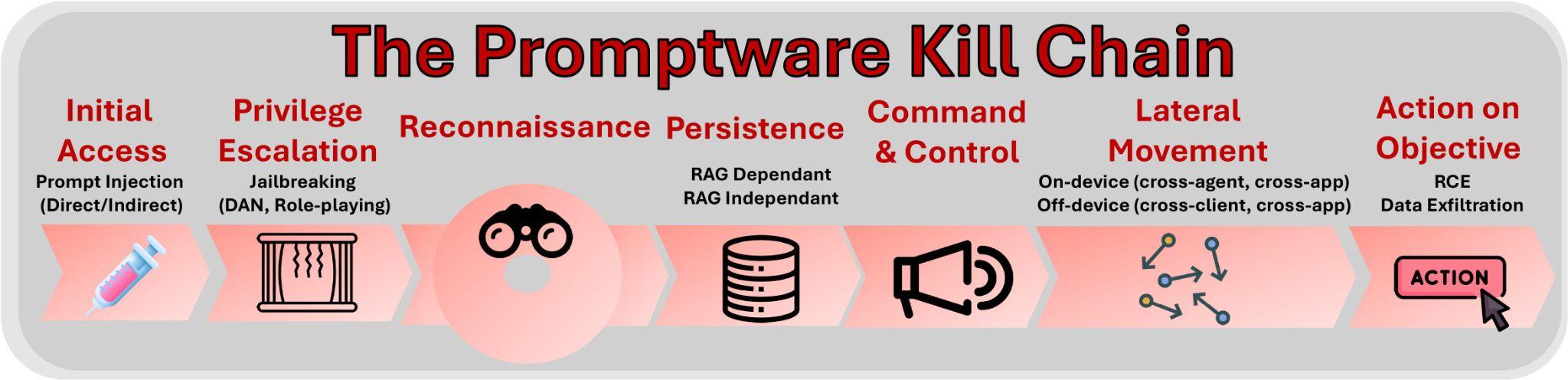
Prompt Injection in AI Browsers

This is why AIs are not ready to be personal assistants:

A new attack called ‘CometJacking’ exploits URL parameters to pass to Perplexity’s Comet AI browser hidden instructions that allow access to sensitive data from connected services, like email and calendar.

In a realistic scenario, no credentials or user interaction are required and a threat actor can leverage the attack by simply exposing a maliciously crafted URL to targeted users.

[…]

CometJacking is a prompt-injection attack where the query string processed by the Comet AI browser contains malicious instructions added using the ‘collection’ parameter of the URL.

LayerX researchers say that the prompt tells the agent to consult its memory and connected services instead of searching the web. As the AI tool is connected to various services, an attacker leveraging the CometJacking method could exfiltrate available data.

In their tests, the connected services and accessible data include Google Calendar invites and Gmail messages and the malicious prompt included instructions to encode the sensitive data in base64 and then exfiltrate them to an external endpoint.

According to the researchers, Comet followed the instructions and delivered the information to an external system controlled by the attacker, evading Perplexity’s checks.

I wrote previously:

Prompt injection isn’t just a minor security problem we need to deal with. It’s a fundamental property of current LLM technology. The systems have no ability to separate trusted commands from untrusted data, and there are an infinite number of prompt injection attacks with no way to block them as a class. We need some new fundamental science of LLMs before we can solve this.

Posted on November 11, 2025 at 7:08 AMView Comments

Faking Receipts with AI

Over the past few decades, it’s become easier and easier to create fake receipts. Decades ago, it required special paper and printers—I remember a company in the UK advertising its services to people trying to cover up their affairs. Then, receipts became computerized, and faking them required some artistic skills to make the page look realistic.

Now, AI can do it all:

Several receipts shown to the FT by expense management platforms demonstrated the realistic nature of the images, which included wrinkles in paper, detailed itemization that matched real-life menus, and signatures.

[…]

The rise in these more realistic copies has led companies to turn to AI to help detect fake receipts, as most are too convincing to be found by human reviewers.

The software works by scanning receipts to check the metadata of the image to discover whether an AI platform created it. However, this can be easily removed by users taking a photo or a screenshot of the picture.

To combat this, it also considers other contextual information by examining details such as repetition in server names and times and broader information about the employee’s trip.

Yet another AI-powered security arms race.

Posted on November 7, 2025 at 7:01 AMView Comments

Scientists Need a Positive Vision for AI

For many in the research community, it’s gotten harder to be optimistic about the impacts of artificial intelligence.

As authoritarianism is rising around the world, AI-generated “slop” is overwhelming legitimate media, while AI-generated deepfakes are spreading misinformation and parroting extremist messages. AI is making warfare more precise and deadly amidst intransigent conflicts. AI companies are exploiting people in the global South who work as data labelers, and profiting from content creators worldwide by using their work without license or compensation. The industry is also affecting an already-roiling climate with its enormous energy demands.

Meanwhile, particularly in the United States, public investment in science seems to be redirected and concentrated on AI at the expense of other disciplines. And Big Tech companies are consolidating their control over the AI ecosystem. In these ways and others, AI seems to be making everything worse.

This is not the whole story. We should not resign ourselves to AI being harmful to humanity. None of us should accept this as inevitable, especially those in a position to influence science, government, and society. Scientists and engineers can push AI towards a beneficial path. Here’s how.

The Academy’s View of AI

A Pew study in April found that 56 percent of AI experts (authors and presenters of AI-related conference papers) predict that AI will have positive effects on society. But that optimism doesn’t extend to the scientific community at large. A 2023 survey of 232 scientists by the Center for Science, Technology and Environmental Policy Studies at Arizona State University found more concern than excitement about the use of generative AI in daily life—by nearly a three to one ratio.

We have encountered this sentiment repeatedly. Our careers of diverse applied work have brought us in contact with many research communities: privacy, cybersecurity, physical sciences, drug discovery, public health, public interest technology, and democratic innovation. In all of these fields, we’ve found strong negative sentiment about the impacts of AI. The feeling is so palpable that we’ve often been asked to represent the voice of the AI optimist, even though we spend most of our time writing about the need to reform the structures of AI development.

We understand why these audiences see AI as a destructive force, but this negativity engenders a different concern: that those with the potential to guide the development of AI and steer its influence on society will view it as a lost cause and sit out that process.

Elements of a Positive Vision for AI

Many have argued that turning the tide of climate action requires clearly articulating a path towards positive outcomes. In the same way, while scientists and technologists should anticipate, warn against, and help mitigate the potential harms of AI, they should also highlight the ways the technology can be harnessed for good, galvanizing public action towards those ends.

There are myriad ways to leverage and reshape AI to improve peoples’ lives, distribute rather than concentrate power, and even strengthen democratic processes. Many examples have arisen from the scientific community and deserve to be celebrated.

Some examples: AI is eliminating communication barriers across languages, including under-resourced contexts like marginalized sign languages and indigenous African languages. It is helping policymakers incorporate the viewpoints of many constituents through AI-assisted deliberations and legislative engagement. Large language models can scale individual dialogs to address climatechange skepticism, spreading accurate information at a critical moment. National labs are building AI foundation models to accelerate scientific research. And throughout the fields of medicine and biology, machine learning is solving scientific problems like the prediction of protein structure in aid of drug discovery, which was recognized with a Nobel Prize in 2024.

While each of these applications is nascent and surely imperfect, they all demonstrate that AI can be wielded to advance the public interest. Scientists should embrace, champion, and expand on such efforts.

A Call to Action for Scientists

In our new book, Rewiring Democracy: How AI Will Transform Our Politics, Government, and Citizenship, we describe four key actions for policymakers committed to steering AI toward the public good.

These apply to scientists as well. Researchers should work to reform the AI industry to be more ethical, equitable, and trustworthy. We must collectively develop ethical norms for research that advance and applies AI, and should use and draw attention to AI developers who adhere to those norms.

Second, we should resist harmful uses of AI by documenting the negative applications of AI and casting a light on inappropriate uses.

Third, we should responsibly use AI to make society and peoples’ lives better, exploiting its capabilities to help the communities they serve.

And finally, we must advocate for the renovation of institutions to prepare them for the impacts of AI; universities, professional societies, and democratic organizations are all vulnerable to disruption.

Scientists have a special privilege and responsibility: We are close to the technology itself and therefore well positioned to influence its trajectory. We must work to create an AI-infused world that we want to live in. Technology, as the historian Melvin Kranzberg observed, “is neither good nor bad; nor is it neutral.” Whether the AI we build is detrimental or beneficial to society depends on the choices we make today. But we cannot create a positive future without a vision of what it looks like.

This essay was written with Nathan E. Sanders, and originally appeared in IEEE Spectrum.

Posted on November 5, 2025 at 7:04 AMView Comments

AI Summarization Optimization

These days, the most important meeting attendee isn’t a person: It’s the AI notetaker.

This system assigns action items and determines the importance of what is said. If it becomes necessary to revisit the facts of the meeting, its summary is treated as impartial evidence.

But clever meeting attendees can manipulate this system’s record by speaking more to what the underlying AI weights for summarization and importance than to their colleagues. As a result, you can expect some meeting attendees to use language more likely to be captured in summaries, timing their interventions strategically, repeating key points, and employing formulaic phrasing that AI models are more likely to pick up on. Welcome to the world of AI summarization optimization (AISO).

Optimizing for algorithmic manipulation

AI summarization optimization has a well-known precursor: SEO.

Search-engine optimization is as old as the World Wide Web. The idea is straightforward: Search engines scour the internet digesting every possible page, with the goal of serving the best results to every possible query. The objective for a content creator, company, or cause is to optimize for the algorithm search engines have developed to determine their webpage rankings for those queries. That requires writing for two audiences at once: human readers and the search-engine crawlers indexing content. Techniques to do this effectively are passed around like trade secrets, and a $75 billion industry offers SEO services to organizations of all sizes.

More recently, researchers have documented techniques for influencing AI responses, including large-language model optimization (LLMO) and generative engine optimization (GEO). Tricks include content optimization—adding citations and statistics—and adversarial approaches: using specially crafted text sequences. These techniques often target sources that LLMs heavily reference, such as Reddit, which is claimed to be cited in 40% of AI-generated responses. The effectiveness and real-world applicability of these methods remains limited and largely experimental, although there is substantial evidence that countries such as Russia are actively pursuing this.

AI summarization optimization follows the same logic on a smaller scale. Human participants in a meeting may want a certain fact highlighted in the record, or their perspective to be reflected as the authoritative one. Rather than persuading colleagues directly, they adapt their speech for the notetaker that will later define the “official” summary. For example:

  • “The main factor in last quarter’s delay was supply chain disruption.”
  • “The key outcome was overwhelmingly positive client feedback.”
  • “Our takeaway here is in alignment moving forward.”
  • “What matters here is the efficiency gains, not the temporary cost overrun.”

The techniques are subtle. They employ high-signal phrases such as “key takeaway” and “action item,” keep statements short and clear, and repeat them when possible. They also use contrastive framing (“this, not that”), and speak early in the meeting or at transition points.

Once spoken words are transcribed, they enter the model’s input. Cue phrases—and even transcription errors—can steer what makes it into the summary. In many tools, the output format itself is also a signal: Summarizers often offer sections such as “Key Takeaways” or “Action Items,” so language that mirrors those headings is more likely to be included. In effect, well-chosen phrases function as implicit markers that guide the AI toward inclusion.

Research confirms this. Early AI summarization research showed that models trained to reconstruct summary-style sentences systematically overweigh such content. Models over-rely on early-position content in news. And models often overweigh statements at the start or end of a transcript, underweighting the middle. Recent work further confirms vulnerability to phrasing-based manipulation: models cannot reliably distinguish embedded instructions from ordinary content, especially when phrasing mimics salient cues.

How to combat AISO

If AISO becomes common, three forms of defense will emerge. First, meeting participants will exert social pressure on one another. When researchers secretly deployed AI bots in Reddit’s r/changemyview community, users and moderators responded with strong backlash calling it “psychological manipulation.” Anyone using obvious AI-gaming phrases may face similar disapproval.

Second, organizations will start governing meeting behavior using AI: risk assessments and access restrictions before the meetings even start, detection of AISO techniques in meetings, and validation and auditing after the meetings.

Third, AI summarizers will have their own technical countermeasures. For example, the AI security company CloudSEK recommends content sanitization to strip suspicious inputs, prompt filtering to detect meta-instructions and excessive repetition, context window balancing to weight repeated content less heavily, and user warnings showing content provenance.

Broader defenses could draw from security and AI safety research: preprocessing content to detect dangerous patterns, consensus approaches requiring consistency thresholds, self-reflection techniques to detect manipulative content, and human oversight protocols for critical decisions. Meeting-specific systems could implement additional defenses: tagging inputs by provenance, weighting content by speaker role or centrality with sentence-level importance scoring, and discounting high-signal phrases while favoring consensus over fervor.

Reshaping human behavior

AI summarization optimization is a small, subtle shift, but it illustrates how the adoption of AI is reshaping human behavior in unexpected ways. The potential implications are quietly profound.

Meetings—humanity’s most fundamental collaborative ritual—are being silently reengineered by those who understand the algorithm’s preferences. The articulate are gaining an invisible advantage over the wise. Adversarial thinking is becoming routine, embedded in the most ordinary workplace rituals, and, as AI becomes embedded in organizational life, strategic interactions with AI notetakers and summarizers may soon be a necessary executive skill for navigating corporate culture.

AI summarization optimization illustrates how quickly humans adapt communication strategies to new technologies. As AI becomes more embedded in workplace communication, recognizing these emerging patterns may prove increasingly important.

This essay was written with Gadi Evron, and originally appeared in CSO.

Posted on November 3, 2025 at 7:05 AMView Comments

Will AI Strengthen or Undermine Democracy?

Listen to the Audio on NextBigIdeaClub.com

Below, co-authors Bruce Schneier and Nathan E. Sanders share five key insights from their new book, Rewiring Democracy: How AI Will Transform Our Politics, Government, and Citizenship.

What’s the big idea?

AI can be used both for and against the public interest within democracies. It is already being used in the governing of nations around the world, and there is no escaping its continued use in the future by leaders, policy makers, and legal enforcers. How we wire AI into democracy today will determine if it becomes a tool of oppression or empowerment.

1. AI’s global democratic impact is already profound.

It’s been just a few years since ChatGPT stormed into view and AI’s influence has already permeated every democratic process in governments around the world:

  • In 2022, an artist collective in Denmark founded the world’s first political party committed to an AI-generated policy platform.
  • Also in 2022, South Korean politicians running for the presidency were the first to use AI avatars to communicate with voters en masse.
  • In 2023, a Brazilian municipal legislator passed the first enacted law written by AI.
  • In 2024, a U.S. federal court judge started using AI to interpret the plain meaning of words in U.S. law.
  • Also in 2024, the Biden administration disclosed more than two thousand discrete use cases for AI across the agencies of the U.S. federal government.

The examples illustrate the diverse uses of AI across citizenship, politics, legislation, the judiciary, and executive administration.

Not all of these uses will create lasting change. Some of these will be one-offs. Some are inherently small in scale. Some were publicity stunts. But each use case speaks to a shifting balance of supply and demand that AI will increasingly mediate.

Legislators need assistance drafting bills and have limited staff resources, especially at the local and state level. Historically, they have looked to lobbyists and interest groups for help. Increasingly, it’s just as easy for them to use an AI tool.

2. The first places AI will be used are where there is the least public oversight.

Many of the use cases for AI in governance and politics have vocal objectors. Some make us uncomfortable, especially in the hands of authoritarians or ideological extremists.

In some cases, politics will be a regulating force to prevent dangerous uses of AI. Massachusetts has banned the use of AI face recognition in law enforcement because of real concerns voiced by the public about their tendency to encode systems of racial bias.

Some of the uses we think might be most impactful are unlikely to be adopted fast because of legitimate concern about their potential to make mistakes, introduce bias, or subvert human agency. AIs could be assistive tools for citizens, acting as their voting proxies to help us weigh in on larger numbers of more complex ballot initiatives, but we know that many will object to anything that verges on AIs being given a vote.

But AI will continue to be rapidly adopted in some aspects of democracy, regardless of how the public feels. People within democracies, even those in government jobs, often have great independence. They don’t have to ask anyone if it’s ok to use AI, and they will use it if they see that it benefits them. The Brazilian city councilor who used AI to draft a bill did not ask for anyone’s permission. The U.S. federal judge who used AI to help him interpret law did not have to check with anyone first. And the Trump administration seems to be using AI for everything from drafting tariff policies to writing public health reports—with some obvious drawbacks.

It’s likely that even the thousands of disclosed AI uses in government are only the tip of the iceberg. These are just the applications that governments have seen fit to share; the ones they think are the best vetted, most likely to persist, or maybe the least controversial to disclose.

3. Elites and authoritarians will use AI to concentrate power.

Many Westerners point to China as a cautionary tale of how AI could empower autocracy, but the reality is that AI provides structural advantages to entrenched power in democratic governments, too. The nature of automation is that it gives those at the top of a power structure more control over the actions taken at its lower levels.

It’s famously hard for newly elected leaders to exert their will over the many layers of human bureaucracies. The civil service is large, unwieldy, and messy. But it’s trivial for an executive to change the parameters and instructions of an AI model being used to automate the systems of government.

The dynamic of AI effectuating concentration of power extends beyond government agencies. Over the past five years, Ohio has undertaken a project to do a wholesale revision of its administrative code using AI. The leaders of that project framed it in terms of efficiency and good governance: deleting millions of words of outdated, unnecessary, or redundant language. The same technology could be applied to advance more ideological ends, like purging all statutory language that places burdens on business, neglects to hold businesses accountable, protects some class of people, or fails to protect others.

Whether you like or despise automating the enactment of those policies will depend on whether you stand with or are opposed to those in power, and that’s the point. AI gives any faction with power the potential to exert more control over the levers of government.

4. Organizers will find ways to use AI to distribute power instead.

We don’t have to resign ourselves to a world where AI makes the rich richer and the elite more powerful. This is a technology that can also be wielded by outsiders to help level the playing field.

In politics, AI gives upstart and local candidates access to skills and the ability to do work on a scale that used to only be available to well-funded campaigns. In the 2024 cycle, Congressional candidates running against incumbents like Glenn Cook in Georgia and Shamaine Daniels in Pennsylvania used AI to help themselves be everywhere all at once. They used AI to make personalized robocalls to voters, write frequent blog posts, and even generate podcasts in the candidate’s voice. In Japan, a candidate for Governor of Tokyo used an AI avatar to respond to more than eight thousand online questions from voters.

Outside of public politics, labor organizers are also leveraging AI to build power. The Worker’s Lab is a U.S. nonprofit developing assistive technologies for labor unions, like AI-enabled apps that help service workers report workplace safety violations. The 2023 Writers’ Guild of America strike serves as a blueprint for organizers. They won concessions from Hollywood studios that protect their members against being displaced by AI while also winning them guarantees for being able to use AI as assistive tools to their own benefit.

5. The ultimate democratic impact of AI depends on us.

If you are excited about AI and see the potential for it to make life, and maybe even democracy, better around the world, recognize that there are a lot of people who don’t feel the same way.

If you are disturbed about the ways you see AI being used and worried about the future that leads to, recognize that the trajectory we’re on now is not the only one available.

The technology of AI itself does not pose an inherent threat to citizens, workers, and the public interest. Like other democratic technologies—voting processes, legislative districts, judicial review—its impacts will depend on how it’s developed, who controls it, and how it’s used.

Constituents of democracies should do four things:

  • Reform the technology ecosystem to be more trustworthy, so that AI is developed with more transparency, more guardrails around exploitative use of data, and public oversight.
  • Resist inappropriate uses of AI in government and politics, like facial recognition technologies that automate surveillance and encode inequity.
  • Responsibly use AI in government where it can help improve outcomes, like making government more accessible to people through translation and speeding up administrative decision processes.
  • Renovate the systems of government vulnerable to the disruptive potential of AI’s superhuman capabilities, like political advertising rules that never anticipated deepfakes.

These four Rs are how we can rewire our democracy in a way that applies AI to truly benefit the public interest.

This essay was written with Nathan E. Sanders, and originally appeared in The Next Big Idea Club.

EDITED TO ADD (11/6): This essay was republished by Fast Company.

Posted on October 31, 2025 at 7:08 AMView Comments

The AI-Designed Bioweapon Arms Race

Interesting article about the arms race between AI systems that invent/design new biological pathogens, and AI systems that detect them before they’re created:

The team started with a basic test: use AI tools to design variants of the toxin ricin, then test them against the software that is used to screen DNA orders. The results of the test suggested there was a risk of dangerous protein variants slipping past existing screening software, so the situation was treated like the equivalent of a zero-day vulnerability.

[…]

Details of that original test are being made available today as part of a much larger analysis that extends the approach to a large range of toxic proteins. Starting with 72 toxins, the researchers used three open source AI packages to generate a total of about 75,000 potential protein variants.

And this is where things get a little complicated. Many of the AI-designed protein variants are going to end up being non-functional, either subtly or catastrophically failing to fold up into the correct configuration to create an active toxin.

[…]

In any case, DNA sequences encoding all 75,000 designs were fed into the software that screens DNA orders for potential threats. One thing that was very clear is that there were huge variations in the ability of the four screening programs to flag these variant designs as threatening. Two of them seemed to do a pretty good job, one was mixed, and another let most of them through. Three of the software packages were updated in response to this performance, which significantly improved their ability to pick out variants.

There was also a clear trend in all four screening packages: The closer the variant was to the original structurally, the more likely the package (both before and after the patches) was to be able to flag it as a threat. In all cases, there was also a cluster of variant designs that were unlikely to fold into a similar structure, and these generally weren’t flagged as threats.

The research is all preliminary, and there are a lot of ways in which the experiment diverges from reality. But I am not optimistic about this particular arms race. I think that the ability of AI systems to create something deadly will advance faster than the ability of AI systems to detect its components.

Posted on October 30, 2025 at 7:05 AMView Comments

Agentic AI’s OODA Loop Problem

The OODA loop—for observe, orient, decide, act—is a framework to understand decision-making in adversarial situations. We apply the same framework to artificial intelligence agents, who have to make their decisions with untrustworthy observations and orientation. To solve this problem, we need new systems of input, processing, and output integrity.

Many decades ago, U.S. Air Force Colonel John Boyd introduced the concept of the “OODA loop,” for Observe, Orient, Decide, and Act. These are the four steps of real-time continuous decision-making. Boyd developed it for fighter pilots, but it’s long been applied in artificial intelligence (AI) and robotics. An AI agent, like a pilot, executes the loop over and over, accomplishing its goals iteratively within an ever-changing environment. This is Anthropic’s definition: “Agents are models using tools in a loop.”1

OODA Loops for Agentic AI

Traditional OODA analysis assumes trusted inputs and outputs, in the same way that classical AI assumed trusted sensors, controlled environments, and physical boundaries. This no longer holds true. AI agents don’t just execute OODA loops; they embed untrusted actors within them. Web-enabled large language models (LLMs) can query adversary-controlled sources mid-loop. Systems that allow AI to use large corpora of content, such as retrieval-augmented generation (https://en.wikipedia.org/wiki/Retrieval-augmented_generation), can ingest poisoned documents. Tool-calling application programming interfaces can execute untrusted code. Modern AI sensors can encompass the entire Internet; their environments are inherently adversarial. That means that fixing AI hallucination is insufficient because even if the AI accurately interprets its inputs and produces corresponding output, it can be fully corrupt.

In 2022, Simon Willison identified a new class of attacks against AI systems: “prompt injection.”2 Prompt injection is possible because an AI mixes untrusted inputs with trusted instructions and then confuses one for the other. Willison’s insight was that this isn’t just a filtering problem; it’s architectural. There is no privilege separation, and there is no separation between the data and control paths. The very mechanism that makes modern AI powerful—treating all inputs uniformly—is what makes it vulnerable. The security challenges we face today are structural consequences of using AI for everything.

  1. Insecurities can have far-reaching effects. A single poisoned piece of training data can affect millions of downstream applications. In this environment, security debt accrues like technical debt.
  2. AI security has a temporal asymmetry. The temporal disconnect between training and deployment creates unauditable vulnerabilities. Attackers can poison a model’s training data and then deploy an exploit years later. Integrity violations are frozen in the model. Models aren’t aware of previous compromises since each inference starts fresh and is equally vulnerable.
  3. AI increasingly maintains state—in the form of chat history and key-value caches. These states accumulate compromises. Every iteration is potentially malicious, and cache poisoning persists across interactions.
  4. Agents compound the risks. Pretrained OODA loops running in one or a dozen AI agents inherit all of these upstream compromises. Model Context Protocol (MCP) and similar systems that allow AI to use tools create their own vulnerabilities that interact with each other. Each tool has its own OODA loop, which nests, interleaves, and races. Tool descriptions become injection vectors. Models can’t verify tool semantics, only syntax. “Submit SQL query” might mean “exfiltrate database” because an agent can be corrupted in prompts, training data, or tool definitions to do what the attacker wants. The abstraction layer itself can be adversarial.

For example, an attacker might want AI agents to leak all the secret keys that the AI knows to the attacker, who might have a collector running in bulletproof hosting in a poorly regulated jurisdiction. They could plant coded instructions in easily scraped web content, waiting for the next AI training set to include it. Once that happens, they can activate the behavior through the front door: tricking AI agents (think a lowly chatbot or an analytics engine or a coding bot or anything in between) that are increasingly taking their own actions, in an OODA loop, using untrustworthy input from a third-party user. This compromise persists in the conversation history and cached responses, spreading to multiple future interactions and even to other AI agents. All this requires us to reconsider risks to the agentic AI OODA loop, from top to bottom.

  • Observe: The risks include adversarial examples, prompt injection, and sensor spoofing. A sticker fools computer vision, a string fools an LLM. The observation layer lacks authentication and integrity.
  • Orient: The risks include training data poisoning, context manipulation, and semantic backdoors. The model’s worldview—its orientation—can be influenced by attackers months before deployment. Encoded behavior activates on trigger phrases.
  • Decide: The risks include logic corruption via fine-tuning attacks, reward hacking, and objective misalignment. The decision process itself becomes the payload. Models can be manipulated to trust malicious sources preferentially.
  • Act: The risks include output manipulation, tool confusion, and action hijacking. MCP and similar protocols multiply attack surfaces. Each tool call trusts prior stages implicitly.

AI gives the old phrase “inside your adversary’s OODA loop” new meaning. For Boyd’s fighter pilots, it meant that you were operating faster than your adversary, able to act on current data while they were still on the previous iteration. With agentic AI, adversaries aren’t just metaphorically inside; they’re literally providing the observations and manipulating the output. We want adversaries inside our loop because that’s where the data are. AI’s OODA loops must observe untrusted sources to be useful. The competitive advantage, accessing web-scale information, is identical to the attack surface. The speed of your OODA loop is irrelevant when the adversary controls your sensors and actuators.

Worse, speed can itself be a vulnerability. The faster the loop, the less time for verification. Millisecond decisions result in millisecond compromises.

The Source of the Problem

The fundamental problem is that AI must compress reality into model-legible forms. In this setting, adversaries can exploit the compression. They don’t have to attack the territory; they can attack the map. Models lack local contextual knowledge. They process symbols, not meaning. A human sees a suspicious URL; an AI sees valid syntax. And that semantic gap becomes a security gap.

Prompt injection might be unsolvable in today’s LLMs. LLMs process token sequences, but no mechanism exists to mark token privileges. Every solution proposed introduces new injection vectors: Delimiter? Attackers include delimiters. Instruction hierarchy? Attackers claim priority. Separate models? Double the attack surface. Security requires boundaries, but LLMs dissolve boundaries. More generally, existing mechanisms to improve models won’t help protect against attack. Fine-tuning preserves backdoors. Reinforcement learning with human feedback adds human preferences without removing model biases. Each training phase compounds prior compromises.

This is Ken Thompson’s “trusting trust” attack all over again.3 Poisoned states generate poisoned outputs, which poison future states. Try to summarize the conversation history? The summary includes the injection. Clear the cache to remove the poison? Lose all context. Keep the cache for continuity? Keep the contamination. Stateful systems can’t forget attacks, and so memory becomes a liability. Adversaries can craft inputs that corrupt future outputs.

This is the agentic AI security trilemma. Fast, smart, secure; pick any two. Fast and smart—you can’t verify your inputs. Smart and secure—you check everything, slowly, because AI itself can’t be used for this. Secure and fast—you’re stuck with models with intentionally limited capabilities.

This trilemma isn’t unique to AI. Some autoimmune disorders are examples of molecular mimicry—when biological recognition systems fail to distinguish self from nonself. The mechanism designed for protection becomes the pathology as T cells attack healthy tissue or fail to attack pathogens and bad cells. AI exhibits the same kind of recognition failure. No digital immunological markers separate trusted instructions from hostile input. The model’s core capability, following instructions in natural language, is inseparable from its vulnerability. Or like oncogenes, the normal function and the malignant behavior share identical machinery.

Prompt injection is semantic mimicry: adversarial instructions that resemble legitimate prompts, which trigger self-compromise. The immune system can’t add better recognition without rejecting legitimate cells. AI can’t filter malicious prompts without rejecting legitimate instructions. Immune systems can’t verify their own recognition mechanisms, and AI systems can’t verify their own integrity because the verification system uses the same corrupted mechanisms.

In security, we often assume that foreign/hostile code looks different from legitimate instructions, and we use signatures, patterns, and statistical anomaly detection to detect it. But getting inside someone’s AI OODA loop uses the system’s native language. The attack is indistinguishable from normal operation because it is normal operation. The vulnerability isn’t a defect—it’s the feature working correctly.

Where to Go Next?

The shift to an AI-saturated world has been dizzying. Seemingly overnight, we have AI in every technology product, with promises of even more—and agents as well. So where does that leave us with respect to security?

Physical constraints protected Boyd’s fighter pilots. Radar returns couldn’t lie about physics; fooling them, through stealth or jamming, constituted some of the most successful attacks against such systems that are still in use today. Observations were authenticated by their presence. Tampering meant physical access. But semantic observations have no physics. When every AI observation is potentially corrupted, integrity violations span the stack. Text can claim anything, and images can show impossibilities. In training, we face poisoned datasets and backdoored models. In inference, we face adversarial inputs and prompt injection. During operation, we face a contaminated context and persistent compromise. We need semantic integrity: verifying not just data but interpretation, not just content but context, not just information but understanding. We can add checksums, signatures, and audit logs. But how do you checksum a thought? How do you sign semantics? How do you audit attention?

Computer security has evolved over the decades. We addressed availability despite failures through replication and decentralization. We addressed confidentiality despite breaches using authenticated encryption. Now we need to address integrity despite corruption.4

Trustworthy AI agents require integrity because we can’t build reliable systems on unreliable foundations. The question isn’t whether we can add integrity to AI but whether the architecture permits integrity at all.

AI OODA loops and integrity aren’t fundamentally opposed, but today’s AI agents observe the Internet, orient via statistics, decide probabilistically, and act without verification. We built a system that trusts everything, and now we hope for a semantic firewall to keep it safe. The adversary isn’t inside the loop by accident; it’s there by architecture. Web-scale AI means web-scale integrity failure. Every capability corrupts.

Integrity isn’t a feature you add; it’s an architecture you choose. So far, we have built AI systems where “fast” and “smart” preclude “secure.” We optimized for capability over verification, for accessing web-scale data over ensuring trust. AI agents will be even more powerful—and increasingly autonomous. And without integrity, they will also be dangerous.

References

1. S. Willison, Simon Willison’s Weblog, May 22, 2025. [Online]. Available: https://simonwillison.net/2025/May/22/tools-in-a-loop/

2. S. Willison, “Prompt injection attacks against GPT-3,” Simon Willison’s Weblog, Sep. 12, 2022. [Online]. Available: https://simonwillison.net/2022/Sep/12/prompt-injection/

3. K. Thompson, “Reflections on trusting trust,” Commun. ACM, vol. 27, no. 8, Aug. 1984. [Online]. Available: https://www.cs.cmu.edu/~rdriley/487/papers/Thompson_1984_ReflectionsonTrustingTrust.pdf

4. B. Schneier, “The age of integrity,” IEEE Security & Privacy, vol. 23, no. 3, p. 96, May/Jun. 2025. [Online]. Available: https://www.computer.org/csdl/magazine/sp/2025/03/11038984/27COaJtjDOM

This essay was written with Barath Raghavan, and originally appeared in IEEE Security & Privacy.

Posted on October 20, 2025 at 7:00 AMView Comments

The Trump Administration’s Increased Use of Social Media Surveillance

This chilling paragraph is in a comprehensive Brookings report about the use of tech to deport people from the US:

The administration has also adapted its methods of social media surveillance. Though agencies like the State Department have gathered millions of handles and monitored political discussions online, the Trump administration has been more explicit in who it’s targeting. Secretary of State Marco Rubio announced a new, zero-tolerance “Catch and Revoke” strategy, which uses AI to monitor the public speech of foreign nationals and revoke visas of those who “abuse [the country’s] hospitality.” In a March press conference, Rubio remarked that at least 300 visas, primarily student and visitor visas, had been revoked on the grounds that visitors are engaging in activity contrary to national interest. A State Department cable also announced a new requirement for student visa applicants to set their social media accounts to public—reflecting stricter vetting practices aimed at identifying individuals who “bear hostile attitudes toward our citizens, culture, government, institutions, or founding principles,” among other criteria.

Posted on October 14, 2025 at 7:09 AMView Comments

AI and the Future of American Politics

Two years ago, Americans anxious about the forthcoming 2024 presidential election were considering the malevolent force of an election influencer: artificial intelligence. Over the past several years, we have seen plenty of warning signs from elections worldwide demonstrating how AI can be used to propagate misinformation and alter the political landscape, whether by trolls on social media, foreign influencers, or even a street magician. AI is poised to play a more volatile role than ever before in America’s next federal election in 2026. We can already see how different groups of political actors are approaching AI. Professional campaigners are using AI to accelerate the traditional tactics of electioneering; organizers are using it to reinvent how movements are built; and citizens are using it both to express themselves and amplify their side’s messaging. Because there are so few rules, and so little prospect of regulatory action, around AI’s role in politics, there is no oversight of these activities, and no safeguards against the dramatic potential impacts for our democracy.

The Campaigners

Campaigners—messengers, ad buyers, fundraisers, and strategists—are focused on efficiency and optimization. To them, AI is a way to augment or even replace expensive humans who traditionally perform tasks like personalizing emails, texting donation solicitations, and deciding what platforms and audiences to target.

This is an incremental evolution of the computerization of campaigning that has been underway for decades. For example, the progressive campaign infrastructure group Tech for Campaigns claims it used AI in the 2024 cycle to reduce the time spent drafting fundraising solicitations by one-third. If AI is working well here, you won’t notice the difference between an annoying campaign solicitation written by a human staffer and an annoying one written by AI.

But AI is scaling these capabilities, which is likely to make them even more ubiquitous. This will make the biggest difference for challengers to incumbents in safe seats, who see AI as both a tacitly useful tool and an attention-grabbing way to get their race into the headlines. Jason Palmer, the little-known Democratic primary challenger to Joe Biden, successfully won the American Samoa primary while extensively leveraging AI avatars for campaigning.

Such tactics were sometimes deployed as publicity stunts in the 2024 cycle; they were firsts that got attention. Pennsylvania Democratic Congressional candidate Shamaine Daniels became the first to use a conversational AI robocaller in 2023. Two long-shot challengers to Rep. Don Beyer used an AI avatar to represent the incumbent in a live debate last October after he declined to participate. In 2026, voters who have seen years of the official White House X account posting deepfaked memes of Donald Trump will be desensitized to the use of AI in political communications.

Strategists are also turning to AI to interpret public opinion data and provide more fine-grained insight into the perspective of different voters. This might sound like AIs replacing people in opinion polls, but it is really a continuation of the evolution of political polling into a data-driven science over the last several decades.

A recent survey by the American Association of Political Consultants found that a majority of their members’ firms already use AI regularly in their work, and more than 40 percent believe it will “fundamentally transform” the future of their profession. If these emerging AI tools become popular in the midterms, it won’t just be a few candidates from the tightest national races texting you three times a day. It may also be the member of Congress in the safe district next to you, and your state representative, and your school board members.

The development and use of AI in campaigning is different depending on what side of the aisle you look at. On the Republican side, Push Digital Group is going “all in” on a new AI initiative, using the technology to create hundreds of ad variants for their clients automatically, as well as assisting with strategy, targeting, and data analysis. On the other side, the National Democratic Training Committee recently released a playbook for using AI. Quiller is building an AI-powered fundraising platform aimed at drastically reducing the time campaigns spend producing emails and texts. Progressive-aligned startups Chorus AI and BattlegroundAI are offering AI tools for automatically generating ads for use on social media and other digital platforms. DonorAtlas automates data collection on potential donors, and RivalMind AI focuses on political research and strategy, automating the production of candidate dossiers.

For now, there seems to be an investment gap between Democratic- and Republican-aligned technology innovators. Progressive venture fund Higher Ground Labs boasts $50 million in deployed investments since 2017 and a significant focus on AI. Republican-aligned counterparts operate on a much smaller scale. Startup Caucus has announced one investment—of $50,000—since 2022. The Center for Campaign Innovation funds research projects and events, not companies. This echoes a longstanding gap in campaign technology between Democratic- and Republican-aligned fundraising platforms ActBlue and WinRed, which has landed the former in Republicans’ political crosshairs.

Of course, not all campaign technology innovations will be visible. In 2016, the Trump campaign vocally eschewed using data to drive campaign strategy and appeared to be falling way behind on ad spending, but was—we learned in retrospect—actually leaning heavily into digital advertising and making use of new controversial mechanisms for accessing and exploiting voters’ social media data with vendor Cambridge Analytica. The most impactful uses of AI in the 2026 midterms may not be known until 2027 or beyond.

The Organizers

Beyond the realm of political consultants driving ad buys and fundraising appeals, organizers are using AI in ways that feel more radically new.

The hypothetical potential of AI to drive political movements was illustrated in 2022 when a Danish artist collective used an AI model to found a political party, the Synthetic Party, and generate its policy goals. This was more of an art project than a popular movement, but it demonstrated that AIs—synthesizing the expressions and policy interests of humans—can formulate a political platform. In 2025, Denmark hosted a “summit” of eight such AI political agents where attendees could witness “continuously orchestrate[d] algorithmic micro-assemblies, spontaneous deliberations, and impromptu policy-making” by the participating AIs.

The more viable version of this concept lies in the use of AIs to facilitate deliberation. AIs are being used to help legislators collect input from constituents and to hold large-scale citizen assemblies. This kind of AI-driven “sensemaking” may play a powerful role in the future of public policy. Some research has suggested that AI can be as or more effective than humans in helping people find common ground on controversial policy issues.

Another movement for “Public AI” is focused on wresting AI from the hands of corporations to put people, through their governments, in control. Civic technologists in national governments from Singapore, Japan, Sweden, and Switzerland are building their own alternatives to Big Tech AI models, for use in public administration and distribution as a public good.

Labor organizers have a particularly interesting relationship to AI. At the same time that they are galvanizing mass resistance against the replacement or endangerment of human workers by AI, many are racing to leverage the technology in their own work to build power.

Some entrepreneurial organizers have used AI in the past few years as tools for activating, connecting, answering questions for, and providing guidance to their members. In the UK, the Centre for Responsible Union AI studies and promotes the use of AI by unions; they’ve published several case studies. The UK Public and Commercial Services Union has used AI to help their reps simulate recruitment conversations before going into the field. The Belgian union ACV-CVS has used AI to sort hundreds of emails per day from members to help them respond more efficiently. Software companies such as Quorum are increasingly offering AI-driven products to cater to the needs of organizers and grassroots campaigns.

But unions have also leveraged AI for its symbolic power. In the U.S., the Screen Actors Guild held up the specter of AI displacement of creative labor to attract public attention and sympathy, and the ETUC (the European confederation of trade unions) developed a policy platform for responding to AI.

Finally, some union organizers have leveraged AI in more provocative ways. Some have applied it to hacking the “bossware” AI to subvert the exploitative intent or disrupt the anti-union practices of their managers.

The Citizens

Many of the tasks we’ve talked about so far are familiar use cases to anyone working in office and management settings: writing emails, providing user (or voter, or member) support, doing research.

But even mundane tasks, when automated at scale and targeted at specific ends, can be pernicious. AI is not neutral. It can be applied by many actors for many purposes. In the hands of the most numerous and diverse actors in a democracy—the citizens—that has profound implications.

Conservative activists in Georgia and Florida have used a tool named EagleAI to automate challenging voter registration en masse (although the tool’s creator later denied that it uses AI). In a nonpartisan electoral management context with access to accurate data sources, such automated review of electoral registrations might be useful and effective. In this hyperpartisan context, AI merely serves to amplify the proclivities of activists at the extreme of their movements. This trend will continue unabated in 2026.

Of course, citizens can use AI to safeguard the integrity of elections. In Ghana’s 2024 presidential election, civic organizations used an AI tool to automatically detect and mitigate electoral disinformation spread on social media. The same year, Kenyan protesters developed specialized chatbots to distribute information about a controversial finance bill in Parliament and instances of government corruption.

So far, the biggest way Americans have leveraged AI in politics is in self-expression. About ten million Americans have used the chatbot Resistbot to help draft and send messages to their elected leaders. It’s hard to find statistics on how widely adopted tools like this are, but researchers have estimated that, as of 2024, about one in five consumer complaints to the U.S. Consumer Financial Protection Bureau was written with the assistance of AI.

OpenAI operates security programs to disrupt foreign influence operations and maintains restrictions on political use in its terms of service, but this is hardly sufficient to deter use of AI technologies for whatever purpose. And widely available free models give anyone the ability to attempt this on their own.

But this could change. The most ominous sign of AI’s potential to disrupt elections is not the deepfakes and misinformation. Rather, it may be the use of AI by the Trump administration to surveil and punish political speech on social media and other online platforms. The scalability and sophistication of AI tools give governments with authoritarian intent unprecedented power to police and selectively limit political speech.

What About the Midterms?

These examples illustrate AI’s pluripotent role as a force multiplier. The same technology used by different actors—campaigners, organizers, citizens, and governments—leads to wildly different impacts. We can’t know for sure what the net result will be. In the end, it will be the interactions and intersections of these uses that matters, and their unstable dynamics will make future elections even more unpredictable than in the past.

For now, the decisions of how and when to use AI lie largely with individuals and the political entities they lead. Whether or not you personally trust AI to write an email for you or make a decision about you hardly matters. If a campaign, an interest group, or a fellow citizen trusts it for that purpose, they are free to use it.

It seems unlikely that Congress or the Trump administration will put guardrails around the use of AI in politics. AI companies have rapidly emerged as among the biggest lobbyists in Washington, reportedly dumping $100 million toward preventing regulation, with a focus on influencing candidate behavior before the midterm elections. The Trump administration seems open and responsive to their appeals.

The ultimate effect of AI on the midterms will largely depend on the experimentation happening now. Candidates and organizations across the political spectrum have ample opportunity—but a ticking clock—to find effective ways to use the technology. Those that do will have little to stop them from exploiting it.

This essay was written with Nathan E. Sanders, and originally appeared in The American Prospect.

Posted on October 13, 2025 at 7:04 AMView Comments

Autonomous AI Hacking and the Future of Cybersecurity

AI agents are now hacking computers. They’re getting better at all phases of cyberattacks, faster than most of us expected. They can chain together different aspects of a cyber operation, and hack autonomously, at computer speeds and scale. This is going to change everything.

Over the summer, hackers proved the concept, industry institutionalized it, and criminals operationalized it. In June, AI company XBOW took the top spot on HackerOne’s US leaderboard after submitting over 1,000 new vulnerabilities in just a few months. In August, the seven teams competing in DARPA’s AI Cyber Challenge collectively found 54 new vulnerabilities in a target system, in four hours (of compute). Also in August, Google announced that its Big Sleep AI found dozens of new vulnerabilities in open-source projects.

It gets worse. In July Ukraine’s CERT discovered a piece of Russian malware that used an LLM to automate the cyberattack process, generating both system reconnaissance and data theft commands in real-time. In August, Anthropic reported that they disrupted a threat actor that used Claude, Anthropic’s AI model, to automate the entire cyberattack process. It was an impressive use of the AI, which performed network reconnaissance, penetrated networks, and harvested victims’ credentials. The AI was able to figure out which data to steal, how much money to extort out of the victims, and how to best write extortion emails.

Another hacker used Claude to create and market his own ransomware, complete with “advanced evasion capabilities, encryption, and anti-recovery mechanisms.” And in September, Checkpoint reported on hackers using HexStrike-AI to create autonomous agents that can scan, exploit, and persist inside target networks. Also in September, a research team showed how they can quickly and easily reproduce hundreds of vulnerabilities from public information. These tools are increasingly free for anyone to use. Villager, a recently released AI pentesting tool from Chinese company Cyberspike, uses the Deepseek model to completely automate attack chains.

This is all well beyond AIs capabilities in 2016, at DARPA’s Cyber Grand Challenge. The annual Chinese AI hacking challenge, Robot Hacking Games, might be on this level, but little is known outside of China.

Tipping point on the horizon

AI agents now rival and sometimes surpass even elite human hackers in sophistication. They automate operations at machine speed and global scale. The scope of their capabilities allows these AI agents to completely automate a criminal’s command to maximize profit, or structure advanced attacks to a government’s precise specifications, such as to avoid detection.

In this future, attack capabilities could accelerate beyond our individual and collective capability to handle. We have long taken it for granted that we have time to patch systems after vulnerabilities become known, or that withholding vulnerability details prevents attackers from exploiting them. This is no longer the case.

The cyberattack/cyberdefense balance has long skewed towards the attackers; these developments threaten to tip the scales completely. We’re potentially looking at a singularity event for cyber attackers. Key parts of the attack chain are becoming automated and integrated: persistence, obfuscation, command-and-control, and endpoint evasion. Vulnerability research could potentially be carried out during operations instead of months in advance.

The most skilled will likely retain an edge for now. But AI agents don’t have to be better at a human task in order to be useful. They just have to excel in one of four dimensions: speed, scale, scope, or sophistication. But there is every indication that they will eventually excel at all four. By reducing the skill, cost, and time required to find and exploit flaws, AI can turn rare expertise into commodity capabilities and gives average criminals an outsized advantage.

The AI-assisted evolution of cyberdefense

AI technologies can benefit defenders as well. We don’t know how the different technologies of cyber-offense and cyber-defense will be amenable to AI enhancement, but we can extrapolate a possible series of overlapping developments.

Phase One: The Transformation of the Vulnerability Researcher. AI-based hacking benefits defenders as well as attackers. In this scenario, AI empowers defenders to do more. It simplifies capabilities, providing far more people the ability to perform previously complex tasks, and empowers researchers previously busy with these tasks to accelerate or move beyond them, freeing time to work on problems that require human creativity. History suggests a pattern. Reverse engineering was a laborious manual process until tools such as IDA Pro made the capability available to many. AI vulnerability discovery could follow a similar trajectory, evolving through scriptable interfaces, automated workflows, and automated research before reaching broad accessibility.

Phase Two: The Emergence of VulnOps. Between research breakthroughs and enterprise adoption, a new discipline might emerge: VulnOps. Large research teams are already building operational pipelines around their tooling. Their evolution could mirror how DevOps professionalized software delivery. In this scenario, specialized research tools become developer products. These products may emerge as a SaaS platform, or some internal operational framework, or something entirely different. Think of it as AI-assisted vulnerability research available to everyone, at scale, repeatable, and integrated into enterprise operations.

Phase Three: The Disruption of the Enterprise Software Model. If enterprises adopt AI-powered security the way they adopted continuous integration/continuous delivery (CI/CD), several paths open up. AI vulnerability discovery could become a built-in stage in delivery pipelines. We can envision a world where AI vulnerability discovery becomes an integral part of the software development process, where vulnerabilities are automatically patched even before reaching production—a shift we might call continuous discovery/continuous repair (CD/CR). Third-party risk management (TPRM) offers a natural adoption route, lower-risk vendor testing, integration into procurement and certification gates, and a proving ground before wider rollout.

Phase Four: The Self-Healing Network. If organizations can independently discover and patch vulnerabilities in running software, they will not have to wait for vendors to issue fixes. Building in-house research teams is costly, but AI agents could perform such discovery and generate patches for many kinds of code, including third-party and vendor products. Organizations may develop independent capabilities that create and deploy third-party patches on vendor timelines, extending the current trend of independent open-source patching. This would increase security, but having customers patch software without vendor approval raises questions about patch correctness, compatibility, liability, right-to-repair, and long-term vendor relationships.

These are all speculations. Maybe AI-enhanced cyberattacks won’t evolve the ways we fear. Maybe AI-enhanced cyberdefense will give us capabilities we can’t yet anticipate. What will surprise us most might not be the paths we can see, but the ones we can’t imagine yet.

This essay was written with Heather Adkins and Gadi Evron, and originally appeared in CSO.

Posted on October 10, 2025 at 7:06 AMView Comments

1 8 9 10 11 12 31

Sidebar photo of Bruce Schneier by Joe MacInnis.