Entries Tagged "espionage"

Page 8 of 20

Talk by the Former Head of French SIGINT

The former head of French SIGINT gave a talk (removed from YouTube) where he talked about a lot of things he probably shouldn’t have.

If anyone has 1) a transcript of the talk, or 2) can read the French articles better than I can, I would appreciate details.

EDITED TO ADD (9/13): Better link to the video. Improved translation of the Le Monde article. Summary of points from the first article. English article about the talk.

Posted on September 7, 2016 at 5:57 AMView Comments

NSO Group

We’re starting to see some information on the Israeli cyberweapons arms manufacturer that sold the iPhone zero-day exploit to the United Arab Emirates so they could spy on human rights defenders.

EDITED TO ADD (9/1): There is criticism in the comments about me calling NSO Group an Israeli company. I was just repeating the news articles, but further research indicates that it is Israeli-founded and Israeli-based, but 100% owned by an American private equity firm.

Posted on August 31, 2016 at 8:16 AMView Comments

Russians Hacking DNC Computers

The Washington Post is reporting that Russian hackers penetrated the network of the Democratic National Committee and stole opposition research on Donald Trump. The evidence is from CrowdStrike:

The firm identified two separate hacker groups, both working for the Russian government, that had infiltrated the network, said Dmitri Alperovitch, CrowdStrike co-founder and chief technology officer. The firm had analyzed other breaches by both groups over the last two years.

One group, which CrowdStrike had dubbed Cozy Bear, had gained access last summer and was monitoring the DNC’s email and chat communications, Alperovitch said.

The other, which the firm had named Fancy Bear, broke into the network in late April and targeted the opposition research files. It was this breach that set off the alarm. The hackers stole two files, Henry said. And they had access to the computers of the entire research staff—an average of about several dozen on any given day.

This seems like standard political espionage to me. We certainly don’t want it to happen, but we shouldn’t be surprised when it does.

Slashdot thread.

EDITED TO ADD (6/16): From the Washington Post article, the Republicans were also hacked:

The intrusion into the DNC was one of several targeting American political organizations. The networks of presidential candidates Hillary Clinton and Donald Trump were also targeted by Russian spies, as were the computers of some Republican political action committees, U.S. officials said. But details on those cases were not available.

EDITED TO ADD (6/16): These leaks might be from this hack, or from another unrelated hack. They don’t seem to be related to the Russian government at all.

EDITED TO ADD (6/12): Another view.

Posted on June 14, 2016 at 12:50 PMView Comments

Brennan Center Report on NSA Overseas Spying and Executive Order 12333

The Brennan Center has released a report on EO 12333, the executive order that regulates the NSA’s overseas surveillance. Much of what the NSA does here is secret and, even though the EO is designed for foreign surveillance, Americans are regularly swept up in the NSA’s collection operations:

Despite a series of significant disclosures, the scope of these operations, as well as critical detail about how they are regulated, remain secret. Nevertheless, an analysis of publicly available documents reveals several salient features of the EO 12333 regime:

  • Bulk collection of information: The NSA engages in bulk collection overseas—for example, gathering all of the telephone calls going into or out of certain countries. These programs include the data of Americans who are visiting those countries or communicating with their inhabitants. While recent executive branch reforms place some limits on how the government may use data collected in bulk, these limits do not apply to data that is collected in bulk and held for a temporary (but unspecified) period of time in order to facilitate “targeted” surveillance.
  • Treating subjects of discussion as “targets”: When the NSA conducts surveillance under EO 12333 that it characterizes as “targeted,” it is not limited to obtaining communications to or from particular individuals or groups, or even communications that refer to specified individuals or groups (such as e-mails that mention “ISIS”). Rather, the selection terms used by the NSA may include broad subjects, such as “Yemen” or “nuclear proliferation.”
  • Weak limits on the retention and sharing of information: Despite recent reforms, the NSA continues to exercise significant discretion over how long it may retain personal data gathered under EO 12333 and the circumstances under which it may share such information. While there is a default five-year limit on data retention, there is an extensive list of exceptions. Information sharing with law enforcement authorities threatens to undermine traditional procedural safeguards in criminal proceedings. Current policies disclosed by the government also lack specific procedures for mitigating the human rights risks of intelligence sharing with foreign governments, particularly regimes with a history of repressive and abusive conduct.
  • Systemic lack of meaningful oversight: Operations that are conducted solely under EO 12333 (i.e., those that are not subject to any statutory law) are not vetted or reviewed by any court. Members of the congressional intelligence committees have cited challenges in overseeing the NSA’s network of EO 12333 programs. While the Agency has argued that its privacy processes are robust, overreliance on internal safeguards fails to address the need for external and independent oversight. It also leaves Congress and the public without sufficient means to assess the risks and benefits of EO 12333 operations.

The report concludes with a list of major unanswered questions about EO 12333 and the array of surveillance activities conducted under its rules and policies. While many operational aspects of surveillance programs are necessarily secret, the NSA can and should share the laws and regulations that govern EO 12333 programs, significant interpretations of those legal authorities, and information about how EO 12333 operations are overseen both within the Executive Branch and by Congress. It should clarify internal definitions of terms such as “collection,” “targeted,” and “bulk” so that the scope of its operations is understandable rather than obscured. And it should provide more information on how its overseas operations impact Americans’ privacy, by releasing statistics on data collection and by specifying in greater detail the instances in which it shares information with other U.S. and foreign agencies and the relevant safeguards.

Here’s an article from the Intercept.

And this is me from Data and Goliath on EO 12333:

Executive Order 12333, the 1981 presidential document authorizing most of NSA’s surveillance, is incredibly permissive. It is supposed to primarily allow the NSA to conduct surveillance outside the US, but it gives the agency broad authority to collect data on Americans. It provides minimal protections for Americans; data collected outside the US, and even less for the hundreds of millions of innocent non-Americans whose data is incidentally collected. Because this is a presidential directive and not a law, courts have no jurisdiction, and congressional oversight is minimal. Additionally, at least in 2007, the president believed he could modify or ignore it at will and in secret. As a result, we know very little about how Executive Order 12333 is being interpreted inside the NSA.

Posted on March 21, 2016 at 6:53 AMView Comments

Espionage Tactics Against Tibetans

A Citizen Lab research study of Chinese attack and espionage tactics against Tibetan networks and users.

This report describes the latest iteration in a long-running espionage campaign against the Tibetan community. We detail how the attackers continuously adapt their campaigns to their targets, shifting tactics from document-based malware to conventional phishing that draws on “inside” knowledge of community activities. This adaptation appears to track changes in security behaviors within the Tibetan community, which has been promoting a move from sharing attachments via e-mail to using cloud-based file sharing alternatives such as Google Drive.

We connect the attack group’s infrastructure and techniques to a group previously identified by Palo Alto Networks, which they named Scarlet Mimic. We provide further context on Scarlet Mimic’s targeting and tactics, and the intended victims of their attack campaigns. In addition, while Scarlet Mimic may be conducting malware attacks using other infrastructure, we analyze how the attackers re-purposed a cluster of their malware Command and Control (C2) infrastructure to mount the recent phishing campaign.

This move is only the latest development in the ongoing cat and mouse game between attack groups like Scarlet Mimic and the Tibetan community. The speed and ease with which attackers continue to adapt highlights the challenges faced by Tibetans who are trying to remain safe online.

News article.

Posted on March 10, 2016 at 2:16 PMView Comments

WikiLeaks Publishes NSA Target List

As part of an ongoing series of classified NSA target list and raw intercepts, WikiLeaks published details of the NSA’s spying on UN Secretary General Ban Ki-Moon, German Chancellor Angela Merkel, Israeli prime minister Benjamin Netanyahu, former Italian prime minister Silvio Berlusconi, former French leader Nicolas Sarkozy, and key Japanese and EU trade reps. WikiLeaks never says this, but it’s pretty obvious that these documents don’t come from Snowden’s archive.

I’ve said this before, but it bears repeating. Spying on foreign leaders is exactly what I expect the NSA to do. It’s spying on the rest of the world that I have a problem with.

Other leaks in this series: France, Germany, Brazil, Japan, Italy, the European Union, and the United Nations.

BoingBoing post.

Posted on March 1, 2016 at 12:55 PMView Comments

UK Government Promoting Backdoor-Enabled Voice Encryption Protocol

The UK government is pushing something called the MIKEY-SAKKE protocol to secure voice. Basically, it’s an identity-based system that necessarily requires a trusted key-distribution center. So key escrow is inherently built in, and there’s no perfect forward secrecy. The only reasonable explanation for designing a protocol with these properties is third-party eavesdropping.

Steven Murdoch has explained the details. The upshot:

The design of MIKEY-SAKKE is motivated by the desire to allow undetectable and unauditable mass surveillance, which may be a requirement in exceptional scenarios such as within government departments processing classified information. However, in the vast majority of cases the properties that MIKEY-SAKKE offers are actively harmful for security. It creates a vulnerable single point of failure, which would require huge effort, skill and cost to secure ­ requiring resource beyond the capability of most companies. Better options for voice encryption exist today, though they are not perfect either. In particular, more work is needed on providing scalable and usable protection against man-in-the-middle attacks, and protection of metadata for contact discovery and calls. More broadly, designers of protocols and systems need to appreciate the ethical consequences of their actions in terms of the political and power structures which naturally follow from their use. MIKEY-SAKKE is the latest example to raise questions over the policy of many governments, including the UK, to put intelligence agencies in charge of protecting companies and individuals from spying, given the conflict of interest it creates.

And GCHQ previously rejected a more secure standard, MIKEY-IBAKE, because it didn’t allow undetectable spying.

Both the NSA and GCHQ repeatedly choose surveillance over security. We need to reject that decision.

Posted on January 22, 2016 at 2:23 PMView Comments

NSA Spies on Israeli Prime Minister

The Wall Street Journal has a story that the NSA spied on Israeli Prime Minister Benjamin Netanyahu and other Israeli government officials, and incidentally collected conversations between US citizens—including lawmakers—and those officials.

US lawmakers who are usually completely fine with NSA surveillance are aghast at this behavior, as both Glenn Greenwald and Trevor Timm explain. Greenwald:

So now, with yesterday’s WSJ report, we witness the tawdry spectacle of large numbers of people who for years were fine with, responsible for, and even giddy about NSA mass surveillance suddenly objecting. Now they’ve learned that they themselves, or the officials of the foreign country they most love, have been caught up in this surveillance dragnet, and they can hardly contain their indignation. Overnight, privacy is of the highest value because now it’s their privacy, rather than just yours, that is invaded.

This reminds me of the 2013 story that the NSA eavesdropped on the cell phone of the German Chancellor Angela Merkel. Back then, I wrote:

Spying on foreign governments is what the NSA is supposed to do. Much more problematic, and dangerous, is that the NSA is spying on entire populations.

Greenwald said the same thing:

I’ve always argued that on the spectrum of spying stories, revelations about targeting foreign leaders is the least important, since that is the most justifiable type of espionage. Whether the U.S. should be surveilling the private conversations of officials of allied democracies is certainly worth debating, but, as I argued in my 2014 book, those “revelations … are less significant than the agency’s warrantless mass surveillance of whole populations” since “countries have spied on heads of state for centuries, including allies.”

And that’s the key point. I am less concerned about Angela Merkel than the other 82 million Germans that are being spied on, and I am less concerned about Benjamin Netanyahu than I am about the other 8 million people living in that country.

Over on Lawfare, Ben Wittes agrees:

There is absolutely nothing surprising about NSA’s activities here—or about the administration’s activities. There is no reason to expect illegality or impropriety. In fact, the remarkable aspect of this story is how constrained both the administration’s and the agency’s behavior appears to have been by rules and norms in exactly the fashion one would hope to see.

[…]

So let’s boil this down to brass tacks: NSA spied on a foreign leader at a time when his country had a major public foreign policy showdown with the President of the United States over a sharp differences between the two countries over Iran’s nuclearization—indeed, at a time when the US believed that leader was contemplating military action without advance notice to the United States. In the course of this surveillance, NSA incidentally collected communications involving members of Congress, who were being heavily lobbied by the Israeli government and Netanyahu personally. There is no indication that the members of Congress were targeted for collection. Moreover, there’s no indication that the rules that govern incidental collection involving members of Congress were not followed. The White House, for its part, appears to have taken a hands-off approach, directing NSA to follow its own policies about what to report, even on a sensitive matter involving delicate negotiations in a tense period with an ally.

The words that really matter are “incidental collection.” I have no doubt that the NSA followed its own rules in that regard. The discussion we need to have is about whether those rules are the correct ones. Section 702 incidental collection is a huge loophole that allows the NSA to collect information on millions of innocent Americans.

Greenwald again:

This claim of “incidental collection” has always been deceitful, designed to mask the fact that the NSA does indeed frequently spy on the conversations of American citizens without warrants of any kind. Indeed, as I detailed here, the 2008 FISA law enacted by Congress had as one of its principal, explicit purposes allowing the NSA to eavesdrop on Americans’ conversations without warrants of any kind. “The principal purpose of the 2008 law was to make it possible for the government to collect Americans’ international communications—and to collect those communications without reference to whether any party to those communications was doing anything illegal,” the ACLU’s Jameel Jaffer said. “And a lot of the government’s advocacy is meant to obscure this fact, but it’s a crucial one: The government doesn’t need to ‘target’ Americans in order to collect huge volumes of their communications.”

If you’re a member of Congress, there are special rules that the NSA has to follow if you’re incidentally spied on:

Special safeguards for lawmakers, dubbed the “Gates Rule,” were put in place starting in the 1990s. Robert Gates, who headed the Central Intelligence Agency from 1991 to 1993, and later went on to be President Barack Obama’s Defense Secretary, required intelligence agencies to notify the leaders of the congressional intelligence committees whenever a lawmaker’s identity was revealed to an executive branch official.

If you’re a regular American citizen, don’t expect any such notification. Your information can be collected, searched, and then saved for later searching, without a warrant. And if you’re a common German, Israeli, or any other countries’ citizen, you have even fewer rights.

In 2014, I argued that we need to separate the NSA’s espionage mission against target agents for a foreign power from any broad surveillance of Americans. I still believe that. But more urgently, we need to reform Section 702 when it comes up for reauthorization in 2017.

EDITED TO ADD: A good article on the topic. And Marcy Wheeler’s interesting take.

Posted on January 5, 2016 at 6:36 AMView Comments

Mapping FinFisher Users

Citizen Lab continues to do excellent work exposing the world’s cyber-weapons arms manufacturers. Its latest report attempts to track users of Gamma International’s FinFisher:

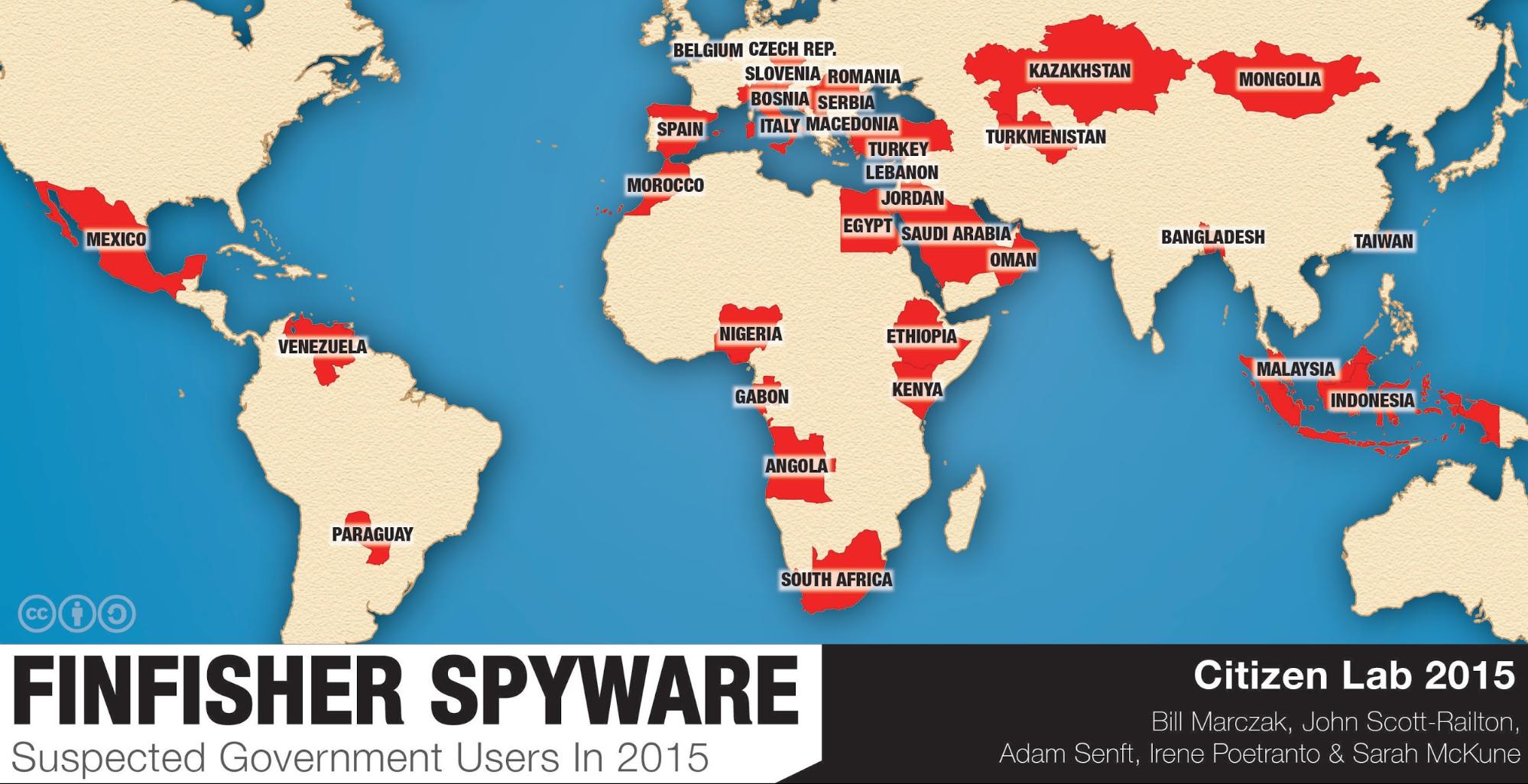
This post describes the results of Internet scanning we recently conducted to identify the users of FinFisher, a sophisticated and user-friendly spyware suite sold exclusively to governments. We devise a method for querying FinFisher’s “anonymizing proxies” to unmask the true location of the spyware’s master servers. Since the master servers are installed on the premises of FinFisher customers, tracing the servers allows us to identify which governments are likely using FinFisher. In some cases, we can trace the servers to specific entities inside a government by correlating our scan results with publicly available sources. Our results indicate 32 countries where at least one government entity is likely using the spyware suite, and we are further able to identify 10 entities by name. Despite the 2014 FinFisher breach, and subsequent disclosure of sensitive customer data, our scanning has detected more servers in more countries than ever before.

Here’s the map of suspected FinFisher users, including some pretty reprehensible governments.

Two news articles.

Posted on October 16, 2015 at 2:33 PMView Comments

1 6 7 8 9 10 20

Sidebar photo of Bruce Schneier by Joe MacInnis.