Entries Tagged "DHS"

Page 12 of 39

Full Body Scanners: What's Next?

Organizers of National Opt Out Day, the Wednesday before Thanksgiving when air travelers were urged to opt out of the full-body scanners at security checkpoints and instead submit to full-body patdowns—were outfoxed by the TSA. The government pre-empted the protest by turning off the machines in most airports during the Thanksgiving weekend. Everyone went through the metal detectors, just as before.

Now that Thanksgiving is over, the machines are back on and the "enhanced" pat-downs have resumed. I suspect that more people would prefer to have naked images of themselves seen by TSA agents in another room, than have themselves intimately touched by a TSA agent right in front of them.

But now, the TSA is in a bind. Regardless of whatever lobbying came before, or whatever former DHS officials had a financial interest in these scanners, the TSA has spent billions on those scanners, claiming they’re essential. But because people can opt out, the alternate manual method must be equally effective; otherwise, the terrorists could just opt out. If they make the pat-downs less invasive, it would be the same as admitting the scanners aren’t essential. Senior officials would get fired over that.

So not counting inconsequential modifications to demonstrate they’re "listening," the pat-downs will continue. And they’ll continue for everyone: children, abuse survivors, rape survivors, urostomy bag wearers, people in wheelchairs. It has to be that way; otherwise, the terrorists could simply adapt. They’d hide their explosives on their children or in their urostomy bags. They’d recruit rape survivors, abuse survivors, or seniors. They’d dress as pilots. They’d sneak their PETN through airport security using the very type of person who isn’t being screened.

And PETN is what the TSA is looking for these days. That’s pentaerythritol tetranitrate, the plastic explosive that both the Shoe Bomber and the Underwear Bomber attempted but failed to detonate. It’s what was mailed from Yemen. It’s in Iraq and Afghanistan. Guns and traditional bombs are passé; PETN is the terrorist tool of the future.

The problem is that no scanners or puffers can detect PETN; only swabs and dogs work. What the TSA hopes is that they will detect the bulge if someone is hiding a wad of it on their person. But they won’t catch PETN hidden in a body cavity. That doesn’t have to be as gross as you’re imagining; you can hide PETN in your mouth. A terrorist can go through the scanners a dozen times with bits in his mouth each time, and assemble a bigger bomb on the other side. Or he can roll it thin enough to be part of a garment, and sneak it through that way. These tricks aren’t new. In the days after the Underwear Bomber was stopped, a scanner manufacturer admitted that the machines might not have caught him.

So what’s next? Strip searches? Body cavity searches? TSA Administrator John Pistole said there would be no body cavity searches for now, but his reasons make no sense. He said that the case widely reported as being a body cavity bomb might not actually have been. While that appears to be true, what does that have to do with future bombs? He also said that even body cavity bombs would need "external initiators" that the TSA would be able to detect.

Do you think for a minute that the TSA can detect these "external initiators"? Do you think that if a terrorist took a laptop—or better yet, a less-common piece of electronics gear—and removed the insides and replaced them with a timer, a pressure sensor, a simple contact switch, or a radio frequency switch, the TSA guy behind the X-ray machine monitor would detect it? How about if those components were distributed over a few trips through airport security. On the other hand, if we believe the TSA can magically detect these "external initiators" so effectively that they make body-cavity searches unnecessary, why do we need the full-body scanners?

Either PETN is a danger that must be searched for, or it isn’t. Pistole was being either ignorant or evasive.

Once again, the TSA is covering their own asses by implementing security-theater measures to prevent the previous attack while ignoring any threats of future attacks. It’s the same thinking that caused them to ban box cutters after 9/11, screen shoes after Richard Reid, limit liquids after that London gang, and—I kid you not—ban printer cartridges over 16 ounces after they were used to house package bombs from Yemen. They act like the terrorists are incapable of thinking creatively, while the terrorists repeatedly demonstrate that can always come up with a new approach that circumvents the old measures.

On the plus side, PETN is very hard to get to explode. The pre-9/11 screening procedures, looking for obvious guns and bombs, forced the terrorists to build inefficient fusing mechanisms. We saw this when Abdulmutallab, the Underwear Bomber, used bottles of liquid and a syringe and 20 minutes in the bathroom to assemble his device, then set his pants on fire—and still failed to ignite his PETN-filled underwear. And when he failed, the passengers quickly subdued him.

The truth is that exactly two things have made air travel safer since 9/11: reinforcing cockpit doors and convincing passengers they need to fight back. The TSA should continue to screen checked luggage. They should start screening airport workers. And then they should return airport security to pre-9/11 levels and let the rest of their budget be used for better purposes. Investigation and intelligence is how we’re going to prevent terrorism, on airplanes and elsewhere. It’s how we caught the liquid bombers. It’s how we found the Yemeni printer-cartridge bombs. And it’s our best chance at stopping the next serious plot.

Because if a group of well-planned and well-funded terrorist plotters makes it to the airport, the chance is pretty low that those blue-shirted crotch-groping water-bottle-confiscating TSA agents are going to catch them. The agents are trying to do a good job, but the deck is so stacked against them that their job is impossible. Airport security is the last line of defense, and it’s not a very good one.

We have a job here, too, and it’s to be indomitable in the face of terrorism. The goal of terrorism is to terrorize us: to make us afraid, and make our government do exactly what the TSA is doing. When we react out of fear, the terrorists succeed even when their plots fail. But if we carry on as before, the terrorists fail—even when their plots succeed.

This essay originally appeared on The Atlantic website.

Posted on December 3, 2010 at 6:20 AMView Comments

The Constitutionality of Full-Body Scanners

Jeffrey Rosen opines:

Although the Supreme Court hasn’t evaluated airport screening technology, lower courts have emphasized, as the U.S. Court of Appeals for the 9th Circuit ruled in 2007, that “a particular airport security screening search is constitutionally reasonable provided that it ‘is no more extensive nor intensive than necessary, in the light of current technology, to detect the presence of weapons or explosives.'”

In a 2006 opinion for the U.S. Court of Appeals for the 3rd Circuit, then-Judge Samuel Alito stressed that screening procedures must be both “minimally intrusive” and “effective” – in other words, they must be “well-tailored to protect personal privacy,” and they must deliver on their promise of discovering serious threats. Alito upheld the practices at an airport checkpoint where passengers were first screened with walk-through magnetometers and then, if they set off an alarm, with hand-held wands. He wrote that airport searches are reasonable if they escalate “in invasiveness only after a lower level of screening disclose[s] a reason to conduct a more probing search.”

As currently used in U.S. airports, the new full-body scanners fail all of Alito’s tests.

In other news, The New York Times wrote an editorial in favor of the scanners. I was surprised.

Posted on November 30, 2010 at 12:09 PMView Comments

The DHS is Getting Rid of the Color-Coded Terrorism Alert System

Good. It was always a dumb idea:

The color-coded threat levels were doomed to fail because “they don’t tell people what they can do—­ they just make people afraid,” said Bruce Schneier, an author on security issues. He said the system was “a relic of our panic after 9/11” that “never served any security purpose.”

I wrote this in 2004:

In theory, the warnings are supposed to cultivate an atmosphere of preparedness. If Americans are vigilant against the terrorist threat, then maybe the terrorists will be caught and their plots foiled. And repeated warnings brace Americans for the aftermath of another attack.

The problem is that the warnings don’t do any of this. Because they are so vague and so frequent, and because they don’t recommend any useful actions that people can take, terror threat warnings don’t prevent terrorist attacks. They might force a terrorist to delay his plan temporarily, or change his target. But in general, professional security experts like me are not particularly impressed by systems that merely force the bad guys to make minor modifications in their tactics.

And the alerts don’t result in a more vigilant America. It’s one thing to issue a hurricane warning, and advise people to board up their windows and remain in the basement. Hurricanes are short-term events, and it’s obvious when the danger is imminent and when it’s over. People can do useful things in response to a hurricane warning; then there is a discrete period when their lives are markedly different, and they feel there was utility in the higher alert mode, even if nothing came of it.

It’s quite another thing to tell people to be on alert, but not to alter their plans, as Americans were instructed last Christmas. A terrorist alert that instills a vague feeling of dread or panic, without giving people anything to do in response, is ineffective. Indeed, it inspires terror itself. Compare people’s reactions to hurricane threats with their reactions to earthquake threats. According to scientists, California is expecting a huge earthquake sometime in the next two hundred years. Even though the magnitude of the disaster will be enormous, people just can’t stay alert for two centuries. The news seems to have generated the same levels of short-term fear and long-term apathy in Californians that the terrorist warnings do. It’s human nature; people simply can’t be vigilant indefinitely.

Another alert system to compare this one to is the DEFCON system. At each DEFCON level, there are specific actions people have to take: at one DEFCON level—and I’m making this up—you call everyone back from leave, at another you fuel all the bombers, at another you arm the bombs, and so on. What actions am I supposed to take when the terrorist threat level is Yellow? When it is Orange? I have no idea.

EDITED TO ADD (11/25): Good observation:

The DHS National Threat Advisory is a public alert system. That a public alert system is indicating imminent disaster is not surprising. In fact it’s inevitable. It’s the nature of public alert systems to signal imminent disaster at all times. I’ve composed “Blakley’s Law” (next time I come up with one of these I’ll rename this one “Blakley’s First Law”) to describe the phenomenon:

“Every public alert system’s status indicator rises until it reaches its disaster imminent setting and remains at that setting until it is retired from service.”

It’s easy to see why Blakley’s law holds: if something terrible happens and the alert status didn’t predict it, the keepers of the alert status will be blamed for not preparing us for the disaster. Setting the alert status to “Disaster imminent” when no disaster is likely costs the public some money and mental health, but it doesn’t hurt them in other ways. On the other hand, setting the alert status to “Don’t worry, be happy” just before a disaster does happen is the worst case for everyone – nobody prepares for the disaster, and the people in power lose their jobs for failing to prevent or prepare for the crisis.

Posted on November 25, 2010 at 6:39 AMView Comments

Me on Airport Security

Yesterday I participated in a New York Times “Room for Debate” discussion on airline security. My contribution is nothing I haven’t said before, so I won’t reprint it here.

A short history of airport security: We screen for guns and bombs, so the terrorists use box cutters. We confiscate box cutters and corkscrews, so they put explosives in their sneakers. We screen footwear, so they try to use liquids. We confiscate liquids, so they put PETN bombs in their underwear. We roll out full-body scanners, even though they wouldn’t have caught the Underwear Bomber, so they put a bomb in a printer cartridge. We ban printer cartridges over 16 ounces—the level of magical thinking here is amazing—and they’re going to do something else.

This is a stupid game, and we should stop playing it.

The other participants are worth reading, too.

I also did an interview in—of all places—Popular Mechanics.

Posted on November 23, 2010 at 6:11 AMView Comments

TSA Backscatter X-ray Backlash

Things are happening so fast that I don’t know if I should bother. But here are some links and observations.

The head of the Allied Pilots Association is telling its members to avoid both the full body scanners and the patdowns.

This first-hand report, from a man who refused to fly rather than subject himself to a full-body scan or an enhanced patdown, has been making the rounds. (The TSA is now investigating him.) It reminds me of Penn Jillette’s story from 2002.

A woman has a horrific story of opting-out of the full body scanners. More stories: this one about the TSA patting down a screaming toddler. And here’s Dave Barry’s encounter (also this NPR interview).

Sadly, I agree with this:

It is no accident that women have been complaining about being pulled out of line because of their big breasts, having their bodies commented on by TSA officials, and getting inappropriate touching when selected for pat-downs for nearly 10 years now, but just this week it went viral. It is no accident that CAIR identified Islamic head scarves (hijab) as an automatic trigger for extra screenings in January, but just this week it went viral. What was different?

Suddenly an able-bodied white man is the one who was complaining.

Seems that once you enter airport security, you need to be subjected to it—whether you decide to fly or not.

I experienced the enhanced patdown myself, at DCA, on Tuesday. It was invasive, but not as bad as these stories. It seems clear that TSA agents are inconsistent about these procedures. They’ve probably all had the same training, but individual agents put it into practice very differently.

Of course, airport security is an extra-Constitutional area, so there’s no clear redress mechanism for those subjected to too-intimate patdowns.

This video provides tips to parents flying with young children. Around 2:50 in, the reporter indicates that you can find out if your child has been pre-selected for secondary, and then recommends requesting “de-selection.” That doesn’t make sense.

Neither does this story, which says that the TSA will only touch Muslim women in the head and neck area.

Nor this story. The author convinces people on line to opt-out with him. After the first four opt-outs, the TSA just sent people through the metal detectors.

Yesterday, the TSA administrator John Pistole was grilled by the Senate Commerce, Science, and Transportation Committee on full-body scanners. Rep. Ron Paul introduced a bill to ban them. (His floor speech is here.) I’m one of the plaintiffs in a lawsuit to ban them.

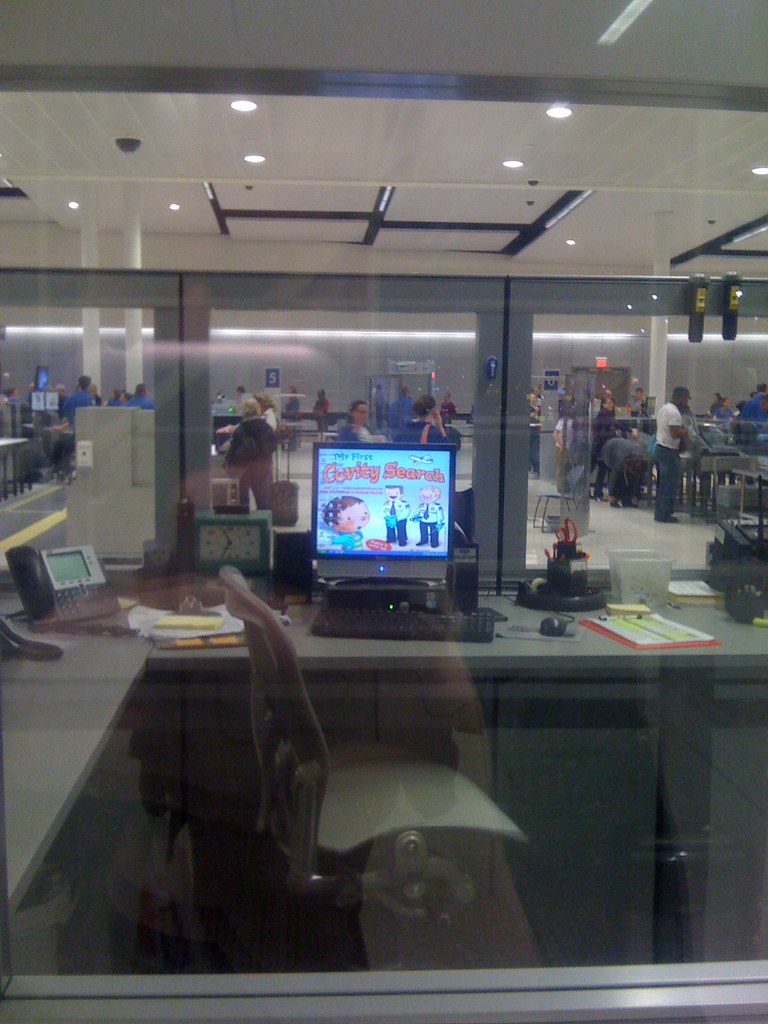
Book for kids: My First Cavity Search. Cover seen at at TSA checkpoint.

T-shirts: one, two, and three and four. “Comply with Me” song parody. Political cartoons: one, two, three, and four. New TSA logo. Best TSA tweets, including “It’s not a grope. It’s a freedom pat.”

Good essay from a libertarian perspective. Two more. Marc Rotenberg’s essay. Ralph Nader’s essay. And the Los Angeles Times really screws up with this editorial: “Shut Up and Be Scanned.” Amitai Etzioni makes a better case for the machines.

Michael Chertoff, former Department of Homeland Security secretary, has been touting the full-body scanners, while at the same time maintaining a financial interest in the company that makes them.

There’s talk about the health risks of the machines, but I can’t believe you won’t get more radiation on the flight. Here’s some data:

A typical dental X-ray exposes the patient to about 2 millirems of radiation. According to one widely cited estimate, exposing each of 10,000 people to one rem (that is, 1,000 millirems) of radiation will likely lead to 8 excess cancer deaths. Using our assumption of linearity, that means that exposure to the 2 millirems of a typical dental X-ray would lead an individual to have an increased risk of dying from cancer of 16 hundred-thousandths of one percent. Given that very small risk, it is easy to see why most rational people would choose to undergo dental X-rays every few years to protect their teeth.

More importantly for our purposes, assuming that the radiation in a backscatter X-ray is about a hundredth the dose of a dental X-ray, we find that a backscatter X-ray increases the odds of dying from cancer by about 16 ten millionths of one percent. That suggests that for every billion passengers screened with backscatter radiation, about 16 will die from cancer as a result.

Given that there will be 600 million airplane passengers per year, that makes the machines deadlier than the terrorists.

Nate Silver on the hidden cost of these new airport security measures.

According to the Cornell study, roughly 130 inconvenienced travelers died every three months as a result of additional traffic fatalities brought on by substituting ground transit for air transit. That’s the equivalent of four fully-loaded Boeing 737s crashing each year.

Jeffrey Goldberg asked me which I would rather see for children: backscatter X-ray or enhanced pat down. After remarking what an icky choice it was, I opted for the X-ray; it’s less traumatic.

Here are a bunch of leaked body scans. They’re not from airports, but they should make you think twice before accepting the TSA’s assurances that the images will never be saved. RateMyBackscatter.com.

November 24 is National Opt Out Day. Doing this just before the Thanksgiving holiday is sure to clog up airports. Jeffrey Goldberg suggests that men wear kilts, commando style if possible.

At least one airport is opting out of the TSA entirely. I hadn’t known you could do that.

The New York Times on the protests.

Common sense from the Netherlands:

The security boss of Amsterdam’s Schiphol Airport is calling for an end to endless investment in new technology to improve airline security.

Marijn Ornstein said: “If you look at all the recent terrorist incidents, the bombs were detected because of human intelligence not because of screening … If even a fraction of what is spent on screening was invested in the intelligence services we would take a real step toward making air travel safer and more pleasant.”

And here’s Rafi Sela, former chief security officer of the Israel Airport Authority:

A leading Israeli airport security expert says the Canadian government has wasted millions of dollars to install “useless” imaging machines at airports across the country.

“I don’t know why everybody is running to buy these expensive and useless machines. I can overcome the body scanners with enough explosives to bring down a Boeing 747,” Rafi Sela told parliamentarians probing the state of aviation safety in Canada.

“That’s why we haven’t put them in our airport,” Sela said, referring to Tel Aviv’s Ben Gurion International Airport, which has some of the toughest security in the world.

They can be fooled by creased clothing. And remember this German video?

I’m quoted in the Los Angeles Times:

Some experts argue the new procedures could make passengers uncomfortable without providing a substantial increase in security. “Security measures that just force the bad guys to change tactics and targets are a waste of money,” said Bruce Schneier, a security expert who works for British Telecom. “It would be better to put that money into investigations and intelligence.”

I’m quoted in The Wall Street Journal twice—once as saying:

“All these machines require you to guess the plot correctly. If you don’t, then they are completely worthless,” said Bruce Schneier, a security expert.

Mr. Schneier and some other experts argue that assembling better intelligence on fliers is the key to making travel safer.

and once as saying:

Security guru Bruce Schneier, a plaintiff in the scanner suit, calls this “magical thinking . . . Descend on what the terrorists happened to do last time, and we’ll all be safe. As if they won’t think of something else.”

In 2005, I wrote:

I’m not impressed with this security trade-off. Yes, backscatter X-ray machines might be able to detect things that conventional screening might miss. But I already think we’re spending too much effort screening airplane passengers at the expense of screening luggage and airport employees…to say nothing of the money we should be spending on non-airport security.

On the other side, these machines are expensive and the technology is incredibly intrusive. I don’t think that people should be subjected to strip searches before they board airplanes. And I believe that most people would be appalled by the prospect of security screeners seeing them naked.

I believe that there will be a groundswell of popular opposition to this idea. Aside from the usual list of pro-privacy and pro-liberty groups, I expect fundamentalist Christian groups to be appalled by this technology. I think we can get a bevy of supermodels to speak out against the invasiveness of the search.

On the other hand, CBS News is reporting that 81% of Americans support full-body scans. Maybe they should only ask flying Americans.

I still stand by this, also from 2005:

Exactly two things have made airline travel safer since 9/11: reinforcement of cockpit doors, and passengers who now know that they may have to fight back. Everything else—Secure Flight and Trusted Traveler included—is security theater. We would all be a lot safer if, instead, we implemented enhanced baggage security—both ensuring that a passenger’s bags don’t fly unless he does, and explosives screening for all baggage—as well as background checks and increased screening for airport employees.

Then we could take all the money we save and apply it to intelligence, investigation and emergency response. These are security measures that pay dividends regardless of what the terrorists are planning next, whether it’s the movie plot threat of the moment, or something entirely different.

And this, written in 2010 after the Underwear Bomber failed:

Finally, we need to be indomitable. The real security failure on Christmas Day was in our reaction. We’re reacting out of fear, wasting money on the story rather than securing ourselves against the threat. Abdulmutallab succeeded in causing terror even though his attack failed.

If we refuse to be terrorized, if we refuse to implement security theater and remember that we can never completely eliminate the risk of terrorism, then the terrorists fail even if their attacks succeed.

See these two essays of mine as well, from the same time.

More resources on the EPIC pages.

What else is going on?

EDITED TO ADD: (11/19): Lots more political cartoons.

Good summary of your legal rights and options from the ACLU. They also have a form you can fill out and send to your Congresscritter.

This has to win for DHS Quote of the Year, from Secretary Janet Napolitano on the issue:

I really want to say, look, let’s be realistic and use our common sense.

The TSA doesn’t train its screeners very well. A response to a letter-writer from Sen. Coburn. From Slate: "Does the TSA Ever Catch Terrorists?" A pilot’s story. The screeners’ point of view. Good essay from the National Post.

Fun with the Playmobil airline security screening playset.

Meg McLain, whose horrific story I linked to above, lied. Here’s an interview with her.

EDITED TO ADD (11/20): I was interviewed by Popular Mechanics.

Woman forced to remove prosthetic breast. TSO officer caught saying “heads up, got a cutie for you” into his headset to the other officers. Complication news video of TSA behavior.

Here’s an alert you can hand out to passengers at security checkpoints where there are backscatter machines.

EDITED TO ADD (11/21): Me in an Associated Press piece on the anti-TSA backlash:

“After 9/11 people were scared and when people are scared they’ll do anything for someone who will make them less scared,” said Bruce Schneier, a Minneapolis security technology expert who has long been critical of the TSA. “But … this is particularly invasive. It’s strip-searching. It’s body groping. As abhorrent goes, this pegs it.”

President Obama comments:

“I understand people’s frustrations, and what I’ve said to the TSA is that you have to constantly refine and measure whether what we’re doing is the only way to assure the American people’s safety. And you also have to think through are there other ways of doing it that are less intrusive,” Obama said.

“But at this point, TSA in consultation with counterterrorism experts have indicated to me that the procedures that they have been putting in place are the only ones right now that they consider to be effective against the kind of threat that we saw in the Christmas Day bombing.”

TSA sendup on Saturday Night Live yesterday.

EDITED TO ADD (11/22): The thing about Muslim women being exempt seems to be based on a misreading of this press release. What they seem to be saying is that if you’re selected because you could have something under your hijab, then they only need to just pat down the area the hijab covers. It’s not a special exemption.

TSA Administrator John Pistole comments:

We are constantly evaluating and adapting our security measures, and as we have said from the beginning, we are seeking to strike the right balance between privacy and security. In all such security programs, especially those that are applied nation-wide, there is a continual process of refinement and adjustment to ensure that best practices are applied and that feedback and comment from the traveling public is taken into account.

EDITED TO ADD (11/23): Fantastic infographic. Excellent poster image. This, too. And another political cartoon.

Yesterday I participated in a New York Times “Room for Debate” discussion on airline security. My contribution is nothing I haven’t said before, so I won’t reprint it here. The other participants are worth reading too.

More from Nate Silver, on public opinion and the likely TSA reaction:

It is perhaps foolish to predict how the T.S.A. will respond this time—when they have relaxed rules in the past, they have done so quietly, rather than in response to some acute public backlash. But caution aside, I would be surprised if the new procedures survived much past the New Year without significant modification.

CNN’s advice to the public.

Things are definitely strained out there:

Through a statement released by his attorney Sunday night, Wolanyk said “TSA needs to see that I’m not carrying any weapons, explosives, or other prohibited substances, I refuse to have images of my naked body viewed by perfect strangers, and having been felt up for the first time by TSA the week prior (I travel frequently) I was not willing to be molested again.”

Wolanyk’s attorney said that TSA requested his client put his clothes on so he could be patted down properly but his client refused to put his clothes back on. He never refused a pat down, according to his attorney. Wolanyk was arrested for refusing to complete the security process.

From the same article:

A woman, identified by Harbor police as Danielle Kelli Hayman,39, of San Diego was detained for recording the incident on a phone.

That’s much more worrying.

Interview with Brian Michael Jenkins, a senior advisor at the RAND Corp. and a former member of the White House Commission on Aviation Safety and Security.

Here’s someone who managed to avoid both the full-body scanners and the enhanced pat down. It took him two and a half hours. And here someone who got patted down, and managed to sneak two razor blades through security anyway.

How the TSA will deal with people with disabilities. How the pat downs affect survivors of sexual assault. (Read also the comments here.) Juan Cole on how airport security has shifted from looking for people with guns and traditional bombs to looking for people with PETN. And TSA-proof underwear.

EDITED TO ADD (11/24): Information on the health risks of the backscatter machines. And here’s a woman who stripped down to her underwear before going through airport security. This comes from a perspective I generally don’t buy, but it’s hard to dismiss his writing. I don’t think it’s a conspiracy, but I do think it’s a trend. “This Modern World” has a comic on the topic. Slate on the lack of guidelines. Why the TSA should be privatized.

EDITED TO ADD (11/25): I was on Keith Olbermann last night.

Posted on November 19, 2010 at 5:37 AMView Comments

The End of In-Flight Wi-Fi?

Okay, now the terrorists have really affected me personally: they’re forcing us to turn off airplane Wi-Fi. No, it’s not that the Yemeni package bombs had a Wi-Fi triggering mechanism—they seem to have had a cell phone triggering mechanism, dubious at best—but we can imagine an Internet-based triggering mechanism. Put together a sloppy and unsuccessful package bomb with an imagined triggering mechanism, and you have a new and dangerous threat that—even though it was a threat ever since the first airplane got Wi-Fi capability—must be immediately dealt with right now.

Please, let’s not ever tell the TSA about timers. Or altimeters.

And, while we’re talking about the TSA, be sure to opt out of the full-body scanners and remember your sense of humor when a TSA officer slips white powder into your suitcase and then threatens you with arrest.

EDITED TO ADD (11/8): We’re banning toner cartridges over 16 ounces.

Additionally, toner and ink cartridges that are over 16 ounces will be banned from all U.S. passenger flights and planes heading to the United States, she said. That ban will also apply to some air cargo shipments.

Other new rules include:

  • International mail packages sent to the U.S. must be screened individually and certified to have come from an established postal shipper;
  • Cargo shippers, such as UPS, Federal Express, and DHL, have been encouraged to report cargo manifests to Homeland Security faster, prior to departure, to aid in identifying risky cargo based on current intelligence.

There’s some impressive magical thinking going on here.

Posted on November 8, 2010 at 10:21 AMView Comments

The Politics of Allocating Homeland Security Money to States

From the Journal of Homeland Security and Emergency Management: “Politics or Risks? An Analysis of Homeland Security Grant Allocations to the States.”

Abstract: In the days following the September 11 terrorist attacks on the United States, the nation’s elected officials created the USA Patriot Act. The act included a grant program for the 50 states that was intended to assist them with homeland security and preparedness efforts. However, not long after its passage, critics charged the Department of Homeland Security with allocating the grant funds on the basis of “politics” rather than “risk.” This study analyzes the allocation of funds through all seven of the grant subprograms for the years 2003 through 2006. Conducting a linear regression analysis for each year, our research indicates that the total per capita amounts are inversely related to risk factors but are not related at all to partisan political factors between 2003-2005. In 2006, Congress changed the formula with the intention of increasing the relationship between allocations and risk. However, our findings reveal that this change did not produce the intended effect and the allocations were still negatively related to risk and unrelated to partisan politics.

I’m not sure I buy the methodology, but there it is.

Posted on October 7, 2010 at 7:03 AMView Comments

Sky Marshals Flying First Class

I regularly say that security decisions are primarily made for non-security reasons. This article about the placement of sky marshals on airplanes is an excellent example. Basically, the airlines would prefer they fly coach instead of first class.

Airline CEOs met recently with TSA administrator John Pistole and officials from the Federal Air Marshal Service requesting the TSA to reconsider the placement of marshals based on current security threats.

“Our concern is far less revenue and more that we have defenses appropriate to the threat,” said James May, chief executive of the Air Transport Association, the airline industry’s lobbying group. “We think there needs to be an even distribution, particularly when we have multiple agents on board.”

[…]

By law, airlines must provide seats to marshals at no cost in any cabin requested. With first-class and business-class seats in particular, the revenue loss to airlines can be substantial because they can’t sell last-minute tickets or upgrades, and travelers sometimes get bumped to the back or lose out on upgrade opportunities. When travelers do get bumped, airlines are barred from divulging why the first-class seat was unexpectedly taken away, to keep the presence of a marshal a secret. Bumped travelers—airlines can’t disclose how many passengers are affected—typically get coach seats and refunds on the cash or miles they paid for the better seat.

When I list the few improvements to airline security since 9/11, I don’t include sky marshals.

EDITED TO ADD (10/9): An article from The Economist.

Posted on October 4, 2010 at 1:55 PMView Comments

1 10 11 12 13 14 39

Sidebar photo of Bruce Schneier by Joe MacInnis.